

362
10 Time-Periodic Quantum Systems
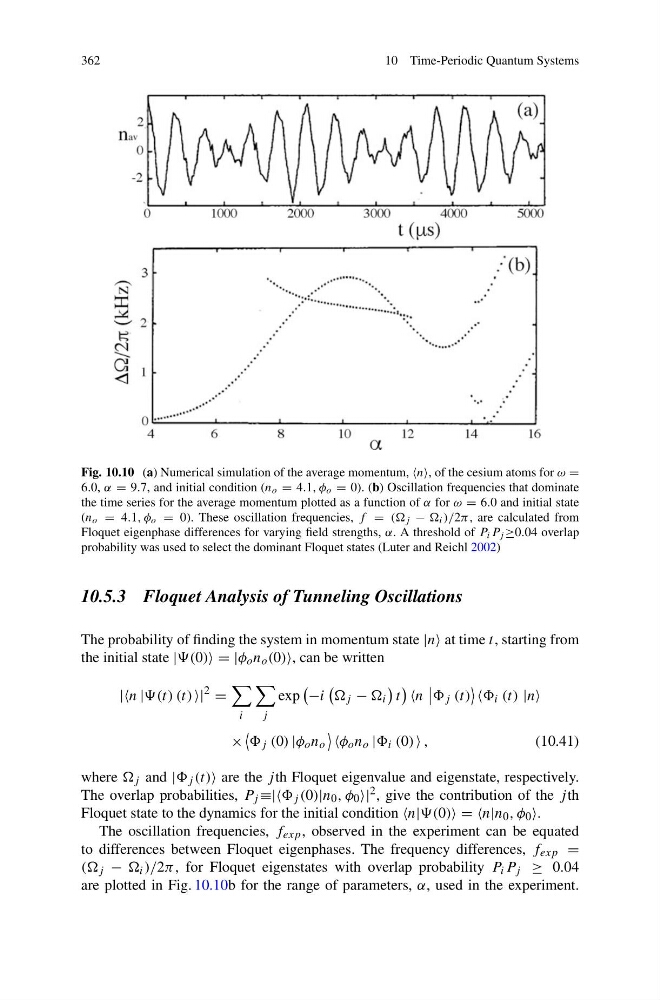
Fig. 10.10 (a) Numerical simulation of the average momentum, of the cesium atoms for ω =
6.0, α = 9.7, and initial condition (n o = 4.1, φ o = 0). (b) Oscillation frequencies that dominate
the time series for the average momentum plotted as a function of α for ω = 6.0 and initial state
(n o = 4.1, φ o = 0). These oscillation frequencies, f = (( j − i )/2π , are calculated from
Floquet eigenphase differences for varying field strengths, α. A threshold of P i P j ≥0.04 overlap
probability was used to select the dominant Floquet states (Luter and Reichl 2002)
10.5.3 Floquet Analysis of Tunneling Oscillations
The probability of finding the system in momentum state |n at time t, starting from
the initial state | = |φ o n o (0), can be written
||n | (t)
2
=
i
j
exp
−i
j − i
t
n
j (t)
i (t) |n
×
j (0) |φ o n o
φ o n o | i (0) ,
(10.41)
where j and | j (t) are the j th Floquet eigenvalue and eigenstate, respectively.
The overlap probabilities, P j ≡|| j (0)|n 0 , φ 0 2 , give the contribution of the j th
Floquet state to the dynamics for the initial condition = =n|n 0 , φ 0
The oscillation frequencies, f exp , observed in the experiment can be equated
to differences between Floquet eigenphases. The frequency differences, f exp =
(( j − i )/2π , for Floquet eigenstates with overlap probability P i P j ≥ 0.04
are plotted in Fig. 10.10b for the range of parameters, α, used in the experiment.
10 Time-Periodic Quantum Systems
Fig. 10.10 (a) Numerical simulation of the average momentum, of the cesium atoms for ω =
6.0, α = 9.7, and initial condition (n o = 4.1, φ o = 0). (b) Oscillation frequencies that dominate
the time series for the average momentum plotted as a function of α for ω = 6.0 and initial state
(n o = 4.1, φ o = 0). These oscillation frequencies, f = (( j − i )/2π , are calculated from
Floquet eigenphase differences for varying field strengths, α. A threshold of P i P j ≥0.04 overlap
probability was used to select the dominant Floquet states (Luter and Reichl 2002)
10.5.3 Floquet Analysis of Tunneling Oscillations
The probability of finding the system in momentum state |n at time t, starting from
the initial state | = |φ o n o (0), can be written
||n | (t)
2
=
i
j
exp
−i
j − i
t
n
j (t)
i (t) |n
×
j (0) |φ o n o
φ o n o | i (0) ,
(10.41)
where j and | j (t) are the j th Floquet eigenvalue and eigenstate, respectively.
The overlap probabilities, P j ≡|| j (0)|n 0 , φ 0 2 , give the contribution of the j th
Floquet state to the dynamics for the initial condition = =n|n 0 , φ 0
The oscillation frequencies, f exp , observed in the experiment can be equated
to differences between Floquet eigenphases. The frequency differences, f exp =
(( j − i )/2π , for Floquet eigenstates with overlap probability P i P j ≥ 0.04
are plotted in Fig. 10.10b for the range of parameters, α, used in the experiment.