

354
10 Time-Periodic Quantum Systems
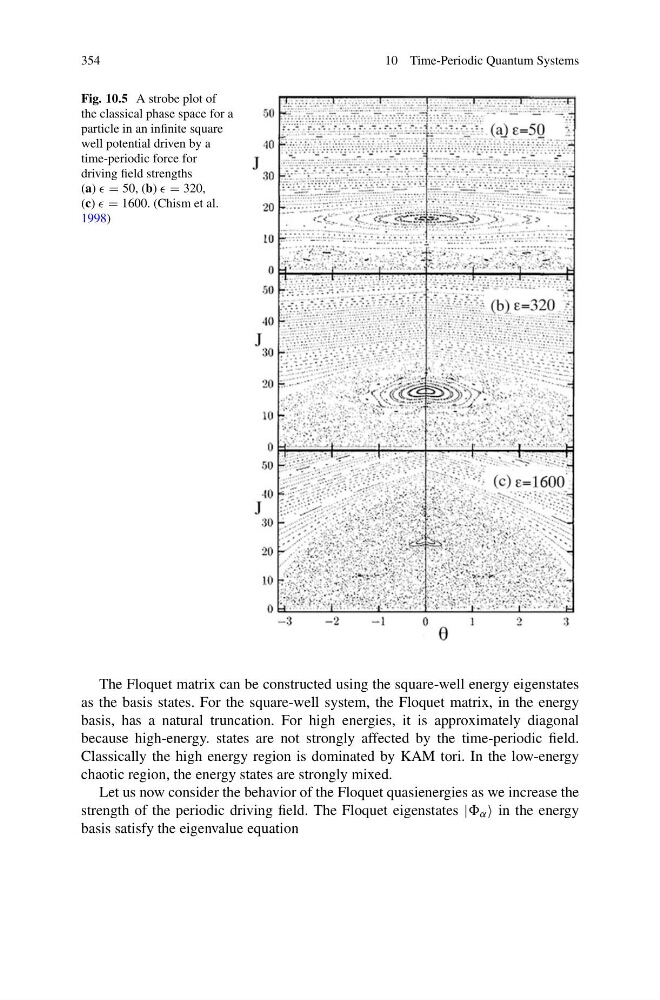
Fig. 10.5 A strobe plot of
the classical phase space for a
particle in an infinite square
well potential driven by a
time-periodic force for
driving field strengths
(a) = 50, (b) = 320,
(c) = 1600. (Chism et al.
1998)
The Floquet matrix can be constructed using the square-well energy eigenstates
as the basis states. For the square-well system, the Floquet matrix, in the energy
basis, has a natural truncation. For high energies, it is approximately diagonal
because high-energy. states are not strongly affected by the time-periodic field.
Classically the high energy region is dominated by KAM tori. In the low-energy
chaotic region, the energy states are strongly mixed.
Let us now consider the behavior of the Floquet quasienergies as we increase the
strength of the periodic driving field. The Floquet eigenstates | α in the energy
basis satisfy the eigenvalue equation
10 Time-Periodic Quantum Systems
Fig. 10.5 A strobe plot of
the classical phase space for a
particle in an infinite square
well potential driven by a
time-periodic force for
driving field strengths
(a) = 50, (b) = 320,
(c) = 1600. (Chism et al.
1998)
The Floquet matrix can be constructed using the square-well energy eigenstates
as the basis states. For the square-well system, the Floquet matrix, in the energy
basis, has a natural truncation. For high energies, it is approximately diagonal
because high-energy. states are not strongly affected by the time-periodic field.
Classically the high energy region is dominated by KAM tori. In the low-energy
chaotic region, the energy states are strongly mixed.
Let us now consider the behavior of the Floquet quasienergies as we increase the
strength of the periodic driving field. The Floquet eigenstates | α in the energy
basis satisfy the eigenvalue equation