

352
10 Time-Periodic Quantum Systems
mechanical systems and is based on the existence of a self-similar set of the rational
approximates to the KAM torus of interest. It involves a mapping of the amplitudes
and wave numbers of the rational approximates and uses action-angle variables as a
vehicle for obtaining the renormalization map.
In Radons and Prange (1988) and Reichl (1989), numerical evidence was
given showing that higher-order resonances also exist in quantum dynamics.
Subsequently, Reichl and Li (1990) showed that renormalization techniques can
be developed that also establish the existence of KAM-like behavior in quantum
dynamics, and Morrow and Reichl (1994, 1998) showed that scaling behavior can
exist in the quantum dynamics of the double-resonance system. In the doubleresonance system, the quantity that measures transport of probability across a region
of mixed phase space is the localization length (in phase space) of the probability in
that region. The fact that the phase space localization length is a quantity that scales
was conjectured in MacKay and Meiss (1988). Morrow and Reichl (1994, 1998),
using the quantum renormalization map, showed that the phase space localization
length does exhibit scaling behavior in certain parameter regimes.
10.4 Dynamics of a Driven Bounded Particle
The infinite square-well potential is a limiting case, as n→∞, of a class of
potentials, V (x) = x 2n for n > 1. For such potentials, the particle is bounded
for all energies, and classically the particle’s oscillation frequency increases with
increasing energy. The quantum mechanical system has an energy eigenvalue
spectrum that becomes more widely spaced with increasing energy and ionization
cannot occur. If the particle is driven by a time-periodic external field, chaos only
occurs at low energies, and the effects of the chaos can be controlled.
10.4.1 Driven Particle in Infinite Square Well
The potential energy for a particle in an infinite square-well potential of width 2a
has the form V (x) = 0 for |x| < a and V (x) = ∞ for |x|≥a. For the classical
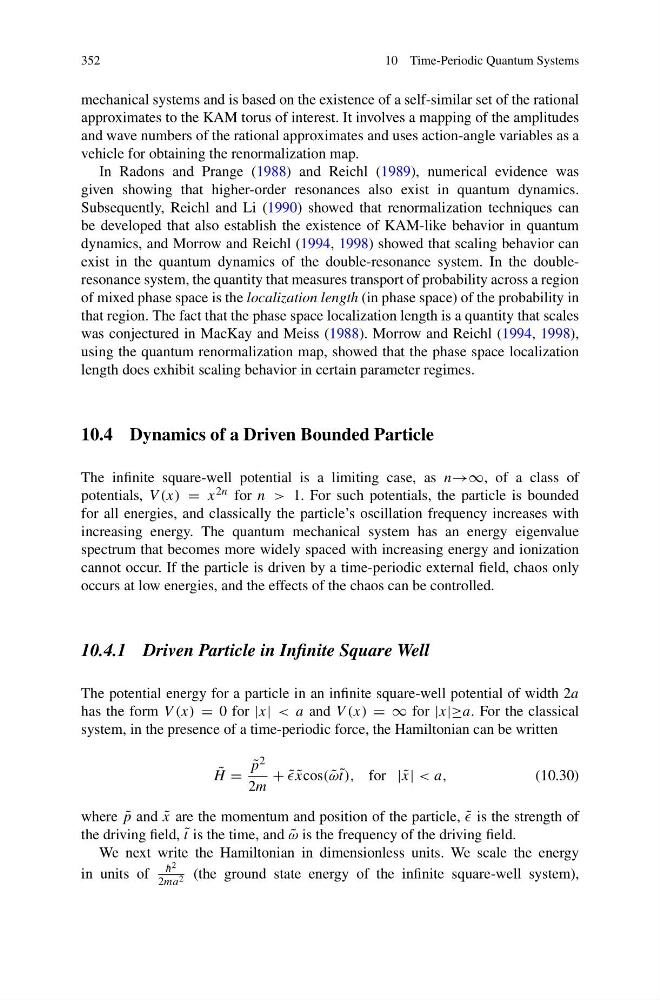
system, in the presence of a time-periodic force, the Hamiltonian can be written
˜
H =
˜
p 2
2m
+ ˜
˜
xcos( ˜
ω˜ t), for | ˜
x| < a,
(10.30)
where ˜
p and ˜
x are the momentum and position of the particle, ˜
is the strength of
the driving field, ˜
t is the time, and ˜
ω is the frequency of the driving field.
We next write the Hamiltonian in dimensionless units. We scale the energy
in units of ¯
h 2
2ma 2 (the ground state energy of the infinite square-well system),
10 Time-Periodic Quantum Systems
mechanical systems and is based on the existence of a self-similar set of the rational
approximates to the KAM torus of interest. It involves a mapping of the amplitudes
and wave numbers of the rational approximates and uses action-angle variables as a
vehicle for obtaining the renormalization map.
In Radons and Prange (1988) and Reichl (1989), numerical evidence was
given showing that higher-order resonances also exist in quantum dynamics.
Subsequently, Reichl and Li (1990) showed that renormalization techniques can
be developed that also establish the existence of KAM-like behavior in quantum
dynamics, and Morrow and Reichl (1994, 1998) showed that scaling behavior can
exist in the quantum dynamics of the double-resonance system. In the doubleresonance system, the quantity that measures transport of probability across a region
of mixed phase space is the localization length (in phase space) of the probability in
that region. The fact that the phase space localization length is a quantity that scales
was conjectured in MacKay and Meiss (1988). Morrow and Reichl (1994, 1998),
using the quantum renormalization map, showed that the phase space localization
length does exhibit scaling behavior in certain parameter regimes.
10.4 Dynamics of a Driven Bounded Particle
The infinite square-well potential is a limiting case, as n→∞, of a class of
potentials, V (x) = x 2n for n > 1. For such potentials, the particle is bounded
for all energies, and classically the particle’s oscillation frequency increases with
increasing energy. The quantum mechanical system has an energy eigenvalue
spectrum that becomes more widely spaced with increasing energy and ionization
cannot occur. If the particle is driven by a time-periodic external field, chaos only
occurs at low energies, and the effects of the chaos can be controlled.
10.4.1 Driven Particle in Infinite Square Well
The potential energy for a particle in an infinite square-well potential of width 2a
has the form V (x) = 0 for |x| < a and V (x) = ∞ for |x|≥a. For the classical
system, in the presence of a time-periodic force, the Hamiltonian can be written
˜
H =
˜
p 2
2m
+ ˜
˜
xcos( ˜
ω˜ t), for | ˜
x| < a,
(10.30)
where ˜
p and ˜
x are the momentum and position of the particle, ˜
is the strength of
the driving field, ˜
t is the time, and ˜
ω is the frequency of the driving field.
We next write the Hamiltonian in dimensionless units. We scale the energy
in units of ¯
h 2
2ma 2 (the ground state energy of the infinite square-well system),