

10.3 Quantum Nonlinear Resonances
351
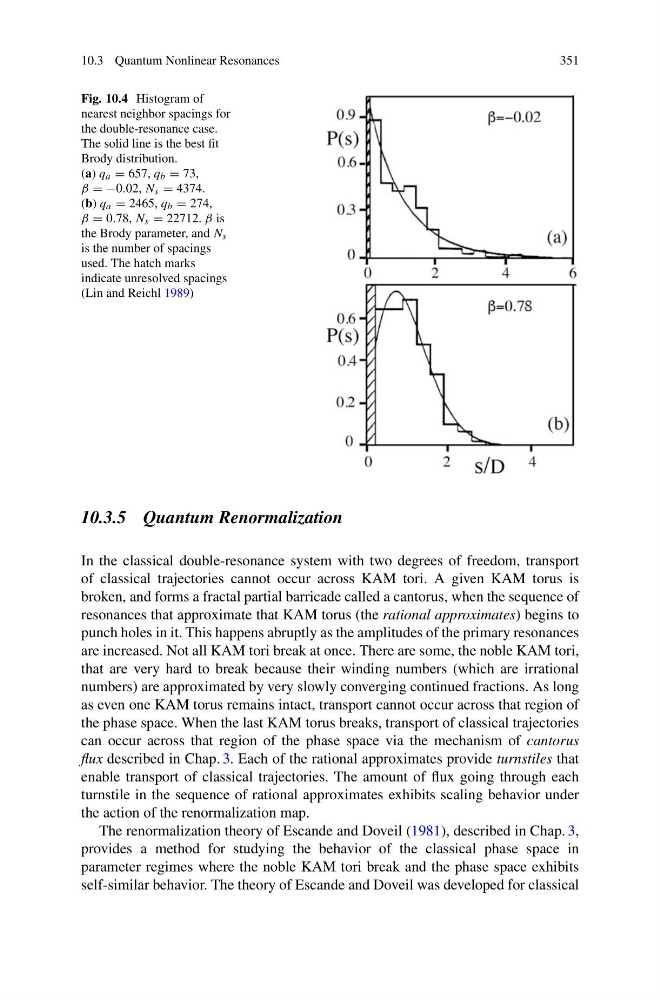
Fig. 10.4 Histogram of
nearest neighbor spacings for
the double-resonance case.
The solid line is the best fit
Brody distribution.
(a) q a = 657, q b = 73,
β = −0.02, N s = 4374.
(b) q a = 2465, q b = 274,
β = 0.78, N s = 22712. β is
the Brody parameter, and N s
is the number of spacings
used. The hatch marks
indicate unresolved spacings
(Lin and Reichl 1989)
10.3.5 Quantum Renormalization
In the classical double-resonance system with two degrees of freedom, transport
of classical trajectories cannot occur across KAM tori. A given KAM torus is
broken, and forms a fractal partial barricade called a cantorus, when the sequence of
resonances that approximate that KAM torus (the rational approximates) begins to
punch holes in it. This happens abruptly as the amplitudes of the primary resonances
are increased. Not all KAM tori break at once. There are some, the noble KAM tori,
that are very hard to break because their winding numbers (which are irrational
numbers) are approximated by very slowly converging continued fractions. As long
as even one KAM torus remains intact, transport cannot occur across that region of
the phase space. When the last KAM torus breaks, transport of classical trajectories
can occur across that region of the phase space via the mechanism of cantorus
flux described in Chap. 3. Each of the rational approximates provide turnstiles that
enable transport of classical trajectories. The amount of flux going through each
turnstile in the sequence of rational approximates exhibits scaling behavior under
the action of the renormalization map.
The renormalization theory of Escande and Doveil (1981), described in Chap. 3,
provides a method for studying the behavior of the classical phase space in
parameter regimes where the noble KAM tori break and the phase space exhibits
self-similar behavior. The theory of Escande and Doveil was developed for classical
351
Fig. 10.4 Histogram of
nearest neighbor spacings for
the double-resonance case.
The solid line is the best fit
Brody distribution.
(a) q a = 657, q b = 73,
β = −0.02, N s = 4374.
(b) q a = 2465, q b = 274,
β = 0.78, N s = 22712. β is
the Brody parameter, and N s
is the number of spacings
used. The hatch marks
indicate unresolved spacings
(Lin and Reichl 1989)
10.3.5 Quantum Renormalization
In the classical double-resonance system with two degrees of freedom, transport
of classical trajectories cannot occur across KAM tori. A given KAM torus is
broken, and forms a fractal partial barricade called a cantorus, when the sequence of
resonances that approximate that KAM torus (the rational approximates) begins to
punch holes in it. This happens abruptly as the amplitudes of the primary resonances
are increased. Not all KAM tori break at once. There are some, the noble KAM tori,
that are very hard to break because their winding numbers (which are irrational
numbers) are approximated by very slowly converging continued fractions. As long
as even one KAM torus remains intact, transport cannot occur across that region of
the phase space. When the last KAM torus breaks, transport of classical trajectories
can occur across that region of the phase space via the mechanism of cantorus
flux described in Chap. 3. Each of the rational approximates provide turnstiles that
enable transport of classical trajectories. The amount of flux going through each
turnstile in the sequence of rational approximates exhibits scaling behavior under
the action of the renormalization map.
The renormalization theory of Escande and Doveil (1981), described in Chap. 3,
provides a method for studying the behavior of the classical phase space in
parameter regimes where the noble KAM tori break and the phase space exhibits
self-similar behavior. The theory of Escande and Doveil was developed for classical