

344
10 Time-Periodic Quantum Systems
10.2.2 Floquet Hamiltonian
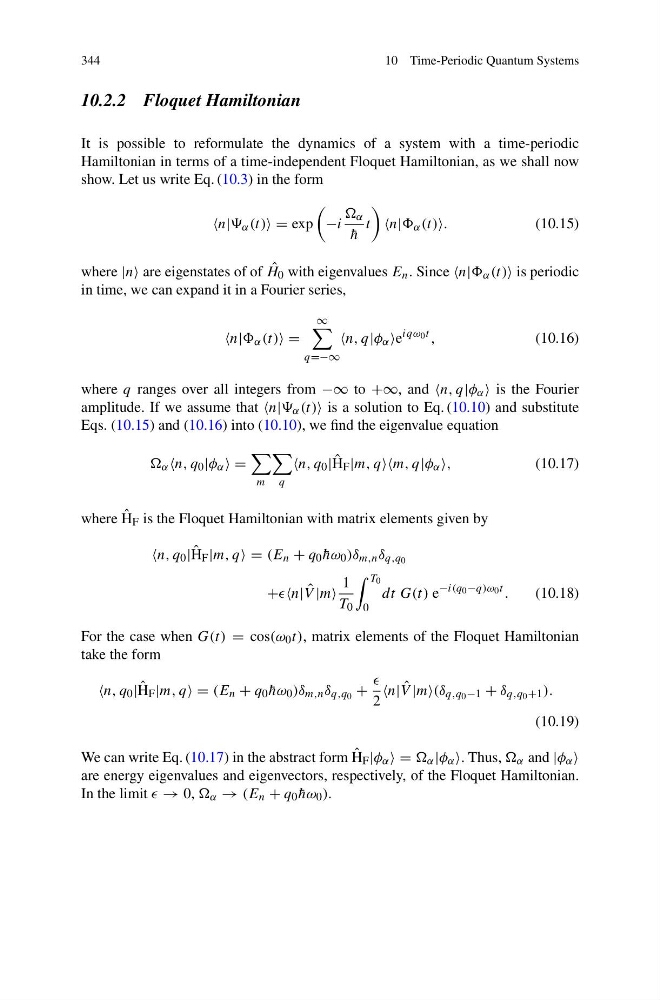
It is possible to reformulate the dynamics of a system with a time-periodic
Hamiltonian in terms of a time-independent Floquet Hamiltonian, as we shall now
show. Let us write Eq. (10.3) in the form
n| α (t) = exp
−i
α
¯
h
t
n| α (t).
(10.15)
where |n are eigenstates of of ˆ
H 0 with eigenvalues E n . Since n| α (t) is periodic
in time, we can expand it in a Fourier series,
n| α (t) =
∞
q=−∞
n, q|φ α e
iqω 0 t ,
(10.16)
where q ranges over all integers from −∞ to +∞, and n, q|φ α is the Fourier
amplitude. If we assume that n| α (t) is a solution to Eq. (10.10) and substitute
Eqs. (10.15) and (10.16) into (10.10), we find the eigenvalue equation
α n, q 0 |φ α =
m
q
n, q 0 | ˆ
H F |m, qm, q|φ α ,
(10.17)
where ˆ
H F is the Floquet Hamiltonian with matrix elements given by
n, q 0 | ˆ
H F |m, q = (E n + q 0 ¯
hω 0 )δ m,n δ q,q 0
+n| ˆ
V |m
1
T 0
T 0
0
dt G(t) e
−i(q 0 −q)ω 0 t .
(10.18)
For the case when G(t) = cos(ω 0 t), matrix elements of the Floquet Hamiltonian
take the form
n, q 0 | ˆ
H F |m, q = (E n + q 0 ¯
hω 0 )δ m,n δ q,q 0 +
2
n| ˆ
V |m(δ q,q 0 −1 + δ q,q 0 +1 ).
(10.19)
We can write Eq. (10.17) in the abstract form ˆ
H F |φ α = α |φ α . Thus, α and |φ α
are energy eigenvalues and eigenvectors, respectively, of the Floquet Hamiltonian.
In the limit → 0, α → (E n + q 0 ¯
hω 0 ).
10 Time-Periodic Quantum Systems
10.2.2 Floquet Hamiltonian
It is possible to reformulate the dynamics of a system with a time-periodic
Hamiltonian in terms of a time-independent Floquet Hamiltonian, as we shall now
show. Let us write Eq. (10.3) in the form
n| α (t) = exp
−i
α
¯
h
t
n| α (t).
(10.15)
where |n are eigenstates of of ˆ
H 0 with eigenvalues E n . Since n| α (t) is periodic
in time, we can expand it in a Fourier series,
n| α (t) =
∞
q=−∞
n, q|φ α e
iqω 0 t ,
(10.16)
where q ranges over all integers from −∞ to +∞, and n, q|φ α is the Fourier
amplitude. If we assume that n| α (t) is a solution to Eq. (10.10) and substitute
Eqs. (10.15) and (10.16) into (10.10), we find the eigenvalue equation
α n, q 0 |φ α =
m
q
n, q 0 | ˆ
H F |m, qm, q|φ α ,
(10.17)
where ˆ
H F is the Floquet Hamiltonian with matrix elements given by
n, q 0 | ˆ
H F |m, q = (E n + q 0 ¯
hω 0 )δ m,n δ q,q 0
+n| ˆ
V |m
1
T 0
T 0
0
dt G(t) e
−i(q 0 −q)ω 0 t .
(10.18)
For the case when G(t) = cos(ω 0 t), matrix elements of the Floquet Hamiltonian
take the form
n, q 0 | ˆ
H F |m, q = (E n + q 0 ¯
hω 0 )δ m,n δ q,q 0 +
2
n| ˆ
V |m(δ q,q 0 −1 + δ q,q 0 +1 ).
(10.19)
We can write Eq. (10.17) in the abstract form ˆ
H F |φ α = α |φ α . Thus, α and |φ α
are energy eigenvalues and eigenvectors, respectively, of the Floquet Hamiltonian.
In the limit → 0, α → (E n + q 0 ¯
hω 0 ).