

304
9 Semiclassical Theory: Path Integrals
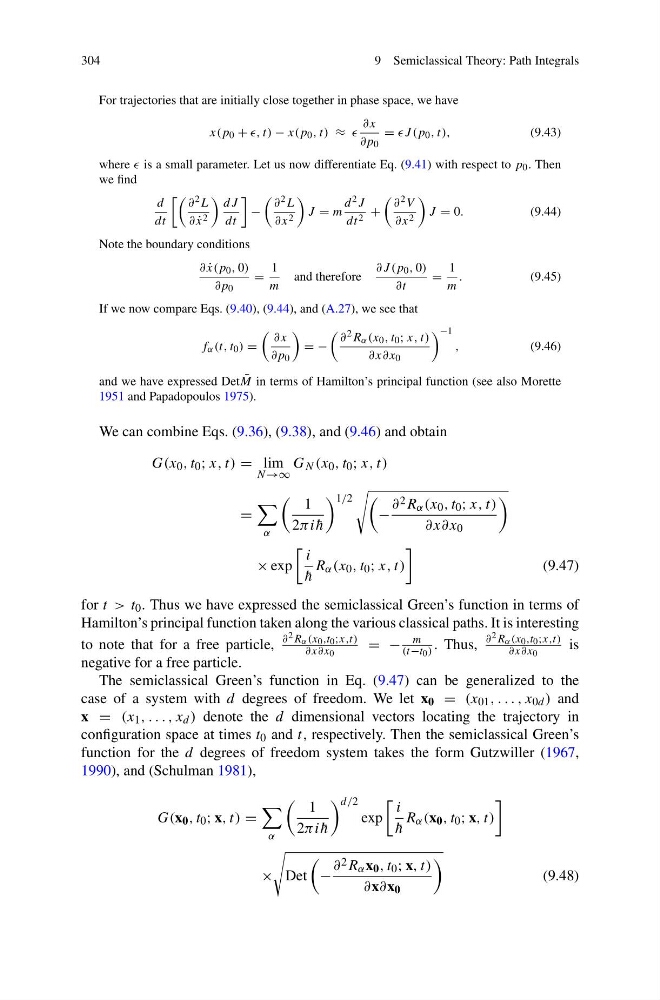
For trajectories that are initially close together in phase space, we have
x(p 0 + t) − x(p 0 , t) ≈
∂x
∂p 0
= (p 0 , t),
(9.43)
where is a small parameter. Let us now differentiate Eq. (9.41) with respect to p 0 . Then
we find
d
dt
∂ 2 L
∂ ˙
x 2
dJ
dt
−
∂ 2 L
∂x 2
J = m
d 2 J
dt 2 +
∂ 2 V
∂x 2
J = 0.
(9.44)
Note the boundary conditions
∂ ˙
x(p 0 , 0)
∂p 0
=
1
m
and therefore
∂J (p 0 , 0)
∂t
=
1
m
.
(9.45)
If we now compare Eqs. (9.40), (9.44), and (A.27), we see that
f α (t, t 0 ) =
∂x
∂p 0
= −
∂ 2 R α (x 0 , t 0 ; x, t)
∂x∂x 0
−1
,
(9.46)
and we have expressed Det ¯
M in terms of Hamilton’s principal function (see also Morette
1951 and Papadopoulos 1975).
We can combine Eqs. (9.36), (9.38), and (9.46) and obtain
G(x 0 , t 0 ; x, t) = lim
N →∞
G N (x 0 , t 0 ; x, t)
=
α
1
2πi ¯
h
1/2
−
∂ 2 R α (x 0 , t 0 ; x, t)
∂x∂x 0
× exp
i
¯
h
R α (x 0 , t 0 ; x, t)
(9.47)
for t > t 0 . Thus we have expressed the semiclassical Green’s function in terms of
Hamilton’s principal function taken along the various classical paths. It is interesting
to note that for a free particle,
∂ 2 R α (x 0 ,t 0 ;x,t)
∂x∂x 0
= −
m
(t−t 0 ) . Thus,
∂ 2 R α (x 0 ,t 0 ;x,t)
∂x∂x 0
is
negative for a free particle.
The semiclassical Green’s function in Eq. (9.47) can be generalized to the
case of a system with d degrees of freedom. We let x 0 = (x 01 , . . . , x 0d ) and
x = (x 1 , . . . , x d ) denote the d dimensional vectors locating the trajectory in
configuration space at times t 0 and t, respectively. Then the semiclassical Green’s
function for the d degrees of freedom system takes the form Gutzwiller (1967,
1990), and (Schulman 1981),
G(x 0 , t 0 ; x, t) =
α
1
2πi ¯
h
d/2
exp
i
¯
h
R α (x 0 , t 0 ; x, t)
×
Det
−
∂ 2 R α x 0 , t 0 ; x, t)
∂x∂x 0
(9.48)
9 Semiclassical Theory: Path Integrals
For trajectories that are initially close together in phase space, we have
x(p 0 + t) − x(p 0 , t) ≈
∂x
∂p 0
= (p 0 , t),
(9.43)
where is a small parameter. Let us now differentiate Eq. (9.41) with respect to p 0 . Then
we find
d
dt
∂ 2 L
∂ ˙
x 2
dJ
dt
−
∂ 2 L
∂x 2
J = m
d 2 J
dt 2 +
∂ 2 V
∂x 2
J = 0.
(9.44)
Note the boundary conditions
∂ ˙
x(p 0 , 0)
∂p 0
=
1
m
and therefore
∂J (p 0 , 0)
∂t
=
1
m
.
(9.45)
If we now compare Eqs. (9.40), (9.44), and (A.27), we see that
f α (t, t 0 ) =
∂x
∂p 0
= −
∂ 2 R α (x 0 , t 0 ; x, t)
∂x∂x 0
−1
,
(9.46)
and we have expressed Det ¯
M in terms of Hamilton’s principal function (see also Morette
1951 and Papadopoulos 1975).
We can combine Eqs. (9.36), (9.38), and (9.46) and obtain
G(x 0 , t 0 ; x, t) = lim
N →∞
G N (x 0 , t 0 ; x, t)
=
α
1
2πi ¯
h
1/2
−
∂ 2 R α (x 0 , t 0 ; x, t)
∂x∂x 0
× exp
i
¯
h
R α (x 0 , t 0 ; x, t)
(9.47)
for t > t 0 . Thus we have expressed the semiclassical Green’s function in terms of
Hamilton’s principal function taken along the various classical paths. It is interesting
to note that for a free particle,
∂ 2 R α (x 0 ,t 0 ;x,t)
∂x∂x 0
= −
m
(t−t 0 ) . Thus,
∂ 2 R α (x 0 ,t 0 ;x,t)
∂x∂x 0
is
negative for a free particle.
The semiclassical Green’s function in Eq. (9.47) can be generalized to the
case of a system with d degrees of freedom. We let x 0 = (x 01 , . . . , x 0d ) and
x = (x 1 , . . . , x d ) denote the d dimensional vectors locating the trajectory in
configuration space at times t 0 and t, respectively. Then the semiclassical Green’s
function for the d degrees of freedom system takes the form Gutzwiller (1967,
1990), and (Schulman 1981),
G(x 0 , t 0 ; x, t) =
α
1
2πi ¯
h
d/2
exp
i
¯
h
R α (x 0 , t 0 ; x, t)
×
Det
−
∂ 2 R α x 0 , t 0 ; x, t)
∂x∂x 0
(9.48)