

9.2 Green’s Function and Density of States
295
As we mentioned earlier, the first successful application of semiclassical path
integrals to chaotic Hamiltonian systems is due to Gutzwiller, who used it to
compute the energy levels for the anisotropic Kepler system, which is a chaotic
system. Gutzwiller focused on the trace of the energy Green’s function and showed,
by means of a stationary phase approximation, that the trace could be expressed
in terms of a sum over all classical stable and unstable periodic orbits. This is the
Gutzwiller trace formula. In Sect. 9.6, we derive the trace formula, and in Sect. 9.7
we describe the steps that Gutzwiller took in applying it to the anisotropic Kepler
system.
In Sect. 9.8, we describe some experimental results on the absorption spectrum
of diamagnetic hydrogen that clearly show the effect of underlying classical orbits
on quantum dynamics. As we will see, semiclassical path integral calculations using
a few periodic orbits and closed orbits are able to reproduce the essential features of
the experimental absorption spectrum data. The effects of bifurcation of underlying
classical orbits also show up clearly in the experimental data.
Finally, in Sect. 9.9, we make some concluding remarks.
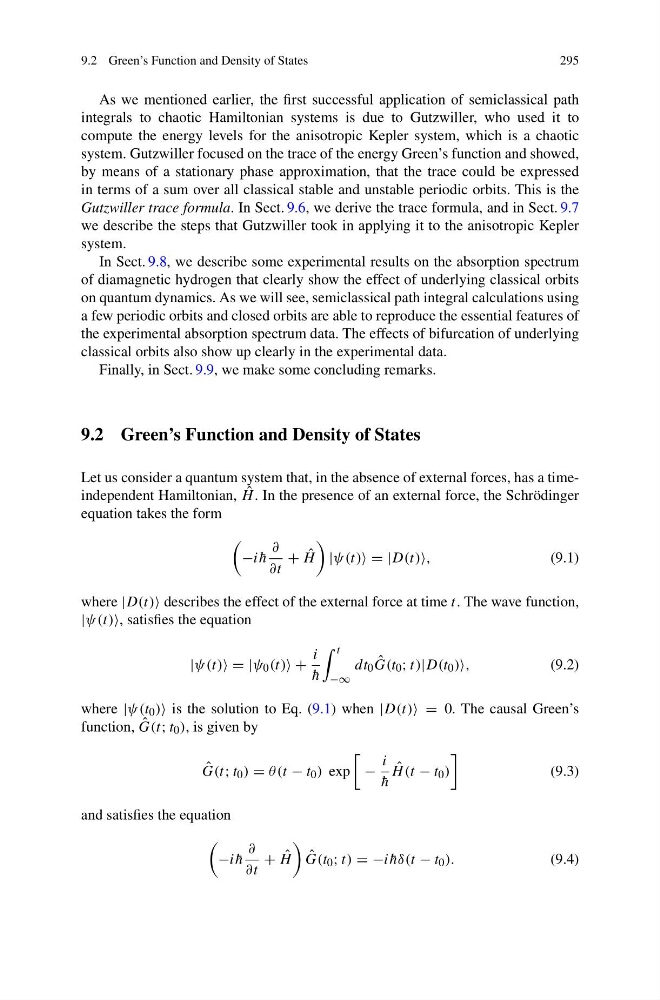
9.2 Green’s Function and Density of States
Let us consider a quantum system that, in the absence of external forces, has a timeindependent Hamiltonian, ˆ
H . In the presence of an external force, the Schrödinger
equation takes the form
−i ¯
h
∂
∂t
+ ˆ
H
|ψ(t) = |D(t),
(9.1)
where |D(t) describes the effect of the external force at time t. The wave function,
|ψ(t), satisfies the equation
|ψ(t) = |ψ 0 (t) +
i
¯
h
t
−∞
dt 0 ˆ
G(t 0 ; t)|D(t 0 ),
(9.2)
where |ψ(t 0 ) is the solution to Eq. (9.1) when |D(t) = 0. The causal Green’s
function, ˆ
G(t; t 0 ), is given by
ˆ
G(t; t 0 ) = θ(t − t 0 ) exp
−
i
¯
h
ˆ
H (t − t 0 )
(9.3)
and satisfies the equation
−i ¯
h
∂
∂t
+ ˆ
H
ˆ
G(t 0 ; t) = −i ¯
hδ(t − t 0 ).
(9.4)
295
As we mentioned earlier, the first successful application of semiclassical path
integrals to chaotic Hamiltonian systems is due to Gutzwiller, who used it to
compute the energy levels for the anisotropic Kepler system, which is a chaotic
system. Gutzwiller focused on the trace of the energy Green’s function and showed,
by means of a stationary phase approximation, that the trace could be expressed
in terms of a sum over all classical stable and unstable periodic orbits. This is the
Gutzwiller trace formula. In Sect. 9.6, we derive the trace formula, and in Sect. 9.7
we describe the steps that Gutzwiller took in applying it to the anisotropic Kepler
system.
In Sect. 9.8, we describe some experimental results on the absorption spectrum
of diamagnetic hydrogen that clearly show the effect of underlying classical orbits
on quantum dynamics. As we will see, semiclassical path integral calculations using
a few periodic orbits and closed orbits are able to reproduce the essential features of
the experimental absorption spectrum data. The effects of bifurcation of underlying
classical orbits also show up clearly in the experimental data.
Finally, in Sect. 9.9, we make some concluding remarks.
9.2 Green’s Function and Density of States
Let us consider a quantum system that, in the absence of external forces, has a timeindependent Hamiltonian, ˆ
H . In the presence of an external force, the Schrödinger
equation takes the form
−i ¯
h
∂
∂t
+ ˆ
H
|ψ(t) = |D(t),
(9.1)
where |D(t) describes the effect of the external force at time t. The wave function,
|ψ(t), satisfies the equation
|ψ(t) = |ψ 0 (t) +
i
¯
h
t
−∞
dt 0 ˆ
G(t 0 ; t)|D(t 0 ),
(9.2)
where |ψ(t 0 ) is the solution to Eq. (9.1) when |D(t) = 0. The causal Green’s
function, ˆ
G(t; t 0 ), is given by
ˆ
G(t; t 0 ) = θ(t − t 0 ) exp
−
i
¯
h
ˆ
H (t − t 0 )
(9.3)
and satisfies the equation
−i ¯
h
∂
∂t
+ ˆ
H
ˆ
G(t 0 ; t) = −i ¯
hδ(t − t 0 ).
(9.4)