

284
8 Manifestations of Chaos in Quantum Scattering Processes
The probability of finding the S-matrix, ¯
S = ¯
S o
M , in the interval ¯
S→ ¯
S + d ¯
S is
P
P ( ¯
S)dd S = dd S C P
det[ ¯
1 M − −S ∗ ··S] (M+1)/2
det[| ¯
1 M − −S ∗ · ¯
S|] (M+1)
,
(8.155)
where P P ( ¯
S) is the Poisson kernel. The Poisson kernel has a reproducing property.
For functions F ( ¯
S) that are analytic in ¯
S (i.e., can be expanded in a power series
in ¯
S), it gives
F ( ¯
S) P
P ( ¯
S)dd S = F ( ¯
S).
(8.156)
Therefore, from Eqs. (8.151), (8.152), and (8.156), the average S-matrix, ¯
S o
M , is
given by
¯
S
o
M =
dd S ¯
S P ( ¯
S) = σ ¯
1 M =
1 − − ig
1 + + ig
¯
1 M .
(8.157)
For the case when ¯
S o
M = 0, the Poisson kernel P ( ¯
S o
M ) = constant and the
probability distribution of ¯
S o
M becomes equal to that of the circular orthogonal
ensemble (see Eq. (G.3)). We next determine when that can happen.
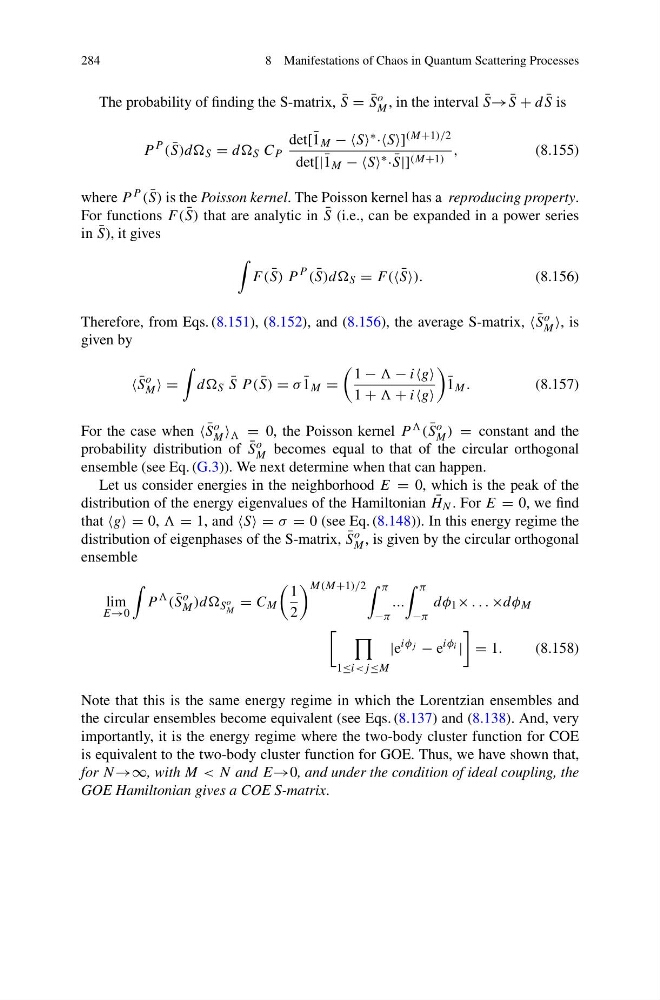
Let us consider energies in the neighborhood E = 0, which is the peak of the
distribution of the energy eigenvalues of the Hamiltonian ¯
H N . For E = 0, we find
that g = 0, = 1, and S = σ = 0 (see Eq. (8.148)). In this energy regime the
distribution of eigenphases of the S-matrix, ¯
S o
M , is given by the circular orthogonal
ensemble
lim
E→0
P
( ¯
S
o
M )dd S o
M
= C M
1
2
M(M+1)/2 π
−π
...
π
−π
dφ 1 × . . . ×dφ M
1≤i
iφ j − e
iφ i |
= 1.
(8.158)
Note that this is the same energy regime in which the Lorentzian ensembles and
the circular ensembles become equivalent (see Eqs. (8.137) and (8.138). And, very
importantly, it is the energy regime where the two-body cluster function for COE
is equivalent to the two-body cluster function for GOE. Thus, we have shown that,
for N →∞, with M < N and E→0, and under the condition of ideal coupling, the
GOE Hamiltonian gives a COE S-matrix.
8 Manifestations of Chaos in Quantum Scattering Processes
The probability of finding the S-matrix, ¯
S = ¯
S o
M , in the interval ¯
S→ ¯
S + d ¯
S is
P
P ( ¯
S)dd S = dd S C P
det[ ¯
1 M − −S ∗ ··S] (M+1)/2
det[| ¯
1 M − −S ∗ · ¯
S|] (M+1)
,
(8.155)
where P P ( ¯
S) is the Poisson kernel. The Poisson kernel has a reproducing property.
For functions F ( ¯
S) that are analytic in ¯
S (i.e., can be expanded in a power series
in ¯
S), it gives
F ( ¯
S) P
P ( ¯
S)dd S = F ( ¯
S).
(8.156)
Therefore, from Eqs. (8.151), (8.152), and (8.156), the average S-matrix, ¯
S o
M , is
given by
¯
S
o
M =
dd S ¯
S P ( ¯
S) = σ ¯
1 M =
1 − − ig
1 + + ig
¯
1 M .
(8.157)
For the case when ¯
S o
M = 0, the Poisson kernel P ( ¯
S o
M ) = constant and the
probability distribution of ¯
S o
M becomes equal to that of the circular orthogonal
ensemble (see Eq. (G.3)). We next determine when that can happen.
Let us consider energies in the neighborhood E = 0, which is the peak of the
distribution of the energy eigenvalues of the Hamiltonian ¯
H N . For E = 0, we find
that g = 0, = 1, and S = σ = 0 (see Eq. (8.148)). In this energy regime the
distribution of eigenphases of the S-matrix, ¯
S o
M , is given by the circular orthogonal
ensemble
lim
E→0
P
( ¯
S
o
M )dd S o
M
= C M
1
2
M(M+1)/2 π
−π
...
π
−π
dφ 1 × . . . ×dφ M
1≤i
iφ j − e
iφ i |
= 1.
(8.158)
Note that this is the same energy regime in which the Lorentzian ensembles and
the circular ensembles become equivalent (see Eqs. (8.137) and (8.138). And, very
importantly, it is the energy regime where the two-body cluster function for COE
is equivalent to the two-body cluster function for GOE. Thus, we have shown that,
for N →∞, with M < N and E→0, and under the condition of ideal coupling, the
GOE Hamiltonian gives a COE S-matrix.