

272
8 Manifestations of Chaos in Quantum Scattering Processes
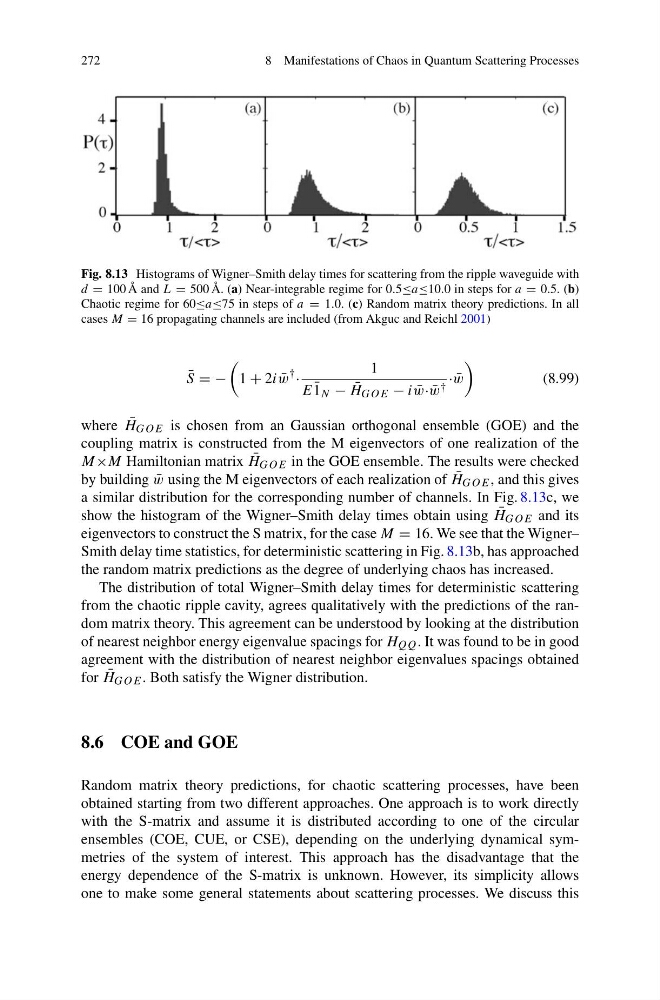
Fig. 8.13 Histograms of Wigner–Smith delay times for scattering from the ripple waveguide with
d = 100 Å and L = 500 Å. (a) Near-integrable regime for 0.5≤a≤10.0 in steps for a = 0.5. (b)
Chaotic regime for 60≤a≤75 in steps of a = 1.0. (c) Random matrix theory predictions. In all
cases M = 16 propagating channels are included (from Akguc and Reichl 2001)
¯
S = −
1 + 2i ¯
w
†
·
1
E ¯
1 N − ¯
H GOE − i ¯
w· ¯
w †
· ¯
w
(8.99)
where ¯
H GOE is chosen from an Gaussian orthogonal ensemble (GOE) and the
coupling matrix is constructed from the M eigenvectors of one realization of the
M×M Hamiltonian matrix ¯
H GOE in the GOE ensemble. The results were checked
by building ¯
w using the M eigenvectors of each realization of ¯
H GOE , and this gives
a similar distribution for the corresponding number of channels. In Fig. 8.13c, we
show the histogram of the Wigner–Smith delay times obtain using ¯
H GOE and its
eigenvectors to construct the S matrix, for the case M = 16. We see that the Wigner–
Smith delay time statistics, for deterministic scattering in Fig. 8.13b, has approached
the random matrix predictions as the degree of underlying chaos has increased.
The distribution of total Wigner–Smith delay times for deterministic scattering
from the chaotic ripple cavity, agrees qualitatively with the predictions of the random matrix theory. This agreement can be understood by looking at the distribution
of nearest neighbor energy eigenvalue spacings for H QQ . It was found to be in good
agreement with the distribution of nearest neighbor eigenvalues spacings obtained
for ¯
H GOE . Both satisfy the Wigner distribution.
8.6 COE and GOE
Random matrix theory predictions, for chaotic scattering processes, have been
obtained starting from two different approaches. One approach is to work directly
with the S-matrix and assume it is distributed according to one of the circular
ensembles (COE, CUE, or CSE), depending on the underlying dynamical symmetries of the system of interest. This approach has the disadvantage that the
energy dependence of the S-matrix is unknown. However, its simplicity allows
one to make some general statements about scattering processes. We discuss this
8 Manifestations of Chaos in Quantum Scattering Processes
Fig. 8.13 Histograms of Wigner–Smith delay times for scattering from the ripple waveguide with
d = 100 Å and L = 500 Å. (a) Near-integrable regime for 0.5≤a≤10.0 in steps for a = 0.5. (b)
Chaotic regime for 60≤a≤75 in steps of a = 1.0. (c) Random matrix theory predictions. In all
cases M = 16 propagating channels are included (from Akguc and Reichl 2001)
¯
S = −
1 + 2i ¯
w
†
·
1
E ¯
1 N − ¯
H GOE − i ¯
w· ¯
w †
· ¯
w
(8.99)
where ¯
H GOE is chosen from an Gaussian orthogonal ensemble (GOE) and the
coupling matrix is constructed from the M eigenvectors of one realization of the
M×M Hamiltonian matrix ¯
H GOE in the GOE ensemble. The results were checked
by building ¯
w using the M eigenvectors of each realization of ¯
H GOE , and this gives
a similar distribution for the corresponding number of channels. In Fig. 8.13c, we
show the histogram of the Wigner–Smith delay times obtain using ¯
H GOE and its
eigenvectors to construct the S matrix, for the case M = 16. We see that the Wigner–
Smith delay time statistics, for deterministic scattering in Fig. 8.13b, has approached
the random matrix predictions as the degree of underlying chaos has increased.
The distribution of total Wigner–Smith delay times for deterministic scattering
from the chaotic ripple cavity, agrees qualitatively with the predictions of the random matrix theory. This agreement can be understood by looking at the distribution
of nearest neighbor energy eigenvalue spacings for H QQ . It was found to be in good
agreement with the distribution of nearest neighbor eigenvalues spacings obtained
for ¯
H GOE . Both satisfy the Wigner distribution.
8.6 COE and GOE
Random matrix theory predictions, for chaotic scattering processes, have been
obtained starting from two different approaches. One approach is to work directly
with the S-matrix and assume it is distributed according to one of the circular
ensembles (COE, CUE, or CSE), depending on the underlying dynamical symmetries of the system of interest. This approach has the disadvantage that the
energy dependence of the S-matrix is unknown. However, its simplicity allows
one to make some general statements about scattering processes. We discuss this