

8.5 Scattering in the Ripple Waveguide
265
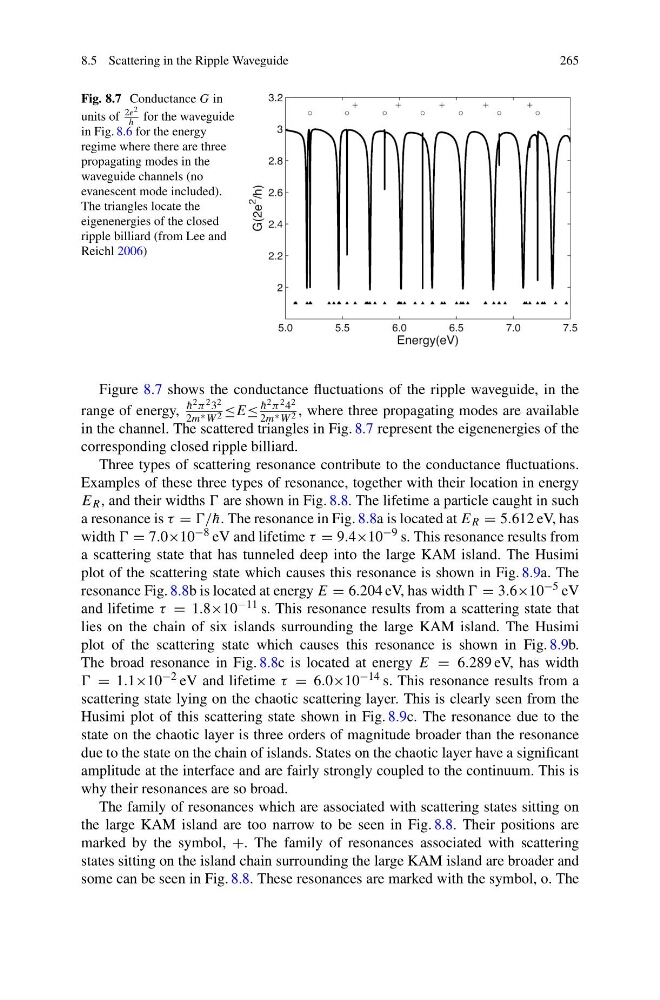
Fig. 8.7 Conductance G in
units of
2e 2
h for the waveguide
in Fig. 8.6 for the energy
regime where there are three
propagating modes in the
waveguide channels (no
evanescent mode included).
The triangles locate the
eigenenergies of the closed
ripple billiard (from Lee and
Reichl 2006)
Figure 8.7 shows the conductance fluctuations of the ripple waveguide, in the
range of energy, ¯
h 2 π 2 3 2
2m ∗ W 2 ≤E≤ ¯
h 2 π 2 4 2
2m ∗ W 2 , where three propagating modes are available
in the channel. The scattered triangles in Fig. 8.7 represent the eigenenergies of the
corresponding closed ripple billiard.
Three types of scattering resonance contribute to the conductance fluctuations.
Examples of these three types of resonance, together with their location in energy
E R , and their widths are shown in Fig. 8.8. The lifetime a particle caught in such
a resonance is τ = ¯
h. The resonance in Fig. 8.8a is located at E R = 5.612 eV, has
width = 7.0×10 −8 eV and lifetime τ = 9.4×10 −9 s. This resonance results from
a scattering state that has tunneled deep into the large KAM island. The Husimi
plot of the scattering state which causes this resonance is shown in Fig. 8.9a. The
resonance Fig. 8.8b is located at energy E = 6.204 eV, has width = 3.6×10 −5 eV
and lifetime τ = 1.8×10 −11 s. This resonance results from a scattering state that
lies on the chain of six islands surrounding the large KAM island. The Husimi
plot of the scattering state which causes this resonance is shown in Fig. 8.9b.
The broad resonance in Fig. 8.8c is located at energy E = 6.289 eV, has width
= 1.1×10 −2 eV and lifetime τ = 6.0×10 −14 s. This resonance results from a
scattering state lying on the chaotic scattering layer. This is clearly seen from the
Husimi plot of this scattering state shown in Fig. 8.9c. The resonance due to the
state on the chaotic layer is three orders of magnitude broader than the resonance
due to the state on the chain of islands. States on the chaotic layer have a significant
amplitude at the interface and are fairly strongly coupled to the continuum. This is
why their resonances are so broad.
The family of resonances which are associated with scattering states sitting on
the large KAM island are too narrow to be seen in Fig. 8.8. Their positions are
marked by the symbol, +. The family of resonances associated with scattering
states sitting on the island chain surrounding the large KAM island are broader and
some can be seen in Fig. 8.8. These resonances are marked with the symbol, o. The
265
Fig. 8.7 Conductance G in
units of
2e 2
h for the waveguide
in Fig. 8.6 for the energy
regime where there are three
propagating modes in the
waveguide channels (no
evanescent mode included).
The triangles locate the
eigenenergies of the closed
ripple billiard (from Lee and
Reichl 2006)
Figure 8.7 shows the conductance fluctuations of the ripple waveguide, in the
range of energy, ¯
h 2 π 2 3 2
2m ∗ W 2 ≤E≤ ¯
h 2 π 2 4 2
2m ∗ W 2 , where three propagating modes are available
in the channel. The scattered triangles in Fig. 8.7 represent the eigenenergies of the
corresponding closed ripple billiard.
Three types of scattering resonance contribute to the conductance fluctuations.
Examples of these three types of resonance, together with their location in energy
E R , and their widths are shown in Fig. 8.8. The lifetime a particle caught in such
a resonance is τ = ¯
h. The resonance in Fig. 8.8a is located at E R = 5.612 eV, has
width = 7.0×10 −8 eV and lifetime τ = 9.4×10 −9 s. This resonance results from
a scattering state that has tunneled deep into the large KAM island. The Husimi
plot of the scattering state which causes this resonance is shown in Fig. 8.9a. The
resonance Fig. 8.8b is located at energy E = 6.204 eV, has width = 3.6×10 −5 eV
and lifetime τ = 1.8×10 −11 s. This resonance results from a scattering state that
lies on the chain of six islands surrounding the large KAM island. The Husimi
plot of the scattering state which causes this resonance is shown in Fig. 8.9b.
The broad resonance in Fig. 8.8c is located at energy E = 6.289 eV, has width
= 1.1×10 −2 eV and lifetime τ = 6.0×10 −14 s. This resonance results from a
scattering state lying on the chaotic scattering layer. This is clearly seen from the
Husimi plot of this scattering state shown in Fig. 8.9c. The resonance due to the
state on the chaotic layer is three orders of magnitude broader than the resonance
due to the state on the chain of islands. States on the chaotic layer have a significant
amplitude at the interface and are fairly strongly coupled to the continuum. This is
why their resonances are so broad.
The family of resonances which are associated with scattering states sitting on
the large KAM island are too narrow to be seen in Fig. 8.8. Their positions are
marked by the symbol, +. The family of resonances associated with scattering
states sitting on the island chain surrounding the large KAM island are broader and
some can be seen in Fig. 8.8. These resonances are marked with the symbol, o. The