

258
8 Manifestations of Chaos in Quantum Scattering Processes
8.4.2 Delay Times for Multichannel Scattering
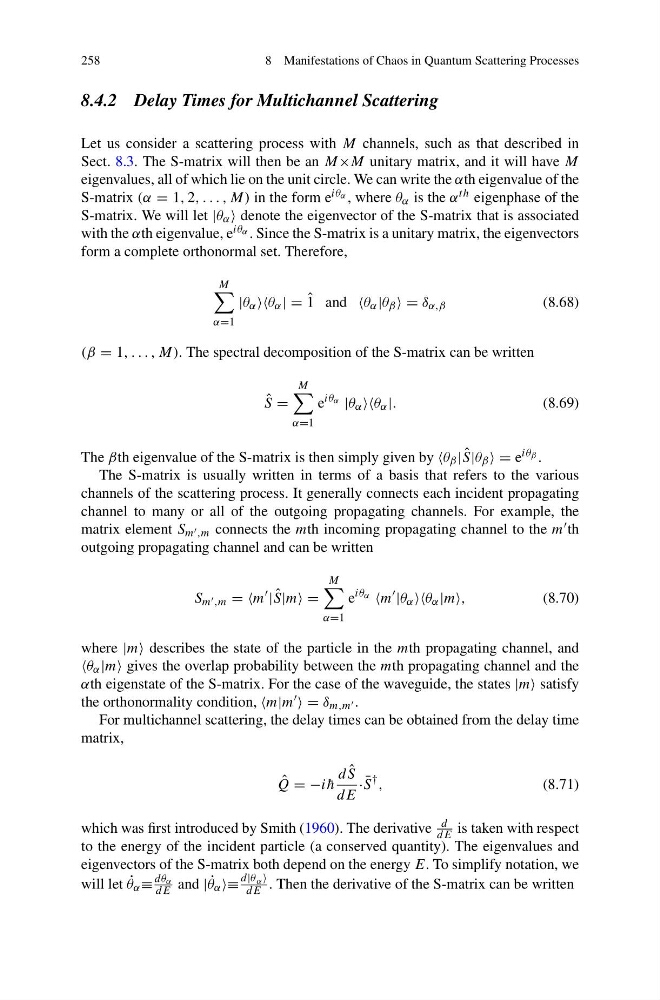
Let us consider a scattering process with M channels, such as that described in
Sect. 8.3. The S-matrix will then be an M×M unitary matrix, and it will have M
eigenvalues, all of which lie on the unit circle. We can write the αth eigenvalue of the
S-matrix (α = 1, 2, . . . , M) in the form e iθ α , where θ α is the α th eigenphase of the
S-matrix. We will let |θ α denote the eigenvector of the S-matrix that is associated
with the αth eigenvalue, e iθ α . Since the S-matrix is a unitary matrix, the eigenvectors
form a complete orthonormal set. Therefore,
M
α=1
|θ α θ α | = ˆ
1 and θ α |θ β = δ α,β
(8.68)
(β = 1, . . . , M). The spectral decomposition of the S-matrix can be written
ˆ
S =
M
α=1
e
iθ α |θ α θ α |.
(8.69)
The βth eigenvalue of the S-matrix is then simply given by θ β | ˆ
S|θ β = e iθ β .
The S-matrix is usually written in terms of a basis that refers to the various
channels of the scattering process. It generally connects each incident propagating
channel to many or all of the outgoing propagating channels. For example, the
matrix element S m ,m connects the mth incoming propagating channel to the m th
outgoing propagating channel and can be written
S m ,m = =m
| ˆ
S|m =
M
α=1
e
iθ α m
|θ α θ α |m,
(8.70)
where |m describes the state of the particle in the mth propagating channel, and
θ α |m gives the overlap probability between the mth propagating channel and the
αth eigenstate of the S-matrix. For the case of the waveguide, the states |m satisfy
the orthonormality condition, m|m = δ m,m .
For multichannel scattering, the delay times can be obtained from the delay time
matrix,
ˆ
Q = −i ¯
h
d ˆ
S
dE
· ¯
S
† ,
(8.71)
which was first introduced by Smith (1960). The derivative
d
dE is taken with respect
to the energy of the incident particle (a conserved quantity). The eigenvalues and
eigenvectors of the S-matrix both depend on the energy E. To simplify notation, we
will let ˙
θ α ≡
dθ α
dE and | ˙
θ α ≡
d|θ α
dE . Then the derivative of the S-matrix can be written
8 Manifestations of Chaos in Quantum Scattering Processes
8.4.2 Delay Times for Multichannel Scattering
Let us consider a scattering process with M channels, such as that described in
Sect. 8.3. The S-matrix will then be an M×M unitary matrix, and it will have M
eigenvalues, all of which lie on the unit circle. We can write the αth eigenvalue of the
S-matrix (α = 1, 2, . . . , M) in the form e iθ α , where θ α is the α th eigenphase of the
S-matrix. We will let |θ α denote the eigenvector of the S-matrix that is associated
with the αth eigenvalue, e iθ α . Since the S-matrix is a unitary matrix, the eigenvectors
form a complete orthonormal set. Therefore,
M
α=1
|θ α θ α | = ˆ
1 and θ α |θ β = δ α,β
(8.68)
(β = 1, . . . , M). The spectral decomposition of the S-matrix can be written
ˆ
S =
M
α=1
e
iθ α |θ α θ α |.
(8.69)
The βth eigenvalue of the S-matrix is then simply given by θ β | ˆ
S|θ β = e iθ β .
The S-matrix is usually written in terms of a basis that refers to the various
channels of the scattering process. It generally connects each incident propagating
channel to many or all of the outgoing propagating channels. For example, the
matrix element S m ,m connects the mth incoming propagating channel to the m th
outgoing propagating channel and can be written
S m ,m = =m
| ˆ
S|m =
M
α=1
e
iθ α m
|θ α θ α |m,
(8.70)
where |m describes the state of the particle in the mth propagating channel, and
θ α |m gives the overlap probability between the mth propagating channel and the
αth eigenstate of the S-matrix. For the case of the waveguide, the states |m satisfy
the orthonormality condition, m|m = δ m,m .
For multichannel scattering, the delay times can be obtained from the delay time
matrix,
ˆ
Q = −i ¯
h
d ˆ
S
dE
· ¯
S
† ,
(8.71)
which was first introduced by Smith (1960). The derivative
d
dE is taken with respect
to the energy of the incident particle (a conserved quantity). The eigenvalues and
eigenvectors of the S-matrix both depend on the energy E. To simplify notation, we
will let ˙
θ α ≡
dθ α
dE and | ˙
θ α ≡
d|θ α
dE . Then the derivative of the S-matrix can be written