

250
8 Manifestations of Chaos in Quantum Scattering Processes
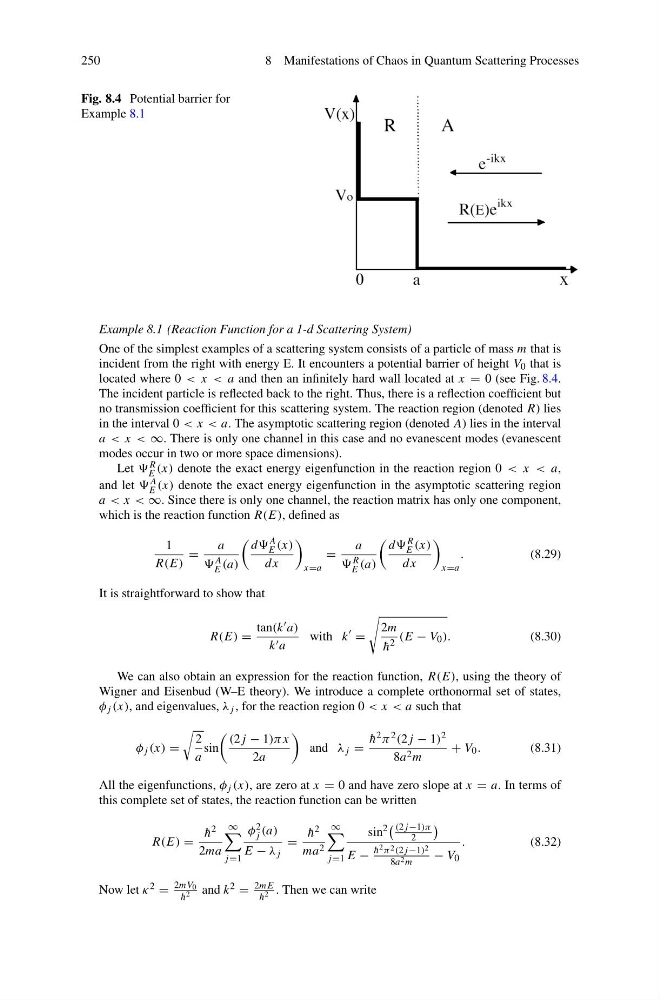
Fig. 8.4 Potential barrier for
Example 8.1
Example 8.1 (Reaction Function for a 1-d Scattering System)
One of the simplest examples of a scattering system consists of a particle of mass m that is
incident from the right with energy E. It encounters a potential barrier of height V 0 that is
located where 0 < x < a and then an infinitely hard wall located at x = 0 (see Fig. 8.4.
The incident particle is reflected back to the right. Thus, there is a reflection coefficient but
no transmission coefficient for this scattering system. The reaction region (denoted R) lies
in the interval 0 < x < a. The asymptotic scattering region (denoted A) lies in the interval
a < x < ∞. There is only one channel in this case and no evanescent modes (evanescent
modes occur in two or more space dimensions).
Let R
E (x) denote the exact energy eigenfunction in the reaction region 0 < x < a,
and let A
E (x) denote the exact energy eigenfunction in the asymptotic scattering region
a < x < ∞. Since there is only one channel, the reaction matrix has only one component,
which is the reaction function R(E), defined as
1
R(E)
=
a
A
E (a)
dd A
E (x)
dx
x=a
=
a
R
E (a)
dd R
E (x)
dx
x=a
.
(8.29)
It is straightforward to show that
R(E) =
tan(k a)
k a
with k
=
2m
¯
h 2 (E − V 0 ).
(8.30)
We can also obtain an expression for the reaction function, R(E), using the theory of
Wigner and Eisenbud (W–E theory). We introduce a complete orthonormal set of states,
φ j (x), and eigenvalues, λ j , for the reaction region 0 < x < a such that
φ j (x) =
2
a
sin
(2j − 1)π x
2a
and λ j =
¯
h 2 π 2 (2j − 1) 2
8a 2 m
+ V 0 .
(8.31)
All the eigenfunctions, φ j (x), are zero at x = 0 and have zero slope at x = a. In terms of
this complete set of states, the reaction function can be written
R(E) =
¯
h 2
2ma
∞
j =1
φ 2
j (a)
E − λ j
=
¯
h 2
ma 2
∞
j =1
sin
2
(2j −1)π
2
E −
¯
h 2 π 2 (2j −1) 2
8a 2 m
− V 0
.
(8.32)
Now let κ 2 =
2mV 0
¯
h 2 and k 2 =
2mE
¯
h 2 . Then we can write
8 Manifestations of Chaos in Quantum Scattering Processes
Fig. 8.4 Potential barrier for
Example 8.1
Example 8.1 (Reaction Function for a 1-d Scattering System)
One of the simplest examples of a scattering system consists of a particle of mass m that is
incident from the right with energy E. It encounters a potential barrier of height V 0 that is
located where 0 < x < a and then an infinitely hard wall located at x = 0 (see Fig. 8.4.
The incident particle is reflected back to the right. Thus, there is a reflection coefficient but
no transmission coefficient for this scattering system. The reaction region (denoted R) lies
in the interval 0 < x < a. The asymptotic scattering region (denoted A) lies in the interval
a < x < ∞. There is only one channel in this case and no evanescent modes (evanescent
modes occur in two or more space dimensions).
Let R
E (x) denote the exact energy eigenfunction in the reaction region 0 < x < a,
and let A
E (x) denote the exact energy eigenfunction in the asymptotic scattering region
a < x < ∞. Since there is only one channel, the reaction matrix has only one component,
which is the reaction function R(E), defined as
1
R(E)
=
a
A
E (a)
dd A
E (x)
dx
x=a
=
a
R
E (a)
dd R
E (x)
dx
x=a
.
(8.29)
It is straightforward to show that
R(E) =
tan(k a)
k a
with k
=
2m
¯
h 2 (E − V 0 ).
(8.30)
We can also obtain an expression for the reaction function, R(E), using the theory of
Wigner and Eisenbud (W–E theory). We introduce a complete orthonormal set of states,
φ j (x), and eigenvalues, λ j , for the reaction region 0 < x < a such that
φ j (x) =
2
a
sin
(2j − 1)π x
2a
and λ j =
¯
h 2 π 2 (2j − 1) 2
8a 2 m
+ V 0 .
(8.31)
All the eigenfunctions, φ j (x), are zero at x = 0 and have zero slope at x = a. In terms of
this complete set of states, the reaction function can be written
R(E) =
¯
h 2
2ma
∞
j =1
φ 2
j (a)
E − λ j
=
¯
h 2
ma 2
∞
j =1
sin
2
(2j −1)π
2
E −
¯
h 2 π 2 (2j −1) 2
8a 2 m
− V 0
.
(8.32)
Now let κ 2 =
2mV 0
¯
h 2 and k 2 =
2mE
¯
h 2 . Then we can write