

7.4 The Quantized Baker’s Map
207
where ˆ
p and ˆ
q are momentum and position operators, respectively. Using ˆ
a † , the
coherent state can be written
|z = exp(z ˆ
a
† )|χ 0 ,
where the state |χ 0 has the property ˆ
a|χ 0 = 0 (a vacuum state), z =
1
√
2
(q + ip),
and p and q are phase space coordinates. The state |z is a minimum uncertainty
Gaussian wave packet with standard deviation p =
√ ¯
h/2 in the p-direction and
q =
√ ¯
h/2 in the q-direction and centered at the phase space point (p, q). The
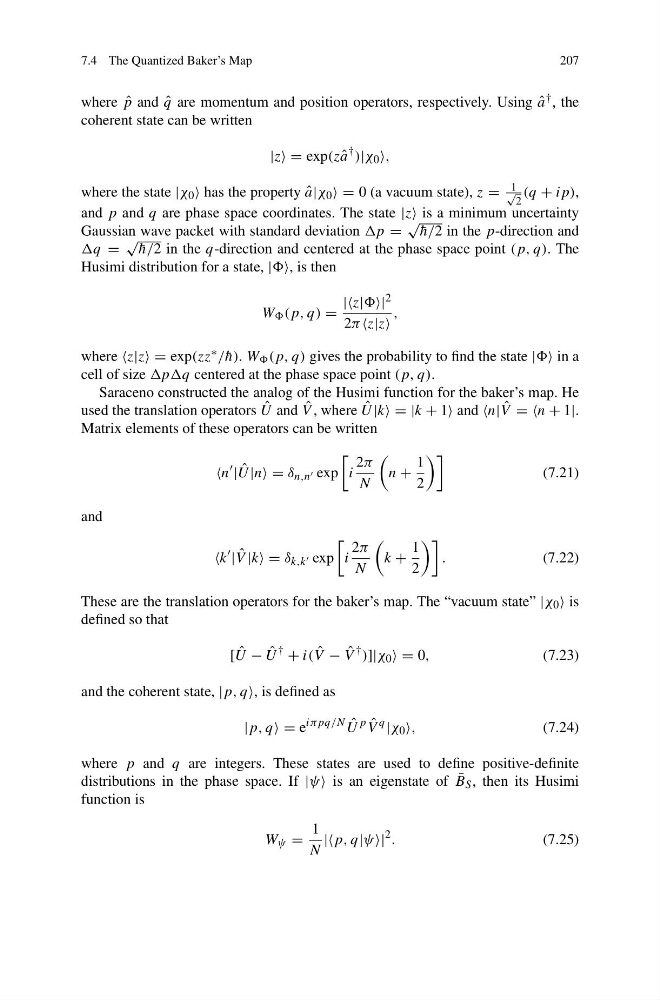
Husimi distribution for a state, |, is then
W (p, q) =
||z|| 2
2π z|z
,
where z|z = exp(zz ∗ / ¯
h). W (p, q) gives the probability to find the state | in a
cell of size centered at the phase space point (p, q).
Saraceno constructed the analog of the Husimi function for the baker’s map. He
used the translation operators ˆ
U and ˆ
V , where ˆ
U |k = |k + 1 and n| ˆ
V = =n + 1|.
Matrix elements of these operators can be written
n
| ˆ
U |n = δ n,n exp
i
2π
N
n +
1
2
(7.21)
and
k
| ˆ
V |k = δ k,k exp
i
2π
N
k +
1
2
.
(7.22)
These are the translation operators for the baker’s map. The “vacuum state” |χ 0 is
defined so that
[ ˆ
U − ˆ
U
†
+ i( ˆ
V − ˆ
V
† )]|χ 0 = 0,
(7.23)
and the coherent state, |p, q, is defined as
|p, q = e
iπpq/N ˆ
U
p ˆ
V
q
|χ 0 ,
(7.24)
where p and q are integers. These states are used to define positive-definite
distributions in the phase space. If |ψ is an eigenstate of ¯
B S , then its Husimi
function is
W ψ =
1
N
||p, q|ψ|
2 .
(7.25)
207
where ˆ
p and ˆ
q are momentum and position operators, respectively. Using ˆ
a † , the
coherent state can be written
|z = exp(z ˆ
a
† )|χ 0 ,
where the state |χ 0 has the property ˆ
a|χ 0 = 0 (a vacuum state), z =
1
√
2
(q + ip),
and p and q are phase space coordinates. The state |z is a minimum uncertainty
Gaussian wave packet with standard deviation p =
√ ¯
h/2 in the p-direction and
q =
√ ¯
h/2 in the q-direction and centered at the phase space point (p, q). The
Husimi distribution for a state, |, is then
W (p, q) =
||z|| 2
2π z|z
,
where z|z = exp(zz ∗ / ¯
h). W (p, q) gives the probability to find the state | in a
cell of size centered at the phase space point (p, q).
Saraceno constructed the analog of the Husimi function for the baker’s map. He
used the translation operators ˆ
U and ˆ
V , where ˆ
U |k = |k + 1 and n| ˆ
V = =n + 1|.
Matrix elements of these operators can be written
n
| ˆ
U |n = δ n,n exp
i
2π
N
n +
1
2
(7.21)
and
k
| ˆ
V |k = δ k,k exp
i
2π
N
k +
1
2
.
(7.22)
These are the translation operators for the baker’s map. The “vacuum state” |χ 0 is
defined so that
[ ˆ
U − ˆ
U
†
+ i( ˆ
V − ˆ
V
† )]|χ 0 = 0,
(7.23)
and the coherent state, |p, q, is defined as
|p, q = e
iπpq/N ˆ
U
p ˆ
V
q
|χ 0 ,
(7.24)
where p and q are integers. These states are used to define positive-definite
distributions in the phase space. If |ψ is an eigenstate of ¯
B S , then its Husimi
function is
W ψ =
1
N
||p, q|ψ|
2 .
(7.25)