

6.6 Thermalization of Quantum Systems
191
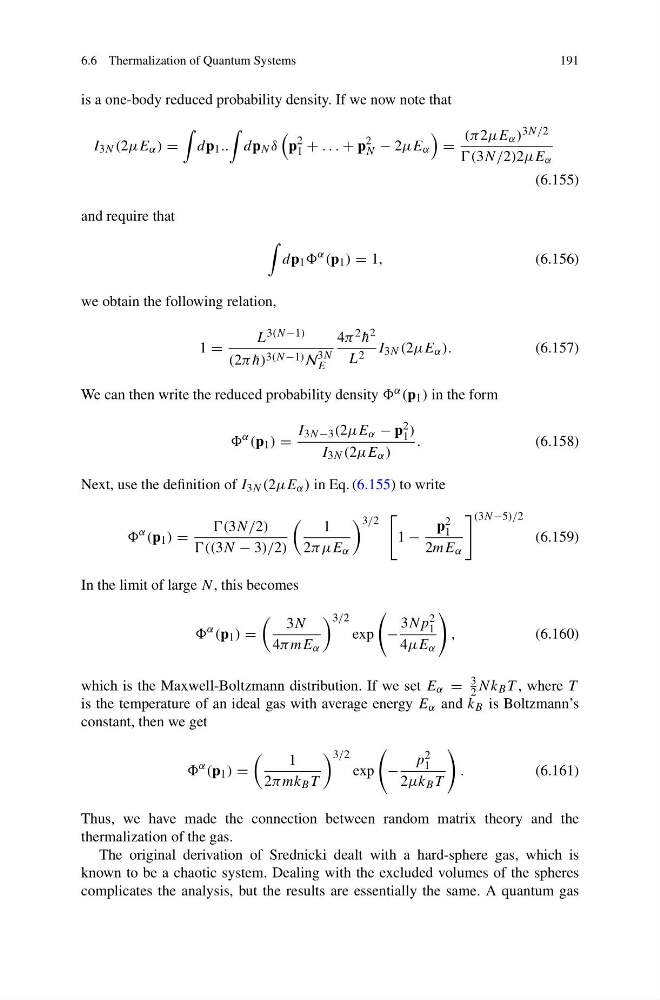
is a one-body reduced probability density. If we now note that
I 3N (2μE α ) =
dp 1 ..
dp N δ
p
2
1 + . . . + p
2
N − 2μE α
=
(π 2μE α ) 3N/2
(3N/2)2μE α
(6.155)
and require that
dp 1
α (p 1 ) = 1,
(6.156)
we obtain the following relation,
1 =
L 3(N −1)
(2π ¯
h) 3(N −1) N
3N
E
4π 2 ¯
h 2
L 2 I 3N (2μE α ).
(6.157)
We can then write the reduced probability density α (p 1 ) in the form
α (p 1 ) =
I 3N −3 (2μE α − p 2
1 )
I 3N (2μE α )
.
(6.158)
Next, use the definition of I 3N (2μE α ) in Eq. (6.155) to write
α (p 1 ) =
(3N/2)
((3N − 3)/2)
1
2πμE α
3/2
1 −
p 2
1
2mE α
(3N −5)/2
(6.159)
In the limit of large N, this becomes
α (p 1 ) =
3N
4πmE α
3/2
exp
−
3Np 2
1
4μE α
,
(6.160)
which is the Maxwell-Boltzmann distribution. If we set E α =
3
2 Nk B T , where T
is the temperature of an ideal gas with average energy E α and k B is Boltzmann’s
constant, then we get
α (p 1 ) =
1
2πmk B T
3/2
exp
−
p 2
1
2μk B T
.
(6.161)
Thus, we have made the connection between random matrix theory and the
thermalization of the gas.
The original derivation of Srednicki dealt with a hard-sphere gas, which is
known to be a chaotic system. Dealing with the excluded volumes of the spheres
complicates the analysis, but the results are essentially the same. A quantum gas
191
is a one-body reduced probability density. If we now note that
I 3N (2μE α ) =
dp 1 ..
dp N δ
p
2
1 + . . . + p
2
N − 2μE α
=
(π 2μE α ) 3N/2
(3N/2)2μE α
(6.155)
and require that
dp 1
α (p 1 ) = 1,
(6.156)
we obtain the following relation,
1 =
L 3(N −1)
(2π ¯
h) 3(N −1) N
3N
E
4π 2 ¯
h 2
L 2 I 3N (2μE α ).
(6.157)
We can then write the reduced probability density α (p 1 ) in the form
α (p 1 ) =
I 3N −3 (2μE α − p 2
1 )
I 3N (2μE α )
.
(6.158)
Next, use the definition of I 3N (2μE α ) in Eq. (6.155) to write
α (p 1 ) =
(3N/2)
((3N − 3)/2)
1
2πμE α
3/2
1 −
p 2
1
2mE α
(3N −5)/2
(6.159)
In the limit of large N, this becomes
α (p 1 ) =
3N
4πmE α
3/2
exp
−
3Np 2
1
4μE α
,
(6.160)
which is the Maxwell-Boltzmann distribution. If we set E α =
3
2 Nk B T , where T
is the temperature of an ideal gas with average energy E α and k B is Boltzmann’s
constant, then we get
α (p 1 ) =
1
2πmk B T
3/2
exp
−
p 2
1
2μk B T
.
(6.161)
Thus, we have made the connection between random matrix theory and the
thermalization of the gas.
The original derivation of Srednicki dealt with a hard-sphere gas, which is
known to be a chaotic system. Dealing with the excluded volumes of the spheres
complicates the analysis, but the results are essentially the same. A quantum gas