

190
6 Quantum Dynamics and Random Matrix Theory
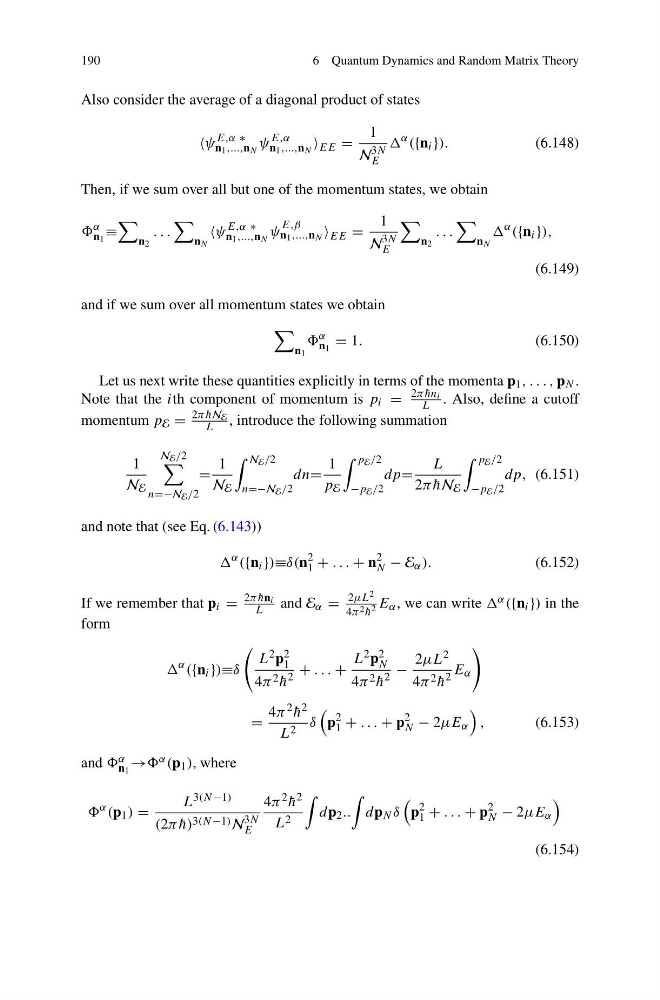
Also consider the average of a diagonal product of states
ψ
E,α ∗
n 1 ,...,n N
ψ
E,α
n 1 ,...,n N
EE =
1
N
3N
E
α ({n i }).
(6.148)
Then, if we sum over all but one of the momentum states, we obtain
α
n 1
≡
n 2
. . .
n N
ψ
E,α ∗
n 1 ,...,n N
ψ
E,β
n 1 ,...,n N EE =
1
N
3N
E
n 2
. . .
n N
α ({n i }),
(6.149)
and if we sum over all momentum states we obtain
n 1
α
n 1
= 1.
(6.150)
Let us next write these quantities explicitly in terms of the momenta p 1 , . . . , p N .
Note that the ith component of momentum is p i =
2π ¯
hn i
L . Also, define a cutoff
momentum p E =
2π ¯
hN E
L , introduce the following summation
1
N E
N E /2
n=−N E /2
=
1
N E
N E /2
n=−N E /2
dn=
1
p E
p E /2
−p E /2
dp=
L
2π ¯
hN E
p E /2
−p E /2
dp, (6.151)
and note that (see Eq. (6.143))
α ({n i })≡δ(n
2
1 + . . . + n
2
N − E α ).
(6.152)
If we remember that p i =
2π ¯
hn i
L
and E α =
2μL 2
4π 2 ¯
h 2 E α , we can write α ({n i }) in the
form
α ({n i })≡δ
L 2 p 2
1
4π 2 ¯
h 2 + . . . +
L 2 p 2
N
4π 2 ¯
h 2 −
2μL 2
4π 2 ¯
h 2 E α
=
4π 2 ¯
h 2
L 2 δ
p
2
1 + . . . + p
2
N − 2μE α
,
(6.153)
and α
n 1
→ α (p 1 ), where
α (p 1 ) =
L 3(N −1)
(2π ¯
h) 3(N −1) N
3N
E
4π 2 ¯
h 2
L 2
dp 2 ..
dp N δ
p
2
1 + . . . + p
2
N − 2μE α
(6.154)
6 Quantum Dynamics and Random Matrix Theory
Also consider the average of a diagonal product of states
ψ
E,α ∗
n 1 ,...,n N
ψ
E,α
n 1 ,...,n N
EE =
1
N
3N
E
α ({n i }).
(6.148)
Then, if we sum over all but one of the momentum states, we obtain
α
n 1
≡
n 2
. . .
n N
ψ
E,α ∗
n 1 ,...,n N
ψ
E,β
n 1 ,...,n N EE =
1
N
3N
E
n 2
. . .
n N
α ({n i }),
(6.149)
and if we sum over all momentum states we obtain
n 1
α
n 1
= 1.
(6.150)
Let us next write these quantities explicitly in terms of the momenta p 1 , . . . , p N .
Note that the ith component of momentum is p i =
2π ¯
hn i
L . Also, define a cutoff
momentum p E =
2π ¯
hN E
L , introduce the following summation
1
N E
N E /2
n=−N E /2
=
1
N E
N E /2
n=−N E /2
dn=
1
p E
p E /2
−p E /2
dp=
L
2π ¯
hN E
p E /2
−p E /2
dp, (6.151)
and note that (see Eq. (6.143))
α ({n i })≡δ(n
2
1 + . . . + n
2
N − E α ).
(6.152)
If we remember that p i =
2π ¯
hn i
L
and E α =
2μL 2
4π 2 ¯
h 2 E α , we can write α ({n i }) in the
form
α ({n i })≡δ
L 2 p 2
1
4π 2 ¯
h 2 + . . . +
L 2 p 2
N
4π 2 ¯
h 2 −
2μL 2
4π 2 ¯
h 2 E α
=
4π 2 ¯
h 2
L 2 δ
p
2
1 + . . . + p
2
N − 2μE α
,
(6.153)
and α
n 1
→ α (p 1 ), where
α (p 1 ) =
L 3(N −1)
(2π ¯
h) 3(N −1) N
3N
E
4π 2 ¯
h 2
L 2
dp 2 ..
dp N δ
p
2
1 + . . . + p
2
N − 2μE α
(6.154)