

178
6 Quantum Dynamics and Random Matrix Theory
We can now perform the integrations in Eqs. (6.88)–(6.90). After a fair amount
of work, we obtain
ˆ
η
2
eig =
4
3
m
2
−
1
4
+
2
π 2 [γ + ln[4π m]] + . . . ,
(6.104)
ˆ
η
2
eig = m
2
+
1
2π 2 −
1
8
+
1
π 2 [γ + ln[4π m]] + . . . ,
(6.105)
and
ˆ
η
2
eig =
m 4
9
+
m 2
4π 2 .
(6.106)
If we combine Eqs. (6.82) and (6.104)–(6.106), we finally obtain
(GOE)
3
=
1
π 2
ln[2πN] + γ −
5
4
−
π 2
8
+ O
1
N
. . . ,
(6.107)
where O
1
N
indicates that we have neglected terms of order
1
N . Equation (6.107)
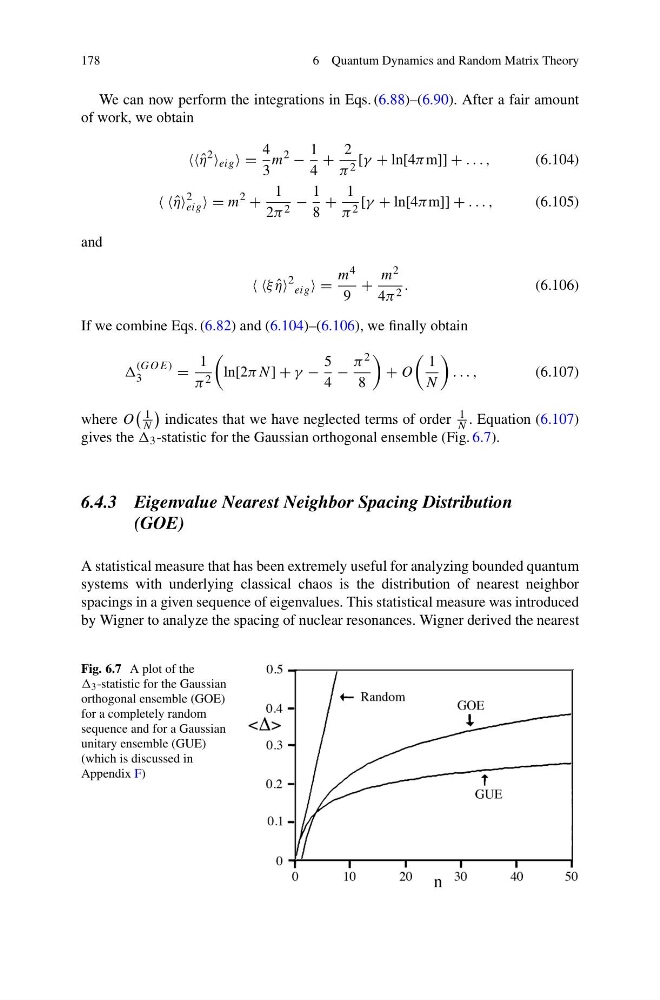
gives the 3 -statistic for the Gaussian orthogonal ensemble (Fig. 6.7).
6.4.3 Eigenvalue Nearest Neighbor Spacing Distribution
(GOE)
A statistical measure that has been extremely useful for analyzing bounded quantum
systems with underlying classical chaos is the distribution of nearest neighbor
spacings in a given sequence of eigenvalues. This statistical measure was introduced
by Wigner to analyze the spacing of nuclear resonances. Wigner derived the nearest
Fig. 6.7 A plot of the
3 -statistic for the Gaussian
orthogonal ensemble (GOE)
for a completely random
sequence and for a Gaussian
unitary ensemble (GUE)
(which is discussed in
Appendix F)
6 Quantum Dynamics and Random Matrix Theory
We can now perform the integrations in Eqs. (6.88)–(6.90). After a fair amount
of work, we obtain
ˆ
η
2
eig =
4
3
m
2
−
1
4
+
2
π 2 [γ + ln[4π m]] + . . . ,
(6.104)
ˆ
η
2
eig = m
2
+
1
2π 2 −
1
8
+
1
π 2 [γ + ln[4π m]] + . . . ,
(6.105)
and
ˆ
η
2
eig =
m 4
9
+
m 2
4π 2 .
(6.106)
If we combine Eqs. (6.82) and (6.104)–(6.106), we finally obtain
(GOE)
3
=
1
π 2
ln[2πN] + γ −
5
4
−
π 2
8
+ O
1
N
. . . ,
(6.107)
where O
1
N
indicates that we have neglected terms of order
1
N . Equation (6.107)
gives the 3 -statistic for the Gaussian orthogonal ensemble (Fig. 6.7).
6.4.3 Eigenvalue Nearest Neighbor Spacing Distribution
(GOE)
A statistical measure that has been extremely useful for analyzing bounded quantum
systems with underlying classical chaos is the distribution of nearest neighbor
spacings in a given sequence of eigenvalues. This statistical measure was introduced
by Wigner to analyze the spacing of nuclear resonances. Wigner derived the nearest
Fig. 6.7 A plot of the
3 -statistic for the Gaussian
orthogonal ensemble (GOE)
for a completely random
sequence and for a Gaussian
unitary ensemble (GUE)
(which is discussed in
Appendix F)