

5.5 Arnol’d Diffusion in an Optical Lattice
141
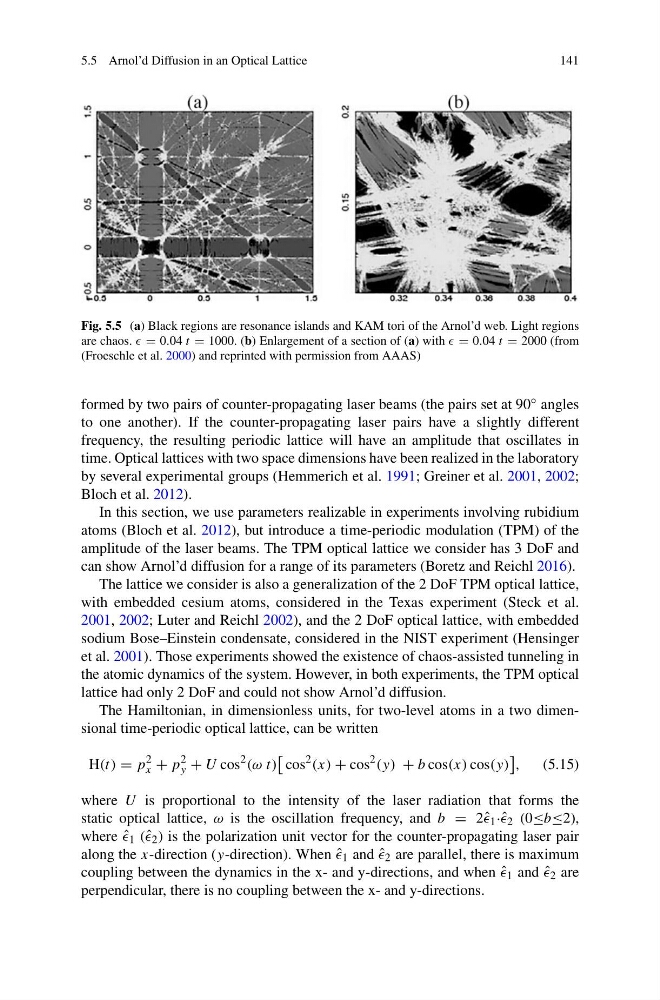
Fig. 5.5 (a) Black regions are resonance islands and KAM tori of the Arnol’d web. Light regions
are chaos. = 0.04 t = 1000. (b) Enlargement of a section of (a) with = 0.04 t = 2000 (from
(Froeschle et al. 2000) and reprinted with permission from AAAS)
formed by two pairs of counter-propagating laser beams (the pairs set at 90 ◦ angles
to one another). If the counter-propagating laser pairs have a slightly different
frequency, the resulting periodic lattice will have an amplitude that oscillates in
time. Optical lattices with two space dimensions have been realized in the laboratory
by several experimental groups (Hemmerich et al. 1991; Greiner et al. 2001, 2002;
Bloch et al. 2012).
In this section, we use parameters realizable in experiments involving rubidium
atoms (Bloch et al. 2012), but introduce a time-periodic modulation (TPM) of the
amplitude of the laser beams. The TPM optical lattice we consider has 3 DoF and
can show Arnol’d diffusion for a range of its parameters (Boretz and Reichl 2016).
The lattice we consider is also a generalization of the 2 DoF TPM optical lattice,
with embedded cesium atoms, considered in the Texas experiment (Steck et al.
2001, 2002; Luter and Reichl 2002), and the 2 DoF optical lattice, with embedded
sodium Bose–Einstein condensate, considered in the NIST experiment (Hensinger
et al. 2001). Those experiments showed the existence of chaos-assisted tunneling in
the atomic dynamics of the system. However, in both experiments, the TPM optical
lattice had only 2 DoF and could not show Arnol’d diffusion.
The Hamiltonian, in dimensionless units, for two-level atoms in a two dimensional time-periodic optical lattice, can be written
H(t) = p
2
x + p
2
y + U cos
2 (ω t)
cos
2 (x) + cos
2 (y) + b cos(x) cos(y)
,
(5.15)
where U is proportional to the intensity of the laser radiation that forms the
static optical lattice, ω is the oscillation frequency, and b = 2ˆ 1 ·ˆ 2 (0≤b≤2),
where ˆ
1 (ˆ 2 ) is the polarization unit vector for the counter-propagating laser pair
along the x-direction (y-direction). When ˆ
1 and ˆ
2 are parallel, there is maximum
coupling between the dynamics in the x- and y-directions, and when ˆ
1 and ˆ
2 are
perpendicular, there is no coupling between the x- and y-directions.
141
Fig. 5.5 (a) Black regions are resonance islands and KAM tori of the Arnol’d web. Light regions
are chaos. = 0.04 t = 1000. (b) Enlargement of a section of (a) with = 0.04 t = 2000 (from
(Froeschle et al. 2000) and reprinted with permission from AAAS)
formed by two pairs of counter-propagating laser beams (the pairs set at 90 ◦ angles
to one another). If the counter-propagating laser pairs have a slightly different
frequency, the resulting periodic lattice will have an amplitude that oscillates in
time. Optical lattices with two space dimensions have been realized in the laboratory
by several experimental groups (Hemmerich et al. 1991; Greiner et al. 2001, 2002;
Bloch et al. 2012).
In this section, we use parameters realizable in experiments involving rubidium
atoms (Bloch et al. 2012), but introduce a time-periodic modulation (TPM) of the
amplitude of the laser beams. The TPM optical lattice we consider has 3 DoF and
can show Arnol’d diffusion for a range of its parameters (Boretz and Reichl 2016).
The lattice we consider is also a generalization of the 2 DoF TPM optical lattice,
with embedded cesium atoms, considered in the Texas experiment (Steck et al.
2001, 2002; Luter and Reichl 2002), and the 2 DoF optical lattice, with embedded
sodium Bose–Einstein condensate, considered in the NIST experiment (Hensinger
et al. 2001). Those experiments showed the existence of chaos-assisted tunneling in
the atomic dynamics of the system. However, in both experiments, the TPM optical
lattice had only 2 DoF and could not show Arnol’d diffusion.
The Hamiltonian, in dimensionless units, for two-level atoms in a two dimensional time-periodic optical lattice, can be written
H(t) = p
2
x + p
2
y + U cos
2 (ω t)
cos
2 (x) + cos
2 (y) + b cos(x) cos(y)
,
(5.15)
where U is proportional to the intensity of the laser radiation that forms the
static optical lattice, ω is the oscillation frequency, and b = 2ˆ 1 ·ˆ 2 (0≤b≤2),
where ˆ
1 (ˆ 2 ) is the polarization unit vector for the counter-propagating laser pair
along the x-direction (y-direction). When ˆ
1 and ˆ
2 are parallel, there is maximum
coupling between the dynamics in the x- and y-directions, and when ˆ
1 and ˆ
2 are
perpendicular, there is no coupling between the x- and y-directions.