

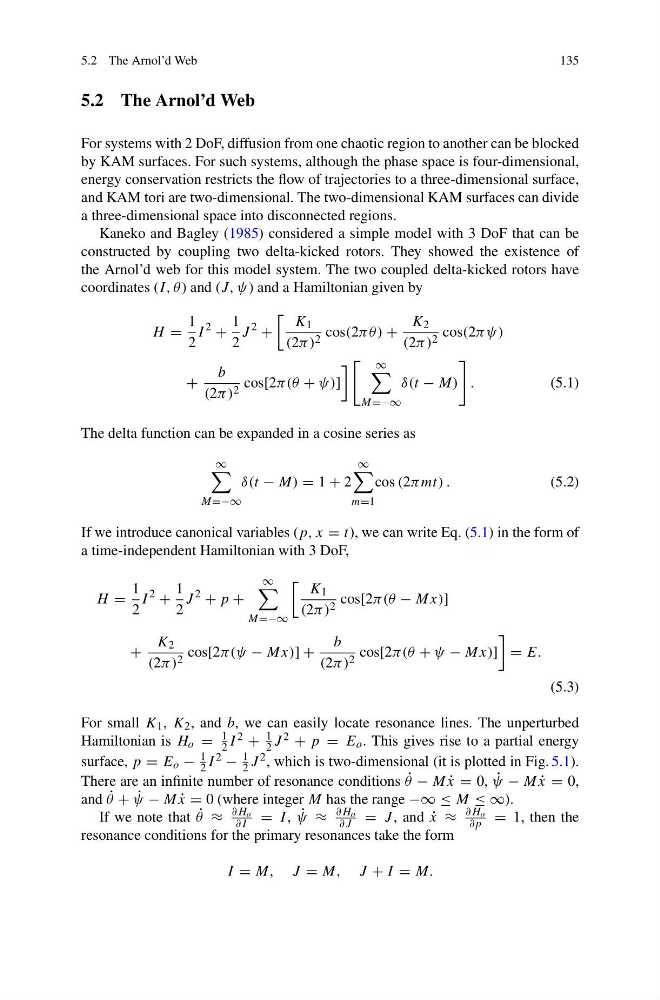
5.2 The Arnol’d Web
135
5.2 The Arnol’d Web
For systems with 2 DoF, diffusion from one chaotic region to another can be blocked
by KAM surfaces. For such systems, although the phase space is four-dimensional,
energy conservation restricts the flow of trajectories to a three-dimensional surface,
and KAM tori are two-dimensional. The two-dimensional KAM surfaces can divide
a three-dimensional space into disconnected regions.
Kaneko and Bagley (1985) considered a simple model with 3 DoF that can be
constructed by coupling two delta-kicked rotors. They showed the existence of
the Arnol’d web for this model system. The two coupled delta-kicked rotors have
coordinates (I, θ) and (J, ψ) and a Hamiltonian given by
H =
1
2
I
2
+
1
2
J
2
+
K 1
(2π) 2 cos(2πθ) +
K 2
(2π) 2 cos(2πψ)
+
b
(2π) 2 cos[2π(θ + ψ)]
∞
M=−∞
δ(t − M)
.
(5.1)
The delta function can be expanded in a cosine series as
∞
M=−∞
δ(t − M) = 1 + 2
∞
m=1
cos (2πmt) .
(5.2)
If we introduce canonical variables (p, x = t), we can write Eq. (5.1) in the form of
a time-independent Hamiltonian with 3 DoF,
H =
1
2
I
2
+
1
2
J
2
+ p +
∞
M=−∞
K 1
(2π) 2 cos[2π(θ − Mx)]
+
K 2
(2π) 2 cos[2π(ψ − Mx)] +
b
(2π) 2 cos[2π(θ + ψ − Mx)]
= E.
(5.3)
For small K 1 , K 2 , and b, we can easily locate resonance lines. The unperturbed
Hamiltonian is H o =
1
2 I 2 +
1
2 J 2 + p = E o . This gives rise to a partial energy
surface, p = E o −
1
2 I 2 −
1
2 J 2 , which is two-dimensional (it is plotted in Fig. 5.1).
There are an infinite number of resonance conditions ˙
θ − M ˙
x = 0, ˙
ψ − M ˙
x = 0,
and ˙
θ + ˙
ψ − M ˙
x = 0 (where integer M has the range −∞ ≤ M ≤ ∞).
If we note that ˙
θ ≈
∂H o
∂I = I , ˙
ψ ≈
∂H o
∂J = J , and ˙
x ≈
∂H o
∂p = 1, then the
resonance conditions for the primary resonances take the form
I = M, J = M, J + I = M.
135
5.2 The Arnol’d Web
For systems with 2 DoF, diffusion from one chaotic region to another can be blocked
by KAM surfaces. For such systems, although the phase space is four-dimensional,
energy conservation restricts the flow of trajectories to a three-dimensional surface,
and KAM tori are two-dimensional. The two-dimensional KAM surfaces can divide
a three-dimensional space into disconnected regions.
Kaneko and Bagley (1985) considered a simple model with 3 DoF that can be
constructed by coupling two delta-kicked rotors. They showed the existence of
the Arnol’d web for this model system. The two coupled delta-kicked rotors have
coordinates (I, θ) and (J, ψ) and a Hamiltonian given by
H =
1
2
I
2
+
1
2
J
2
+
K 1
(2π) 2 cos(2πθ) +
K 2
(2π) 2 cos(2πψ)
+
b
(2π) 2 cos[2π(θ + ψ)]
∞
M=−∞
δ(t − M)
.
(5.1)
The delta function can be expanded in a cosine series as
∞
M=−∞
δ(t − M) = 1 + 2
∞
m=1
cos (2πmt) .
(5.2)
If we introduce canonical variables (p, x = t), we can write Eq. (5.1) in the form of
a time-independent Hamiltonian with 3 DoF,
H =
1
2
I
2
+
1
2
J
2
+ p +
∞
M=−∞
K 1
(2π) 2 cos[2π(θ − Mx)]
+
K 2
(2π) 2 cos[2π(ψ − Mx)] +
b
(2π) 2 cos[2π(θ + ψ − Mx)]
= E.
(5.3)
For small K 1 , K 2 , and b, we can easily locate resonance lines. The unperturbed
Hamiltonian is H o =
1
2 I 2 +
1
2 J 2 + p = E o . This gives rise to a partial energy
surface, p = E o −
1
2 I 2 −
1
2 J 2 , which is two-dimensional (it is plotted in Fig. 5.1).
There are an infinite number of resonance conditions ˙
θ − M ˙
x = 0, ˙
ψ − M ˙
x = 0,
and ˙
θ + ˙
ψ − M ˙
x = 0 (where integer M has the range −∞ ≤ M ≤ ∞).
If we note that ˙
θ ≈
∂H o
∂I = I , ˙
ψ ≈
∂H o
∂J = J , and ˙
x ≈
∂H o
∂p = 1, then the
resonance conditions for the primary resonances take the form
I = M, J = M, J + I = M.