

4.4 Model of Chlorine Ion in a Radiation Field
121
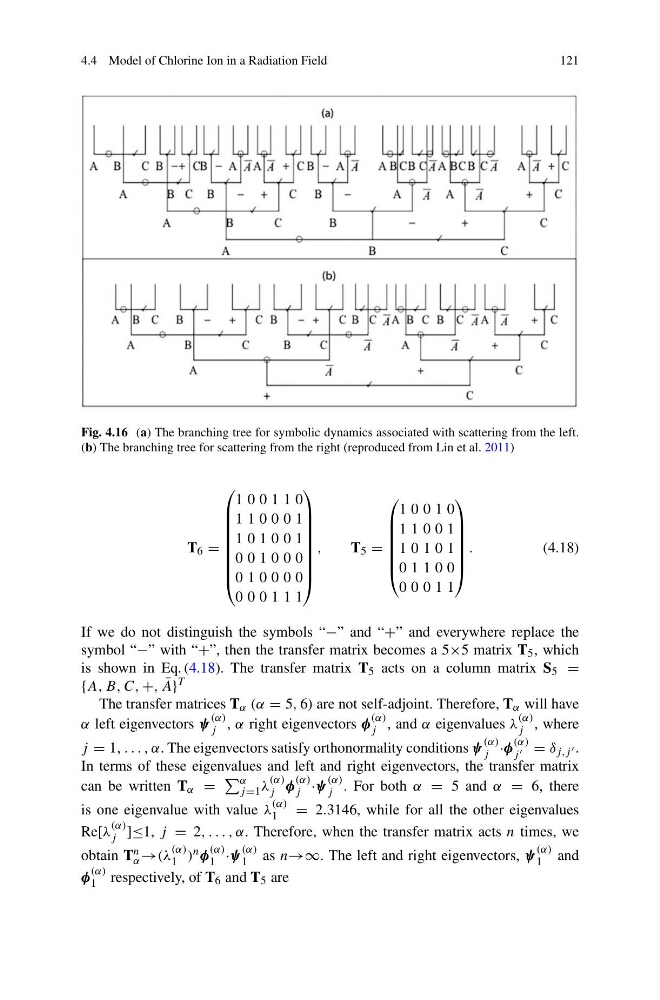
Fig. 4.16 (a) The branching tree for symbolic dynamics associated with scattering from the left.
(b) The branching tree for scattering from the right (reproduced from Lin et al. 2011)
T 6 =
⎛
⎜
⎜
⎜
⎜
⎜
⎜
⎜
⎝
1 0 0 1 1 0
1 1 0 0 0 1
1 0 1 0 0 1
0 0 1 0 0 0
0 1 0 0 0 0
0 0 0 1 1 1
⎞
⎟
⎟
⎟
⎟
⎟
⎟
⎟
⎠
,
T 5 =
⎛
⎜
⎜
⎜
⎜
⎜
⎝
1 0 0 1 0
1 1 0 0 1
1 0 1 0 1
0 1 1 0 0
0 0 0 1 1
⎞
⎟
⎟
⎟
⎟
⎟
⎠
.
(4.18)
If we do not distinguish the symbols “−” and “+” and everywhere replace the
symbol “−” with “+”, then the transfer matrix becomes a 5×5 matrix T 5 , which
is shown in Eq. (4.18). The transfer matrix T 5 acts on a column matrix S 5 =
{A, B, C, +, ¯
A} T
The transfer matrices T α (α = 5, 6) are not self-adjoint. Therefore, T α will have
α left eigenvectors ψ
(α)
j , α right eigenvectors φ
(α)
j , and α eigenvalues λ
(α)
j , where
j = 1, . . . , α. The eigenvectors satisfy orthonormality conditions ψ
(α)
j ·φ
(α)
j = δ j,j .
In terms of these eigenvalues and left and right eigenvectors, the transfer matrix
can be written T α =
α
j =1 λ
(α)
j φ
(α)
j ·ψ
(α)
j . For both α = 5 and α = 6, there
is one eigenvalue with value λ
(α)
1
= 2.3146, while for all the other eigenvalues
Re[λ
(α)
j ]≤1, j = 2, . . . , α. Therefore, when the transfer matrix acts n times, we
obtain T n
α →(λ
(α)
1 ) n φ
(α)
1 ·ψ
(α)
1 as n→∞. The left and right eigenvectors, ψ
(α)
1 and
φ
(α)
1 respectively, of T 6 and T 5 are
121
Fig. 4.16 (a) The branching tree for symbolic dynamics associated with scattering from the left.
(b) The branching tree for scattering from the right (reproduced from Lin et al. 2011)
T 6 =
⎛
⎜
⎜
⎜
⎜
⎜
⎜
⎜
⎝
1 0 0 1 1 0
1 1 0 0 0 1
1 0 1 0 0 1
0 0 1 0 0 0
0 1 0 0 0 0
0 0 0 1 1 1
⎞
⎟
⎟
⎟
⎟
⎟
⎟
⎟
⎠
,
T 5 =
⎛
⎜
⎜
⎜
⎜
⎜
⎝
1 0 0 1 0
1 1 0 0 1
1 0 1 0 1
0 1 1 0 0
0 0 0 1 1
⎞
⎟
⎟
⎟
⎟
⎟
⎠
.
(4.18)
If we do not distinguish the symbols “−” and “+” and everywhere replace the
symbol “−” with “+”, then the transfer matrix becomes a 5×5 matrix T 5 , which
is shown in Eq. (4.18). The transfer matrix T 5 acts on a column matrix S 5 =
{A, B, C, +, ¯
A} T
The transfer matrices T α (α = 5, 6) are not self-adjoint. Therefore, T α will have
α left eigenvectors ψ
(α)
j , α right eigenvectors φ
(α)
j , and α eigenvalues λ
(α)
j , where
j = 1, . . . , α. The eigenvectors satisfy orthonormality conditions ψ
(α)
j ·φ
(α)
j = δ j,j .
In terms of these eigenvalues and left and right eigenvectors, the transfer matrix
can be written T α =
α
j =1 λ
(α)
j φ
(α)
j ·ψ
(α)
j . For both α = 5 and α = 6, there
is one eigenvalue with value λ
(α)
1
= 2.3146, while for all the other eigenvalues
Re[λ
(α)
j ]≤1, j = 2, . . . , α. Therefore, when the transfer matrix acts n times, we
obtain T n
α →(λ
(α)
1 ) n φ
(α)
1 ·ψ
(α)
1 as n→∞. The left and right eigenvectors, ψ
(α)
1 and
φ
(α)
1 respectively, of T 6 and T 5 are