

118
4 Chaotic Scattering
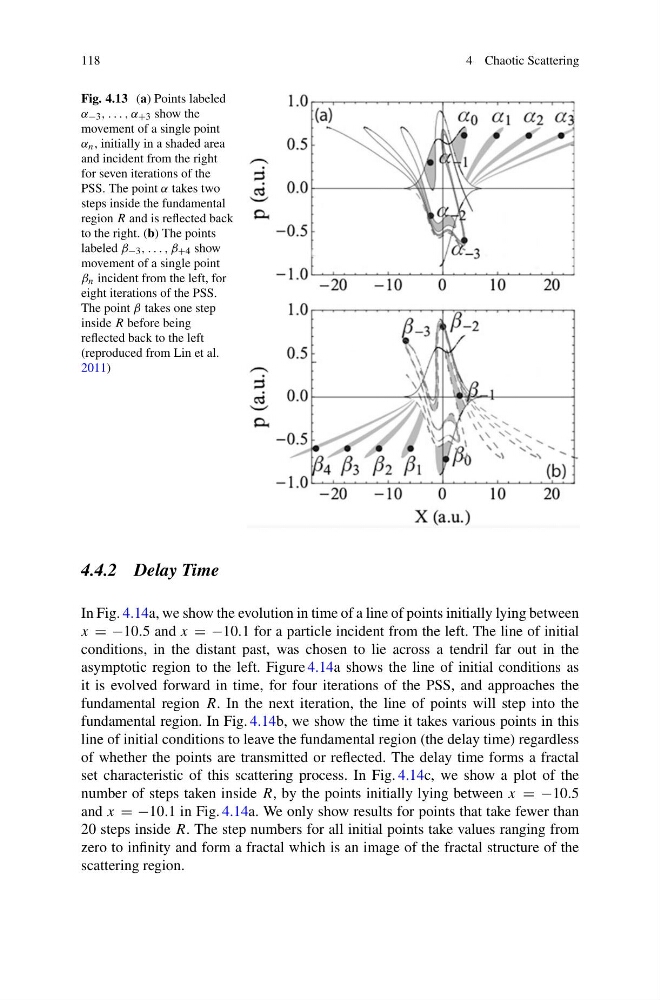
Fig. 4.13 (a) Points labeled
α −3 , . . . , α +3 show the
movement of a single point
α n , initially in a shaded area
and incident from the right
for seven iterations of the
PSS. The point α takes two
steps inside the fundamental
region R and is reflected back
to the right. (b) The points
labeled β −3 , . . . , β +4 show
movement of a single point
β n incident from the left, for
eight iterations of the PSS.
The point β takes one step
inside R before being
reflected back to the left
(reproduced from Lin et al.
2011)
4.4.2 Delay Time
In Fig. 4.14a, we show the evolution in time of a line of points initially lying between
x = −10.5 and x = −10.1 for a particle incident from the left. The line of initial
conditions, in the distant past, was chosen to lie across a tendril far out in the
asymptotic region to the left. Figure 4.14a shows the line of initial conditions as
it is evolved forward in time, for four iterations of the PSS, and approaches the
fundamental region R. In the next iteration, the line of points will step into the
fundamental region. In Fig. 4.14b, we show the time it takes various points in this
line of initial conditions to leave the fundamental region (the delay time) regardless
of whether the points are transmitted or reflected. The delay time forms a fractal
set characteristic of this scattering process. In Fig. 4.14c, we show a plot of the
number of steps taken inside R, by the points initially lying between x = −10.5
and x = −10.1 in Fig. 4.14a. We only show results for points that take fewer than
20 steps inside R. The step numbers for all initial points take values ranging from
zero to infinity and form a fractal which is an image of the fractal structure of the
scattering region.
4 Chaotic Scattering
Fig. 4.13 (a) Points labeled
α −3 , . . . , α +3 show the
movement of a single point
α n , initially in a shaded area
and incident from the right
for seven iterations of the
PSS. The point α takes two
steps inside the fundamental
region R and is reflected back
to the right. (b) The points
labeled β −3 , . . . , β +4 show
movement of a single point
β n incident from the left, for
eight iterations of the PSS.
The point β takes one step
inside R before being
reflected back to the left
(reproduced from Lin et al.
2011)
4.4.2 Delay Time
In Fig. 4.14a, we show the evolution in time of a line of points initially lying between
x = −10.5 and x = −10.1 for a particle incident from the left. The line of initial
conditions, in the distant past, was chosen to lie across a tendril far out in the
asymptotic region to the left. Figure 4.14a shows the line of initial conditions as
it is evolved forward in time, for four iterations of the PSS, and approaches the
fundamental region R. In the next iteration, the line of points will step into the
fundamental region. In Fig. 4.14b, we show the time it takes various points in this
line of initial conditions to leave the fundamental region (the delay time) regardless
of whether the points are transmitted or reflected. The delay time forms a fractal
set characteristic of this scattering process. In Fig. 4.14c, we show a plot of the
number of steps taken inside R, by the points initially lying between x = −10.5
and x = −10.1 in Fig. 4.14a. We only show results for points that take fewer than
20 steps inside R. The step numbers for all initial points take values ranging from
zero to infinity and form a fractal which is an image of the fractal structure of the
scattering region.