

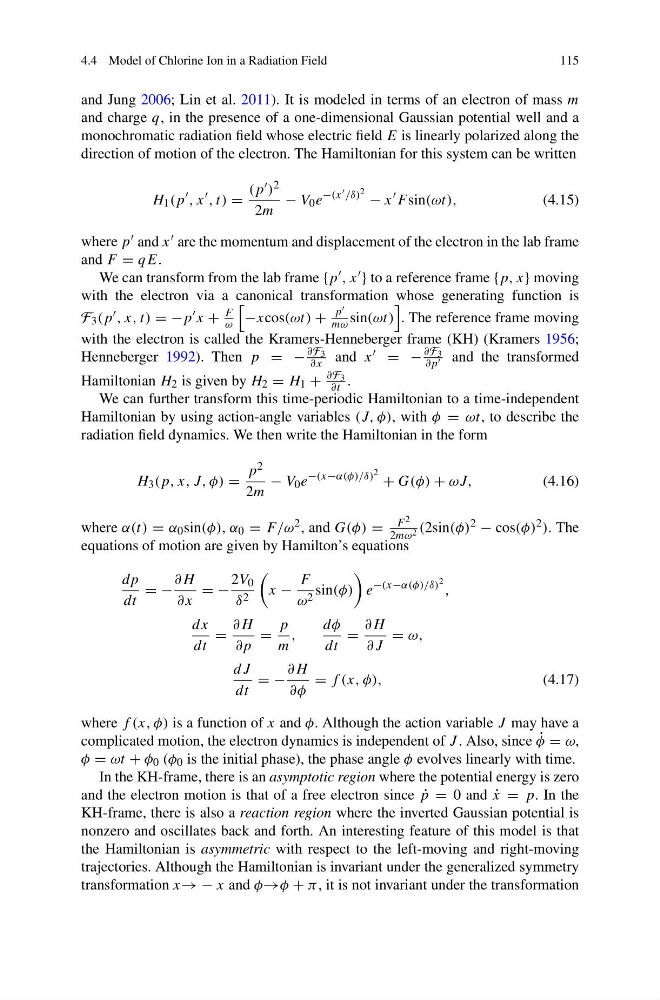
4.4 Model of Chlorine Ion in a Radiation Field
115
and Jung 2006; Lin et al. 2011). It is modeled in terms of an electron of mass m
and charge q, in the presence of a one-dimensional Gaussian potential well and a
monochromatic radiation field whose electric field E is linearly polarized along the
direction of motion of the electron. The Hamiltonian for this system can be written
H 1 (p
, x
, t) =
(p ) 2
2m
− V 0 e
−(x /δ) 2 − x
F sin(ωt),
(4.15)
where p and x are the momentum and displacement of the electron in the lab frame
and F = qE.
We can transform from the lab frame {p , x } to a reference frame {p, x} moving
with the electron via a canonical transformation whose generating function is
F 3 (p , x, t) = −p x +
F
ω
−xcos(ωt) +
p
mω sin(ωt)
. The reference frame moving
with the electron is called the Kramers-Henneberger frame (KH) (Kramers 1956;
Henneberger 1992). Then p = −
∂F 3
∂x and x = −
∂F 3
∂p and the transformed
Hamiltonian H 2 is given by H 2 = H 1 +
∂F 3
∂t .
We can further transform this time-periodic Hamiltonian to a time-independent
Hamiltonian by using action-angle variables (J, φ), with φ = ωt, to describe the
radiation field dynamics. We then write the Hamiltonian in the form
H 3 (p, x, J, φ) =
p 2
2m
− V 0 e
−(x−α(φ)/δ) 2 + G(φ) + ωJ,
(4.16)
where α(t) = α 0 sin(φ), α 0 = F /ω 2 , and G(φ) =
F 2
2mω 2 (2sin(φ) 2 − cos(φ) 2 ). The
equations of motion are given by Hamilton’s equations
dp
dt
= −
∂H
∂x
= −
2V 0
δ 2
x −
F
ω 2 sin(φ)
e
−(x−α(φ)/δ) 2
,
dx
dt
=
∂H
∂p
=
p
m
,
dφ
dt
=
∂H
∂J
= ω,
dJ
dt
= −
∂H
∂φ
= f (x, φ),
(4.17)
where f (x, φ) is a function of x and φ. Although the action variable J may have a
complicated motion, the electron dynamics is independent of J . Also, since ˙
φ = ω,
φ = ωt + φ 0 (φ 0 is the initial phase), the phase angle φ evolves linearly with time.
In the KH-frame, there is an asymptotic region where the potential energy is zero
and the electron motion is that of a free electron since ˙
p = 0 and ˙
x = p. In the
KH-frame, there is also a reaction region where the inverted Gaussian potential is
nonzero and oscillates back and forth. An interesting feature of this model is that
the Hamiltonian is asymmetric with respect to the left-moving and right-moving
trajectories. Although the Hamiltonian is invariant under the generalized symmetry
transformation x→ − x and φ→φ + π , it is not invariant under the transformation
115
and Jung 2006; Lin et al. 2011). It is modeled in terms of an electron of mass m
and charge q, in the presence of a one-dimensional Gaussian potential well and a
monochromatic radiation field whose electric field E is linearly polarized along the
direction of motion of the electron. The Hamiltonian for this system can be written
H 1 (p
, x
, t) =
(p ) 2
2m
− V 0 e
−(x /δ) 2 − x
F sin(ωt),
(4.15)
where p and x are the momentum and displacement of the electron in the lab frame
and F = qE.
We can transform from the lab frame {p , x } to a reference frame {p, x} moving
with the electron via a canonical transformation whose generating function is
F 3 (p , x, t) = −p x +
F
ω
−xcos(ωt) +
p
mω sin(ωt)
. The reference frame moving
with the electron is called the Kramers-Henneberger frame (KH) (Kramers 1956;
Henneberger 1992). Then p = −
∂F 3
∂x and x = −
∂F 3
∂p and the transformed
Hamiltonian H 2 is given by H 2 = H 1 +
∂F 3
∂t .
We can further transform this time-periodic Hamiltonian to a time-independent
Hamiltonian by using action-angle variables (J, φ), with φ = ωt, to describe the
radiation field dynamics. We then write the Hamiltonian in the form
H 3 (p, x, J, φ) =
p 2
2m
− V 0 e
−(x−α(φ)/δ) 2 + G(φ) + ωJ,
(4.16)
where α(t) = α 0 sin(φ), α 0 = F /ω 2 , and G(φ) =
F 2
2mω 2 (2sin(φ) 2 − cos(φ) 2 ). The
equations of motion are given by Hamilton’s equations
dp
dt
= −
∂H
∂x
= −
2V 0
δ 2
x −
F
ω 2 sin(φ)
e
−(x−α(φ)/δ) 2
,
dx
dt
=
∂H
∂p
=
p
m
,
dφ
dt
=
∂H
∂J
= ω,
dJ
dt
= −
∂H
∂φ
= f (x, φ),
(4.17)
where f (x, φ) is a function of x and φ. Although the action variable J may have a
complicated motion, the electron dynamics is independent of J . Also, since ˙
φ = ω,
φ = ωt + φ 0 (φ 0 is the initial phase), the phase angle φ evolves linearly with time.
In the KH-frame, there is an asymptotic region where the potential energy is zero
and the electron motion is that of a free electron since ˙
p = 0 and ˙
x = p. In the
KH-frame, there is also a reaction region where the inverted Gaussian potential is
nonzero and oscillates back and forth. An interesting feature of this model is that
the Hamiltonian is asymmetric with respect to the left-moving and right-moving
trajectories. Although the Hamiltonian is invariant under the generalized symmetry
transformation x→ − x and φ→φ + π , it is not invariant under the transformation