

114
4 Chaotic Scattering
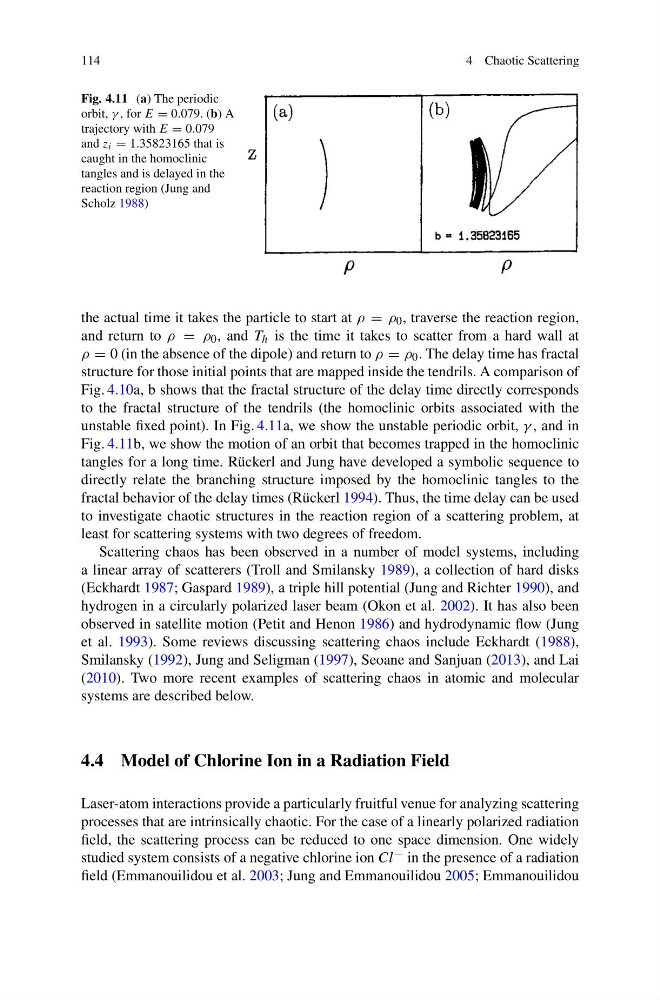
Fig. 4.11 (a) The periodic
orbit, γ , for E = 0.079. (b) A
trajectory with E = 0.079
and z i = 1.35823165 that is
caught in the homoclinic
tangles and is delayed in the
reaction region (Jung and
Scholz 1988)
the actual time it takes the particle to start at ρ = ρ 0 , traverse the reaction region,
and return to ρ = ρ 0 , and T h is the time it takes to scatter from a hard wall at
ρ = 0 (in the absence of the dipole) and return to ρ = ρ 0 . The delay time has fractal
structure for those initial points that are mapped inside the tendrils. A comparison of
Fig. 4.10a, b shows that the fractal structure of the delay time directly corresponds
to the fractal structure of the tendrils (the homoclinic orbits associated with the
unstable fixed point). In Fig. 4.11a, we show the unstable periodic orbit, γ , and in
Fig. 4.11b, we show the motion of an orbit that becomes trapped in the homoclinic
tangles for a long time. Rückerl and Jung have developed a symbolic sequence to
directly relate the branching structure imposed by the homoclinic tangles to the
fractal behavior of the delay times (Rückerl 1994). Thus, the time delay can be used
to investigate chaotic structures in the reaction region of a scattering problem, at
least for scattering systems with two degrees of freedom.
Scattering chaos has been observed in a number of model systems, including
a linear array of scatterers (Troll and Smilansky 1989), a collection of hard disks
(Eckhardt 1987; Gaspard 1989), a triple hill potential (Jung and Richter 1990), and
hydrogen in a circularly polarized laser beam (Okon et al. 2002). It has also been
observed in satellite motion (Petit and Henon 1986) and hydrodynamic flow (Jung
et al. 1993). Some reviews discussing scattering chaos include Eckhardt (1988),
Smilansky (1992), Jung and Seligman (1997), Seoane and Sanjuan (2013), and Lai
(2010). Two more recent examples of scattering chaos in atomic and molecular
systems are described below.
4.4 Model of Chlorine Ion in a Radiation Field
Laser-atom interactions provide a particularly fruitful venue for analyzing scattering
processes that are intrinsically chaotic. For the case of a linearly polarized radiation
field, the scattering process can be reduced to one space dimension. One widely
studied system consists of a negative chlorine ion Cl − in the presence of a radiation
field (Emmanouilidou et al. 2003; Jung and Emmanouilidou 2005; Emmanouilidou
4 Chaotic Scattering
Fig. 4.11 (a) The periodic
orbit, γ , for E = 0.079. (b) A
trajectory with E = 0.079
and z i = 1.35823165 that is
caught in the homoclinic
tangles and is delayed in the
reaction region (Jung and
Scholz 1988)
the actual time it takes the particle to start at ρ = ρ 0 , traverse the reaction region,
and return to ρ = ρ 0 , and T h is the time it takes to scatter from a hard wall at
ρ = 0 (in the absence of the dipole) and return to ρ = ρ 0 . The delay time has fractal
structure for those initial points that are mapped inside the tendrils. A comparison of
Fig. 4.10a, b shows that the fractal structure of the delay time directly corresponds
to the fractal structure of the tendrils (the homoclinic orbits associated with the
unstable fixed point). In Fig. 4.11a, we show the unstable periodic orbit, γ , and in
Fig. 4.11b, we show the motion of an orbit that becomes trapped in the homoclinic
tangles for a long time. Rückerl and Jung have developed a symbolic sequence to
directly relate the branching structure imposed by the homoclinic tangles to the
fractal behavior of the delay times (Rückerl 1994). Thus, the time delay can be used
to investigate chaotic structures in the reaction region of a scattering problem, at
least for scattering systems with two degrees of freedom.
Scattering chaos has been observed in a number of model systems, including
a linear array of scatterers (Troll and Smilansky 1989), a collection of hard disks
(Eckhardt 1987; Gaspard 1989), a triple hill potential (Jung and Richter 1990), and
hydrogen in a circularly polarized laser beam (Okon et al. 2002). It has also been
observed in satellite motion (Petit and Henon 1986) and hydrodynamic flow (Jung
et al. 1993). Some reviews discussing scattering chaos include Eckhardt (1988),
Smilansky (1992), Jung and Seligman (1997), Seoane and Sanjuan (2013), and Lai
(2010). Two more recent examples of scattering chaos in atomic and molecular
systems are described below.
4.4 Model of Chlorine Ion in a Radiation Field
Laser-atom interactions provide a particularly fruitful venue for analyzing scattering
processes that are intrinsically chaotic. For the case of a linearly polarized radiation
field, the scattering process can be reduced to one space dimension. One widely
studied system consists of a negative chlorine ion Cl − in the presence of a radiation
field (Emmanouilidou et al. 2003; Jung and Emmanouilidou 2005; Emmanouilidou