

3.8 Renormalization Map
91
the fixed points of the map. We will first find the fixed points of the map, Eq. (3.85),
for the relative wave number, and then we will use these results to compute the fixed
points of the amplitude map, Eq. (3.93).
The map of ν α between successive scales is given by Eq. (3.85). We shall
consider Eq. (3.85) for the special case that gives us the noble KAM tori. We assume
that at each level we always take the same pair of resonances. That is, we set n α = n
for all scales.
Relative Wave Number Fixed Point
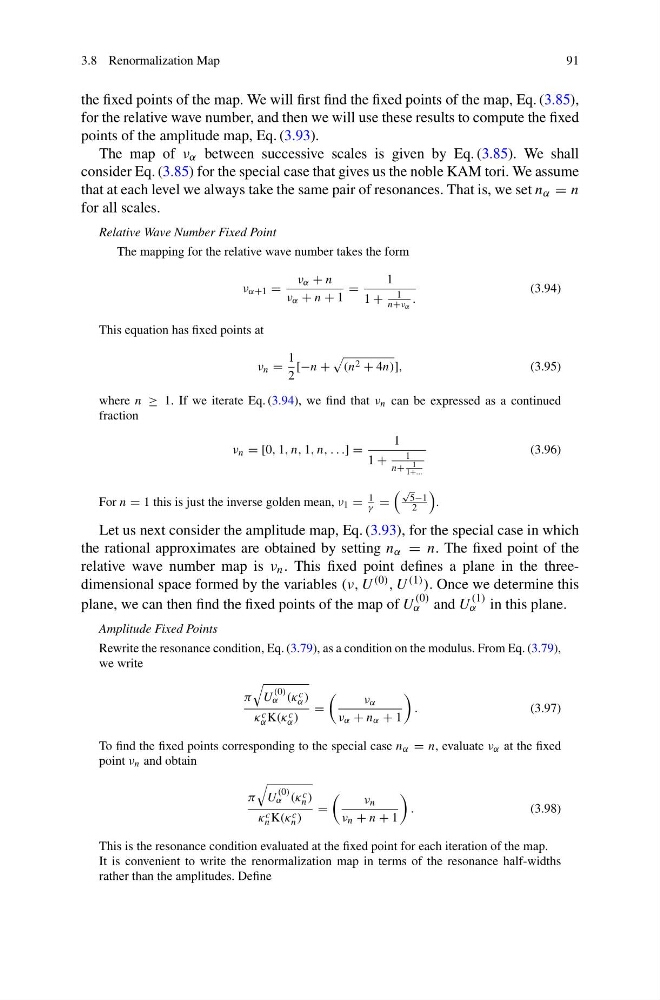
The mapping for the relative wave number takes the form
ν α+1 =
ν α + n
ν α + n + 1
=
1
1 +
1
n+να .
(3.94)
This equation has fixed points at
ν n =
1
2
[−n +
(n 2 + 4n)],
(3.95)
where n ≥ 1. If we iterate Eq. (3.94), we find that ν n can be expressed as a continued
fraction
ν n = [0, 1, n, 1, n, . . .] =
1
1 +
1
n+
1
1+...
(3.96)
For n = 1 this is just the inverse golden mean, ν 1 =
1
γ =
√
5−1
2
.
Let us next consider the amplitude map, Eq. (3.93), for the special case in which
the rational approximates are obtained by setting n α = n. The fixed point of the
relative wave number map is ν n . This fixed point defines a plane in the threedimensional space formed by the variables (ν, U (0) , U (1) ). Once we determine this
plane, we can then find the fixed points of the map of U
(0)
α and U
(1)
α in this plane.
Amplitude Fixed Points
Rewrite the resonance condition, Eq. (3.79), as a condition on the modulus. From Eq. (3.79),
we write
π
U
(0)
α (κ c
α )
κ c
α K(κ c
α )
=
ν α
ν α + n α + 1
.
(3.97)
To find the fixed points corresponding to the special case n α = n, evaluate ν α at the fixed
point ν n and obtain
π
U
(0)
α (κ c
n )
κ c
n K(κ c
n )
=
ν n
ν n + n + 1
.
(3.98)
This is the resonance condition evaluated at the fixed point for each iteration of the map.
It is convenient to write the renormalization map in terms of the resonance half-widths
rather than the amplitudes. Define
91
the fixed points of the map. We will first find the fixed points of the map, Eq. (3.85),
for the relative wave number, and then we will use these results to compute the fixed
points of the amplitude map, Eq. (3.93).
The map of ν α between successive scales is given by Eq. (3.85). We shall
consider Eq. (3.85) for the special case that gives us the noble KAM tori. We assume
that at each level we always take the same pair of resonances. That is, we set n α = n
for all scales.
Relative Wave Number Fixed Point
The mapping for the relative wave number takes the form
ν α+1 =
ν α + n
ν α + n + 1
=
1
1 +
1
n+να .
(3.94)
This equation has fixed points at
ν n =
1
2
[−n +
(n 2 + 4n)],
(3.95)
where n ≥ 1. If we iterate Eq. (3.94), we find that ν n can be expressed as a continued
fraction
ν n = [0, 1, n, 1, n, . . .] =
1
1 +
1
n+
1
1+...
(3.96)
For n = 1 this is just the inverse golden mean, ν 1 =
1
γ =
√
5−1
2
.
Let us next consider the amplitude map, Eq. (3.93), for the special case in which
the rational approximates are obtained by setting n α = n. The fixed point of the
relative wave number map is ν n . This fixed point defines a plane in the threedimensional space formed by the variables (ν, U (0) , U (1) ). Once we determine this
plane, we can then find the fixed points of the map of U
(0)
α and U
(1)
α in this plane.
Amplitude Fixed Points
Rewrite the resonance condition, Eq. (3.79), as a condition on the modulus. From Eq. (3.79),
we write
π
U
(0)
α (κ c
α )
κ c
α K(κ c
α )
=
ν α
ν α + n α + 1
.
(3.97)
To find the fixed points corresponding to the special case n α = n, evaluate ν α at the fixed
point ν n and obtain
π
U
(0)
α (κ c
n )
κ c
n K(κ c
n )
=
ν n
ν n + n + 1
.
(3.98)
This is the resonance condition evaluated at the fixed point for each iteration of the map.
It is convenient to write the renormalization map in terms of the resonance half-widths
rather than the amplitudes. Define