

the Eulerian photochemical model REMSAD (S.A.I. 1998) and sensitivity simulations were performed with the same modelling tool to identify and quantify source
contribution.
An interesting point in the AQP for Athens was that different emission reduction
scenarios were evaluated both for the urban scale (using the OFIS model) as well as
for particular hot spots due to local traffic emissions (using the OSPM model). In
this way it was shown that a further emission reduction is required in order to
comply with standards at the local scale (i.e. to reduce number of exceedances), on
top of the emission reduction that is necessary to comply with annual limit values.
An optimization procedure was not performed. A thorough Multiple Criteria
Analysis using the ELECTRE III method (Roy 1968) was applied in order to
identify the most suitable set of abatement measures. Parameters such as the public
cost, public acceptance and socio-economic impacts were considered.
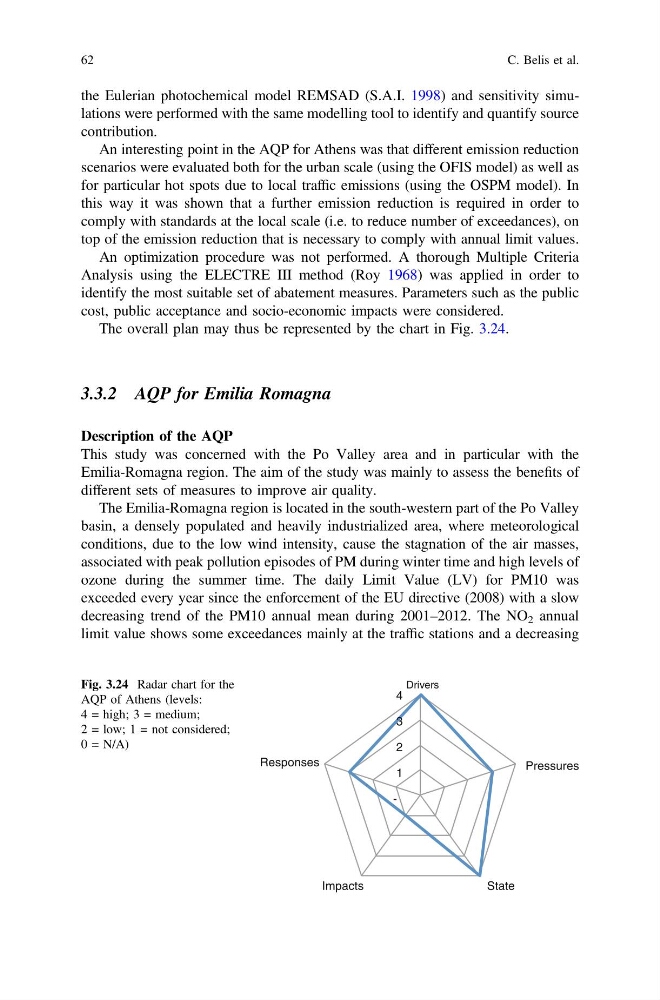
The overall plan may thus be represented by the chart in Fig. 3.24.
3.3.2 AQP for Emilia Romagna
Description of the AQP
This study was concerned with the Po Valley area and in particular with the
Emilia-Romagna region. The aim of the study was mainly to assess the benefits of
different sets of measures to improve air quality.
The Emilia-Romagna region is located in the south-western part of the Po Valley
basin, a densely populated and heavily industrialized area, where meteorological
conditions, due to the low wind intensity, cause the stagnation of the air masses,
associated with peak pollution episodes of PM during winter time and high levels of
ozone during the summer time. The daily Limit Value (LV) for PM10 was
exceeded every year since the enforcement of the EU directive (2008) with a slow
decreasing trend of the PM10 annual mean during 2001–2012. The NO 2 annual
limit value shows some exceedances mainly at the traffic stations and a decreasing
-
1
2
3
4
Drivers
Pressures
State
Impacts
Responses
Fig. 3.24 Radar chart for the
AQP of Athens (levels:
4 = high; 3 = medium;
2 = low; 1 = not considered;
0 = N/A)
62
C. Belis et al.
contribution.
An interesting point in the AQP for Athens was that different emission reduction
scenarios were evaluated both for the urban scale (using the OFIS model) as well as
for particular hot spots due to local traffic emissions (using the OSPM model). In
this way it was shown that a further emission reduction is required in order to
comply with standards at the local scale (i.e. to reduce number of exceedances), on
top of the emission reduction that is necessary to comply with annual limit values.
An optimization procedure was not performed. A thorough Multiple Criteria
Analysis using the ELECTRE III method (Roy 1968) was applied in order to
identify the most suitable set of abatement measures. Parameters such as the public
cost, public acceptance and socio-economic impacts were considered.
The overall plan may thus be represented by the chart in Fig. 3.24.
3.3.2 AQP for Emilia Romagna
Description of the AQP
This study was concerned with the Po Valley area and in particular with the
Emilia-Romagna region. The aim of the study was mainly to assess the benefits of
different sets of measures to improve air quality.
The Emilia-Romagna region is located in the south-western part of the Po Valley
basin, a densely populated and heavily industrialized area, where meteorological
conditions, due to the low wind intensity, cause the stagnation of the air masses,
associated with peak pollution episodes of PM during winter time and high levels of
ozone during the summer time. The daily Limit Value (LV) for PM10 was
exceeded every year since the enforcement of the EU directive (2008) with a slow
decreasing trend of the PM10 annual mean during 2001–2012. The NO 2 annual
limit value shows some exceedances mainly at the traffic stations and a decreasing
-
1
2
3
4
Drivers
Pressures
State
Impacts
Responses
Fig. 3.24 Radar chart for the
AQP of Athens (levels:
4 = high; 3 = medium;
2 = low; 1 = not considered;
0 = N/A)
62
C. Belis et al.