

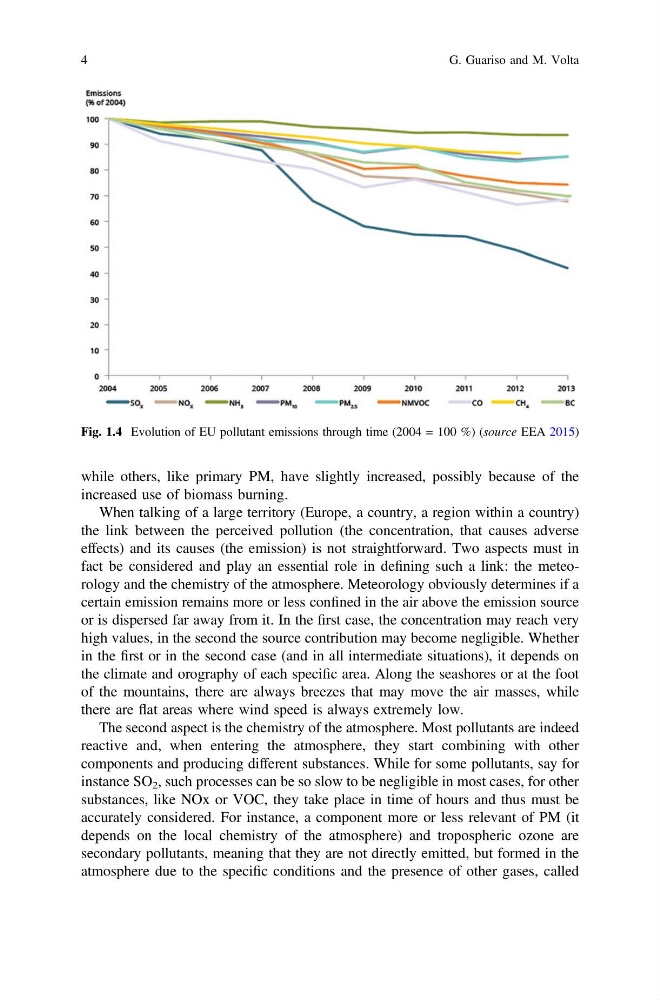
while others, like primary PM, have slightly increased, possibly because of the
increased use of biomass burning.
When talking of a large territory (Europe, a country, a region within a country)
the link between the perceived pollution (the concentration, that causes adverse
effects) and its causes (the emission) is not straightforward. Two aspects must in
fact be considered and play an essential role in defining such a link: the meteorology and the chemistry of the atmosphere. Meteorology obviously determines if a
certain emission remains more or less confined in the air above the emission source
or is dispersed far away from it. In the first case, the concentration may reach very
high values, in the second the source contribution may become negligible. Whether
in the first or in the second case (and in all intermediate situations), it depends on
the climate and orography of each specific area. Along the seashores or at the foot
of the mountains, there are always breezes that may move the air masses, while
there are flat areas where wind speed is always extremely low.
The second aspect is the chemistry of the atmosphere. Most pollutants are indeed
reactive and, when entering the atmosphere, they start combining with other
components and producing different substances. While for some pollutants, say for
instance SO 2 , such processes can be so slow to be negligible in most cases, for other
substances, like NOx or VOC, they take place in time of hours and thus must be
accurately considered. For instance, a component more or less relevant of PM (it
depends on the local chemistry of the atmosphere) and tropospheric ozone are
secondary pollutants, meaning that they are not directly emitted, but formed in the
atmosphere due to the specific conditions and the presence of other gases, called
Fig. 1.4 Evolution of EU pollutant emissions through time (2004 = 100 %) (source EEA 2015)
4
G. Guariso and M. Volta
increased use of biomass burning.
When talking of a large territory (Europe, a country, a region within a country)
the link between the perceived pollution (the concentration, that causes adverse
effects) and its causes (the emission) is not straightforward. Two aspects must in
fact be considered and play an essential role in defining such a link: the meteorology and the chemistry of the atmosphere. Meteorology obviously determines if a
certain emission remains more or less confined in the air above the emission source
or is dispersed far away from it. In the first case, the concentration may reach very
high values, in the second the source contribution may become negligible. Whether
in the first or in the second case (and in all intermediate situations), it depends on
the climate and orography of each specific area. Along the seashores or at the foot
of the mountains, there are always breezes that may move the air masses, while
there are flat areas where wind speed is always extremely low.
The second aspect is the chemistry of the atmosphere. Most pollutants are indeed
reactive and, when entering the atmosphere, they start combining with other
components and producing different substances. While for some pollutants, say for
instance SO 2 , such processes can be so slow to be negligible in most cases, for other
substances, like NOx or VOC, they take place in time of hours and thus must be
accurately considered. For instance, a component more or less relevant of PM (it
depends on the local chemistry of the atmosphere) and tropospheric ozone are
secondary pollutants, meaning that they are not directly emitted, but formed in the
atmosphere due to the specific conditions and the presence of other gases, called
Fig. 1.4 Evolution of EU pollutant emissions through time (2004 = 100 %) (source EEA 2015)
4
G. Guariso and M. Volta