

64
N. Crampé and A. M. Grundland
X k+1 = X k − i
S + P k S −
tr(S + P k S − )
+ P k −
2
2s + 1
I
,
X k−1 = X k + i
S − P k S +
tr(S − P k S + )
+ P k −
2
2s + 1
I
.
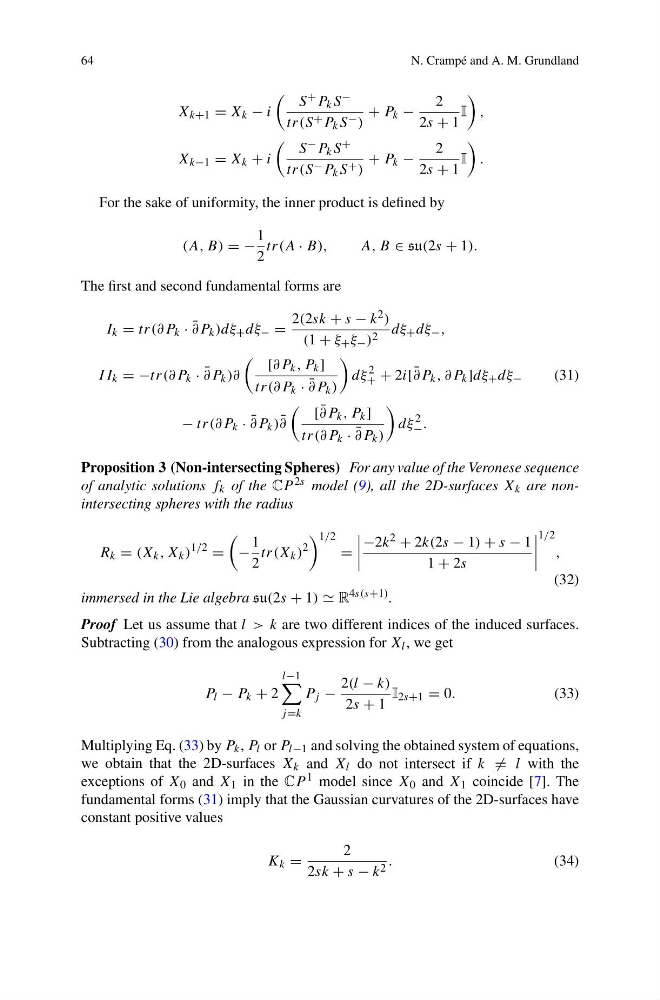
For the sake of uniformity, the inner product is defined by
(A, B) = −
1
2
tr(A · B),
A, B ∈ su(2s + 1).
The first and second fundamental forms are
I k = tr(∂P k · ¯
∂P k )dξ + dξ − =
2(2sk + s − k 2 )
(1 + ξ + ξ − ) 2 dξ + dξ − ,
I I k = −tr(∂P k · ¯
∂P k )∂
[∂P k , P k ]
tr(∂P k · ¯
∂P k )
dξ
2
+ + 2i[ ¯
∂P k , ∂P k ]dξ + dξ −
(31)
− tr(∂P k · ¯
∂P k ) ¯
∂
[ ¯
∂P k , P k ]
tr(∂P k · ¯
∂P k )
dξ
2
− .
Proposition 3 (Non-intersecting Spheres) For any value of the Veronese sequence
of analytic solutions f k of the CP 2s model (9), all the 2D-surfaces X k are nonintersecting spheres with the radius
R k = (X k , X k )
1/2
=
−
1
2
tr(X k )
2
1/2
=
−2k 2 + 2k(2s − 1) + s − 1
1 + 2s
1/2
,
(32)
immersed in the Lie algebra su(2s + 1) R 4s(s+1) .
Proof Let us assume that l > k are two different indices of the induced surfaces.
Subtracting (30) from the analogous expression for X l , we get
P l − P k + 2
l−1
j =k
P j −
2(l − k)
2s + 1
I 2s+1 = 0.
(33)
Multiplying Eq. (33) by P k , P l or P l−1 and solving the obtained system of equations,
we obtain that the 2D-surfaces X k and X l do not intersect if k = l with the
exceptions of X 0 and X 1 in the CP 1 model since X 0 and X 1 coincide [7]. The
fundamental forms (31) imply that the Gaussian curvatures of the 2D-surfaces have
constant positive values
K k =
2
2sk + s − k 2 .
(34)
N. Crampé and A. M. Grundland
X k+1 = X k − i
S + P k S −
tr(S + P k S − )
+ P k −
2
2s + 1
I
,
X k−1 = X k + i
S − P k S +
tr(S − P k S + )
+ P k −
2
2s + 1
I
.
For the sake of uniformity, the inner product is defined by
(A, B) = −
1
2
tr(A · B),
A, B ∈ su(2s + 1).
The first and second fundamental forms are
I k = tr(∂P k · ¯
∂P k )dξ + dξ − =
2(2sk + s − k 2 )
(1 + ξ + ξ − ) 2 dξ + dξ − ,
I I k = −tr(∂P k · ¯
∂P k )∂
[∂P k , P k ]
tr(∂P k · ¯
∂P k )
dξ
2
+ + 2i[ ¯
∂P k , ∂P k ]dξ + dξ −
(31)
− tr(∂P k · ¯
∂P k ) ¯
∂
[ ¯
∂P k , P k ]
tr(∂P k · ¯
∂P k )
dξ
2
− .
Proposition 3 (Non-intersecting Spheres) For any value of the Veronese sequence
of analytic solutions f k of the CP 2s model (9), all the 2D-surfaces X k are nonintersecting spheres with the radius
R k = (X k , X k )
1/2
=
−
1
2
tr(X k )
2
1/2
=
−2k 2 + 2k(2s − 1) + s − 1
1 + 2s
1/2
,
(32)
immersed in the Lie algebra su(2s + 1) R 4s(s+1) .
Proof Let us assume that l > k are two different indices of the induced surfaces.
Subtracting (30) from the analogous expression for X l , we get
P l − P k + 2
l−1
j =k
P j −
2(l − k)
2s + 1
I 2s+1 = 0.
(33)
Multiplying Eq. (33) by P k , P l or P l−1 and solving the obtained system of equations,
we obtain that the 2D-surfaces X k and X l do not intersect if k = l with the
exceptions of X 0 and X 1 in the CP 1 model since X 0 and X 1 coincide [7]. The
fundamental forms (31) imply that the Gaussian curvatures of the 2D-surfaces have
constant positive values
K k =
2
2sk + s − k 2 .
(34)