

The Veronese Sequence of Analytic Solutions of the CP 2s Sigma Model. . .
63
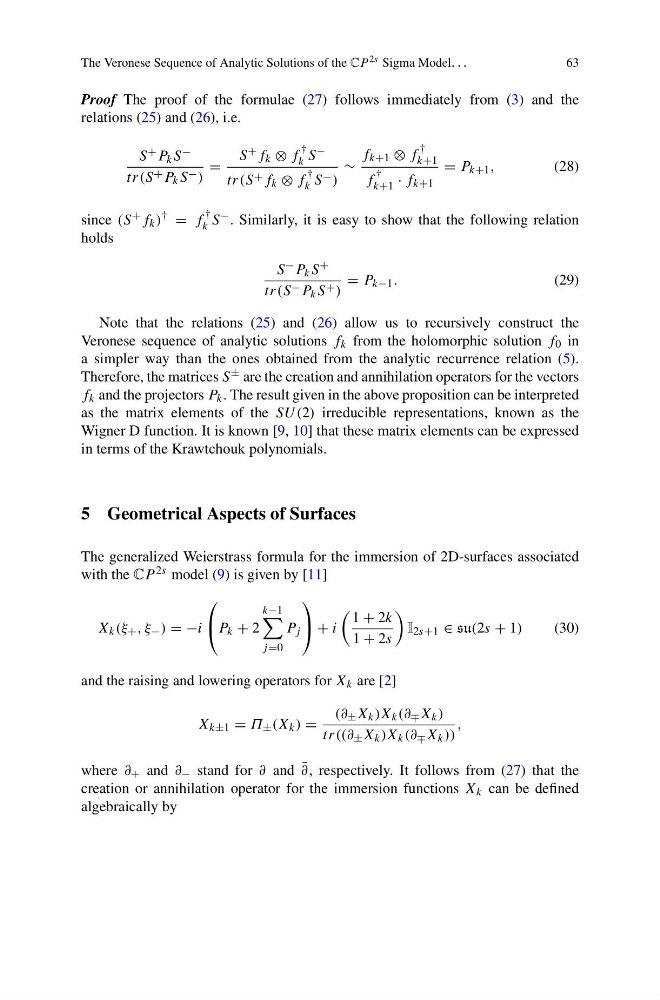
Proof The proof of the formulae (27) follows immediately from (3) and the
relations (25) and (26), i.e.
S + P k S −
tr(S + P k S − )
=
S + f k ⊗ f
†
k S −
tr(S + f k ⊗ f
†
k S − )
∼
f k+1 ⊗ f
†
k+1
f
†
k+1 · f k+1
= P k+1 ,
(28)
since (S + f k ) † = f
†
k S − . Similarly, it is easy to show that the following relation
holds
S − P k S +
tr(S − P k S + )
= P k−1 .
(29)
Note that the relations (25) and (26) allow us to recursively construct the
Veronese sequence of analytic solutions f k from the holomorphic solution f 0 in
a simpler way than the ones obtained from the analytic recurrence relation (5).
Therefore, the matrices S ± are the creation and annihilation operators for the vectors
f k and the projectors P k . The result given in the above proposition can be interpreted
as the matrix elements of the SU (2) irreducible representations, known as the
Wigner D function. It is known [9, 10] that these matrix elements can be expressed
in terms of the Krawtchouk polynomials.
5 Geometrical Aspects of Surfaces
The generalized Weierstrass formula for the immersion of 2D-surfaces associated
with the CP 2s model (9) is given by [11]
X k (ξ + , ξ − ) = −i
⎛
⎝ P k + 2
k−1
j =0
P j
⎞
⎠ + i
1 + 2k
1 + 2s
I 2s+1 ∈ su(2s + 1)
(30)
and the raising and lowering operators for X k are [2]
X k±1 = Π ± (X k ) =
(∂ ± X k )X k (∂ ∓ X k )
tr((∂ ± X k )X k (∂ ∓ X k ))
,
where ∂ + and ∂ − stand for ∂ and ¯
∂, respectively. It follows from (27) that the
creation or annihilation operator for the immersion functions X k can be defined
algebraically by
63
Proof The proof of the formulae (27) follows immediately from (3) and the
relations (25) and (26), i.e.
S + P k S −
tr(S + P k S − )
=
S + f k ⊗ f
†
k S −
tr(S + f k ⊗ f
†
k S − )
∼
f k+1 ⊗ f
†
k+1
f
†
k+1 · f k+1
= P k+1 ,
(28)
since (S + f k ) † = f
†
k S − . Similarly, it is easy to show that the following relation
holds
S − P k S +
tr(S − P k S + )
= P k−1 .
(29)
Note that the relations (25) and (26) allow us to recursively construct the
Veronese sequence of analytic solutions f k from the holomorphic solution f 0 in
a simpler way than the ones obtained from the analytic recurrence relation (5).
Therefore, the matrices S ± are the creation and annihilation operators for the vectors
f k and the projectors P k . The result given in the above proposition can be interpreted
as the matrix elements of the SU (2) irreducible representations, known as the
Wigner D function. It is known [9, 10] that these matrix elements can be expressed
in terms of the Krawtchouk polynomials.
5 Geometrical Aspects of Surfaces
The generalized Weierstrass formula for the immersion of 2D-surfaces associated
with the CP 2s model (9) is given by [11]
X k (ξ + , ξ − ) = −i
⎛
⎝ P k + 2
k−1
j =0
P j
⎞
⎠ + i
1 + 2k
1 + 2s
I 2s+1 ∈ su(2s + 1)
(30)
and the raising and lowering operators for X k are [2]
X k±1 = Π ± (X k ) =
(∂ ± X k )X k (∂ ∓ X k )
tr((∂ ± X k )X k (∂ ∓ X k ))
,
where ∂ + and ∂ − stand for ∂ and ¯
∂, respectively. It follows from (27) that the
creation or annihilation operator for the immersion functions X k can be defined
algebraically by