

Painlevé IV Transcendents Generated from the Complex Oscillator
49
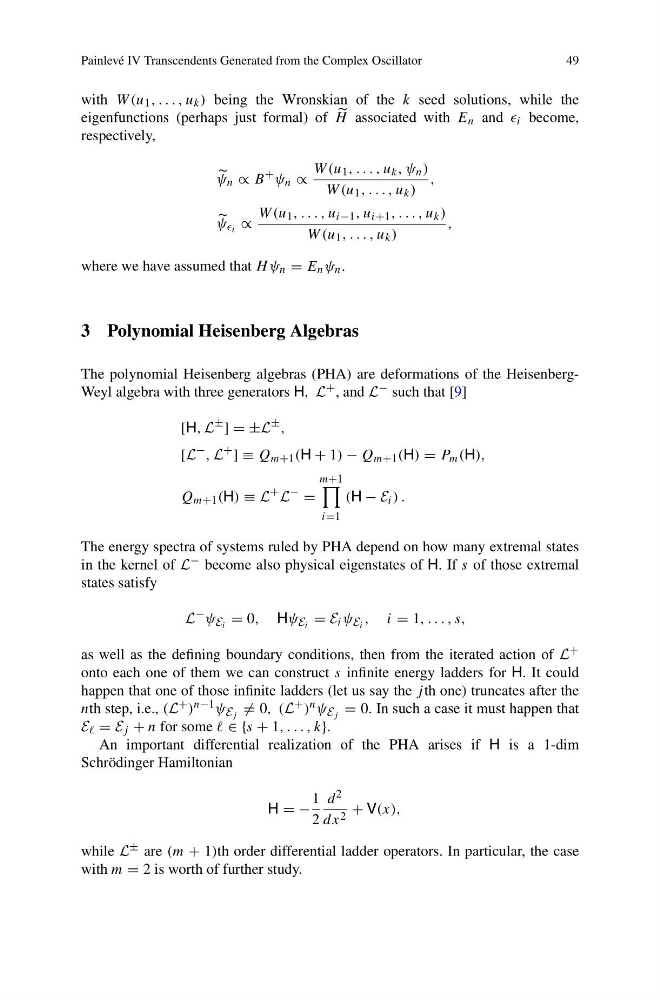
with W (u 1 , . . . , u k ) being the Wronskian of the k seed solutions, while the
eigenfunctions (perhaps just formal) of
H associated with E n and i become,
respectively,
ψ n ∝ B
+ ψ n ∝
W (u 1 , . . . , u k , ψ n )
W (u 1 , . . . , u k )
,
ψ i ∝
W (u 1 , . . . , u i−1 , u i+1 , . . . , u k )
W (u 1 , . . . , u k )
,
where we have assumed that H ψ n = E n ψ n .
3 Polynomial Heisenberg Algebras
The polynomial Heisenberg algebras (PHA) are deformations of the HeisenbergWeyl algebra with three generators H, L + , and L − such that [9]
[H, L
±
] = ±L
± ,
[L
− , L
+
] ≡ Q m+1 (H + 1) − Q m+1 (H) = P m (H),
Q m+1 (H) ≡ L
+
L
−
=
m+1
i=1
(H − E i ) .
The energy spectra of systems ruled by PHA depend on how many extremal states
in the kernel of L − become also physical eigenstates of H. If s of those extremal
states satisfy
L
− ψ E i = 0, Hψ E i = E i ψ E i , i = 1, . . . , s,
as well as the defining boundary conditions, then from the iterated action of L +
onto each one of them we can construct s infinite energy ladders for H. It could
happen that one of those infinite ladders (let us say the j th one) truncates after the
nth step, i.e., (L + ) n−1 ψ E j = 0, (L + ) n ψ E j = 0. In such a case it must happen that
E = E j + n for some ∈ {s + 1, . . . , k}.
An important differential realization of the PHA arises if H is a 1-dim
Schrödinger Hamiltonian
H = −
1
2
d 2
dx 2 + V(x),
while L ± are (m + 1)th order differential ladder operators. In particular, the case
with m = 2 is worth of further study.
49
with W (u 1 , . . . , u k ) being the Wronskian of the k seed solutions, while the
eigenfunctions (perhaps just formal) of
H associated with E n and i become,
respectively,
ψ n ∝ B
+ ψ n ∝
W (u 1 , . . . , u k , ψ n )
W (u 1 , . . . , u k )
,
ψ i ∝
W (u 1 , . . . , u i−1 , u i+1 , . . . , u k )
W (u 1 , . . . , u k )
,
where we have assumed that H ψ n = E n ψ n .
3 Polynomial Heisenberg Algebras
The polynomial Heisenberg algebras (PHA) are deformations of the HeisenbergWeyl algebra with three generators H, L + , and L − such that [9]
[H, L
±
] = ±L
± ,
[L
− , L
+
] ≡ Q m+1 (H + 1) − Q m+1 (H) = P m (H),
Q m+1 (H) ≡ L
+
L
−
=
m+1
i=1
(H − E i ) .
The energy spectra of systems ruled by PHA depend on how many extremal states
in the kernel of L − become also physical eigenstates of H. If s of those extremal
states satisfy
L
− ψ E i = 0, Hψ E i = E i ψ E i , i = 1, . . . , s,
as well as the defining boundary conditions, then from the iterated action of L +
onto each one of them we can construct s infinite energy ladders for H. It could
happen that one of those infinite ladders (let us say the j th one) truncates after the
nth step, i.e., (L + ) n−1 ψ E j = 0, (L + ) n ψ E j = 0. In such a case it must happen that
E = E j + n for some ∈ {s + 1, . . . , k}.
An important differential realization of the PHA arises if H is a 1-dim
Schrödinger Hamiltonian
H = −
1
2
d 2
dx 2 + V(x),
while L ± are (m + 1)th order differential ladder operators. In particular, the case
with m = 2 is worth of further study.