

640
M. Zaimi et al.
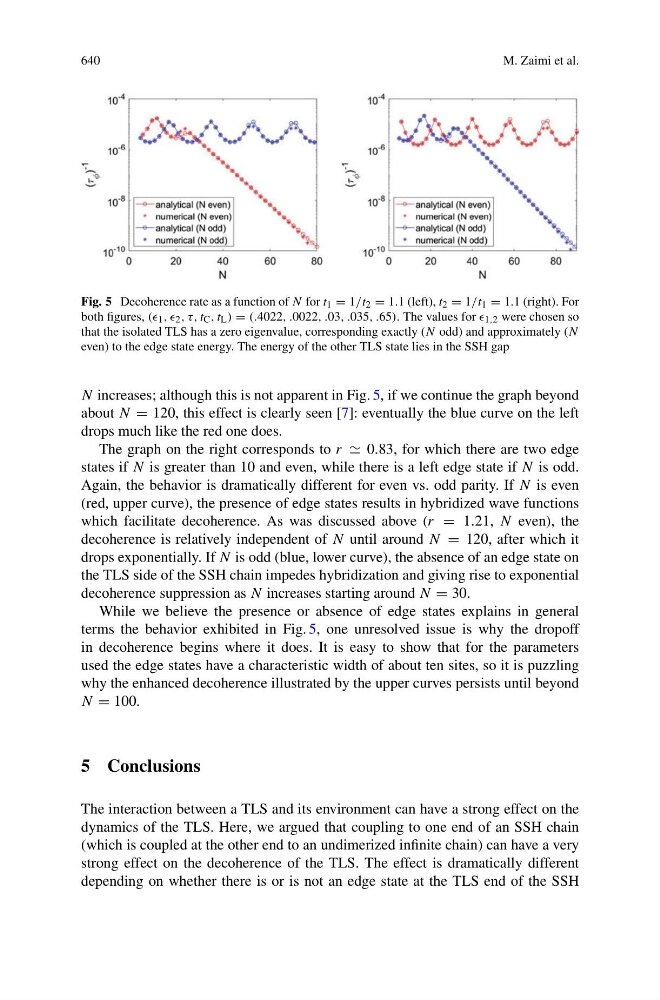
Fig. 5 Decoherence rate as a function of N for t 1 = 1/t 2 = 1.1 (left), t 2 = 1/t 1 = 1.1 (right). For
both figures, (( 1 , , 2 , τ, t C , t L ) = (.4022, .0022, .03, .035, .65). The values for 1,2 were chosen so
that the isolated TLS has a zero eigenvalue, corresponding exactly (N odd) and approximately (N
even) to the edge state energy. The energy of the other TLS state lies in the SSH gap
N increases; although this is not apparent in Fig. 5, if we continue the graph beyond
about N = 120, this effect is clearly seen [7]: eventually the blue curve on the left
drops much like the red one does.
The graph on the right corresponds to r 0.83, for which there are two edge
states if N is greater than 10 and even, while there is a left edge state if N is odd.
Again, the behavior is dramatically different for even vs. odd parity. If N is even
(red, upper curve), the presence of edge states results in hybridized wave functions
which facilitate decoherence. As was discussed above (r = 1.21, N even), the
decoherence is relatively independent of N until around N = 120, after which it
drops exponentially. If N is odd (blue, lower curve), the absence of an edge state on
the TLS side of the SSH chain impedes hybridization and giving rise to exponential
decoherence suppression as N increases starting around N = 30.
While we believe the presence or absence of edge states explains in general
terms the behavior exhibited in Fig. 5, one unresolved issue is why the dropoff
in decoherence begins where it does. It is easy to show that for the parameters
used the edge states have a characteristic width of about ten sites, so it is puzzling
why the enhanced decoherence illustrated by the upper curves persists until beyond
N = 100.
5 Conclusions
The interaction between a TLS and its environment can have a strong effect on the
dynamics of the TLS. Here, we argued that coupling to one end of an SSH chain
(which is coupled at the other end to an undimerized infinite chain) can have a very
strong effect on the decoherence of the TLS. The effect is dramatically different
depending on whether there is or is not an edge state at the TLS end of the SSH
M. Zaimi et al.
Fig. 5 Decoherence rate as a function of N for t 1 = 1/t 2 = 1.1 (left), t 2 = 1/t 1 = 1.1 (right). For
both figures, (( 1 , , 2 , τ, t C , t L ) = (.4022, .0022, .03, .035, .65). The values for 1,2 were chosen so
that the isolated TLS has a zero eigenvalue, corresponding exactly (N odd) and approximately (N
even) to the edge state energy. The energy of the other TLS state lies in the SSH gap
N increases; although this is not apparent in Fig. 5, if we continue the graph beyond
about N = 120, this effect is clearly seen [7]: eventually the blue curve on the left
drops much like the red one does.
The graph on the right corresponds to r 0.83, for which there are two edge
states if N is greater than 10 and even, while there is a left edge state if N is odd.
Again, the behavior is dramatically different for even vs. odd parity. If N is even
(red, upper curve), the presence of edge states results in hybridized wave functions
which facilitate decoherence. As was discussed above (r = 1.21, N even), the
decoherence is relatively independent of N until around N = 120, after which it
drops exponentially. If N is odd (blue, lower curve), the absence of an edge state on
the TLS side of the SSH chain impedes hybridization and giving rise to exponential
decoherence suppression as N increases starting around N = 30.
While we believe the presence or absence of edge states explains in general
terms the behavior exhibited in Fig. 5, one unresolved issue is why the dropoff
in decoherence begins where it does. It is easy to show that for the parameters
used the edge states have a characteristic width of about ten sites, so it is puzzling
why the enhanced decoherence illustrated by the upper curves persists until beyond
N = 100.
5 Conclusions
The interaction between a TLS and its environment can have a strong effect on the
dynamics of the TLS. Here, we argued that coupling to one end of an SSH chain
(which is coupled at the other end to an undimerized infinite chain) can have a very
strong effect on the decoherence of the TLS. The effect is dramatically different
depending on whether there is or is not an edge state at the TLS end of the SSH