

Qubits as Edge State Detectors: Illustration Using the SSH Model
639
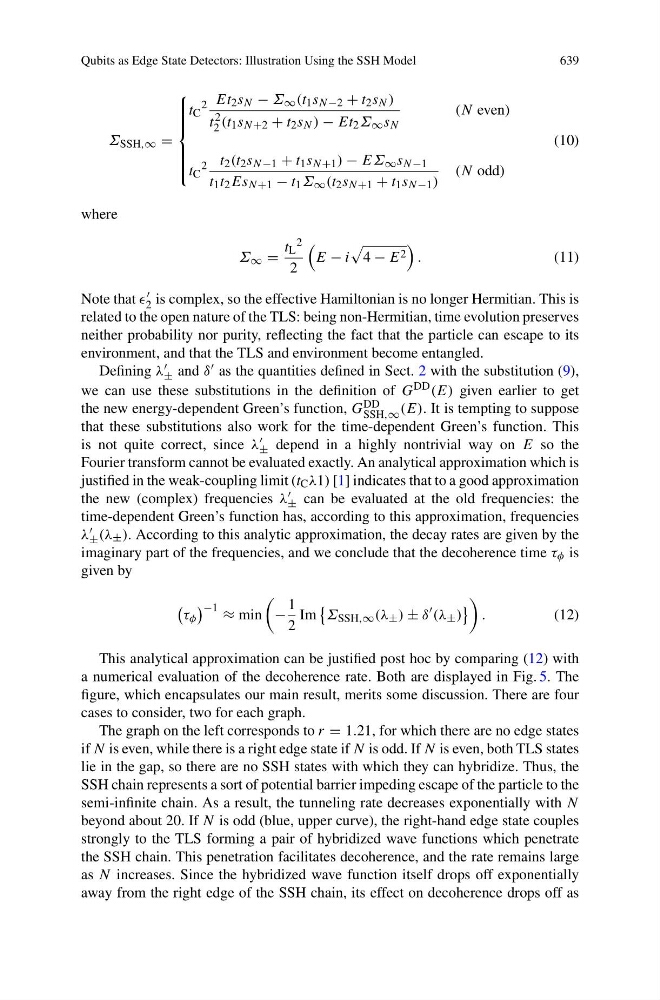
Σ SSH,∞ =
⎧
⎪ ⎪ ⎪ ⎪ ⎨
⎪ ⎪ ⎪ ⎪ ⎩
t C
2 Et 2 s N − Σ ∞ (t 1 s N −2 + t 2 s N )
t 2
2 (t 1 s N +2 + t 2 s N ) − Et 2 Σ ∞ s N
(N even)
t C
2 t 2 (t 2 s N −1 + t 1 s N +1 ) − EΣ ∞ s N −1
t 1 t 2 Es N +1 − t 1 Σ ∞ (t 2 s N +1 + t 1 s N −1 )
(N odd)
(10)
where
Σ ∞ =
t L
2
2
E − i
4 − E 2
.
(11)
Note that
2 is complex, so the effective Hamiltonian is no longer Hermitian. This is
related to the open nature of the TLS: being non-Hermitian, time evolution preserves
neither probability nor purity, reflecting the fact that the particle can escape to its
environment, and that the TLS and environment become entangled.
Defining λ
± and δ as the quantities defined in Sect. 2 with the substitution (9),
we can use these substitutions in the definition of G DD (E) given earlier to get
the new energy-dependent Green’s function, G DD
SSH,∞ (E). It is tempting to suppose
that these substitutions also work for the time-dependent Green’s function. This
is not quite correct, since λ
± depend in a highly nontrivial way on E so the
Fourier transform cannot be evaluated exactly. An analytical approximation which is
justified in the weak-coupling limit (t C λ1) [1] indicates that to a good approximation
the new (complex) frequencies λ
± can be evaluated at the old frequencies: the
time-dependent Green’s function has, according to this approximation, frequencies
λ
± (λ ± ). According to this analytic approximation, the decay rates are given by the
imaginary part of the frequencies, and we conclude that the decoherence time τ φ is
given by
τ φ
−1 ≈ min
−
1
2
Im
Σ SSH,∞ (λ ± ) ± δ
(λ ± )
.
(12)
This analytical approximation can be justified post hoc by comparing (12) with
a numerical evaluation of the decoherence rate. Both are displayed in Fig. 5. The
figure, which encapsulates our main result, merits some discussion. There are four
cases to consider, two for each graph.
The graph on the left corresponds to r = 1.21, for which there are no edge states
if N is even, while there is a right edge state if N is odd. If N is even, both TLS states
lie in the gap, so there are no SSH states with which they can hybridize. Thus, the
SSH chain represents a sort of potential barrier impeding escape of the particle to the
semi-infinite chain. As a result, the tunneling rate decreases exponentially with N
beyond about 20. If N is odd (blue, upper curve), the right-hand edge state couples
strongly to the TLS forming a pair of hybridized wave functions which penetrate
the SSH chain. This penetration facilitates decoherence, and the rate remains large
as N increases. Since the hybridized wave function itself drops off exponentially
away from the right edge of the SSH chain, its effect on decoherence drops off as
639
Σ SSH,∞ =
⎧
⎪ ⎪ ⎪ ⎪ ⎨
⎪ ⎪ ⎪ ⎪ ⎩
t C
2 Et 2 s N − Σ ∞ (t 1 s N −2 + t 2 s N )
t 2
2 (t 1 s N +2 + t 2 s N ) − Et 2 Σ ∞ s N
(N even)
t C
2 t 2 (t 2 s N −1 + t 1 s N +1 ) − EΣ ∞ s N −1
t 1 t 2 Es N +1 − t 1 Σ ∞ (t 2 s N +1 + t 1 s N −1 )
(N odd)
(10)
where
Σ ∞ =
t L
2
2
E − i
4 − E 2
.
(11)
Note that
2 is complex, so the effective Hamiltonian is no longer Hermitian. This is
related to the open nature of the TLS: being non-Hermitian, time evolution preserves
neither probability nor purity, reflecting the fact that the particle can escape to its
environment, and that the TLS and environment become entangled.
Defining λ
± and δ as the quantities defined in Sect. 2 with the substitution (9),
we can use these substitutions in the definition of G DD (E) given earlier to get
the new energy-dependent Green’s function, G DD
SSH,∞ (E). It is tempting to suppose
that these substitutions also work for the time-dependent Green’s function. This
is not quite correct, since λ
± depend in a highly nontrivial way on E so the
Fourier transform cannot be evaluated exactly. An analytical approximation which is
justified in the weak-coupling limit (t C λ1) [1] indicates that to a good approximation
the new (complex) frequencies λ
± can be evaluated at the old frequencies: the
time-dependent Green’s function has, according to this approximation, frequencies
λ
± (λ ± ). According to this analytic approximation, the decay rates are given by the
imaginary part of the frequencies, and we conclude that the decoherence time τ φ is
given by
τ φ
−1 ≈ min
−
1
2
Im
Σ SSH,∞ (λ ± ) ± δ
(λ ± )
.
(12)
This analytical approximation can be justified post hoc by comparing (12) with
a numerical evaluation of the decoherence rate. Both are displayed in Fig. 5. The
figure, which encapsulates our main result, merits some discussion. There are four
cases to consider, two for each graph.
The graph on the left corresponds to r = 1.21, for which there are no edge states
if N is even, while there is a right edge state if N is odd. If N is even, both TLS states
lie in the gap, so there are no SSH states with which they can hybridize. Thus, the
SSH chain represents a sort of potential barrier impeding escape of the particle to the
semi-infinite chain. As a result, the tunneling rate decreases exponentially with N
beyond about 20. If N is odd (blue, upper curve), the right-hand edge state couples
strongly to the TLS forming a pair of hybridized wave functions which penetrate
the SSH chain. This penetration facilitates decoherence, and the rate remains large
as N increases. Since the hybridized wave function itself drops off exponentially
away from the right edge of the SSH chain, its effect on decoherence drops off as