

Qubits as Edge State Detectors: Illustration Using the SSH Model
637
- 2
p
p
p
p
p
p
p
p
- 4
4
2
k
-2
-1
1
2
r >r C
- 2
- 4
4
2
k
-2
-1
1
2
r
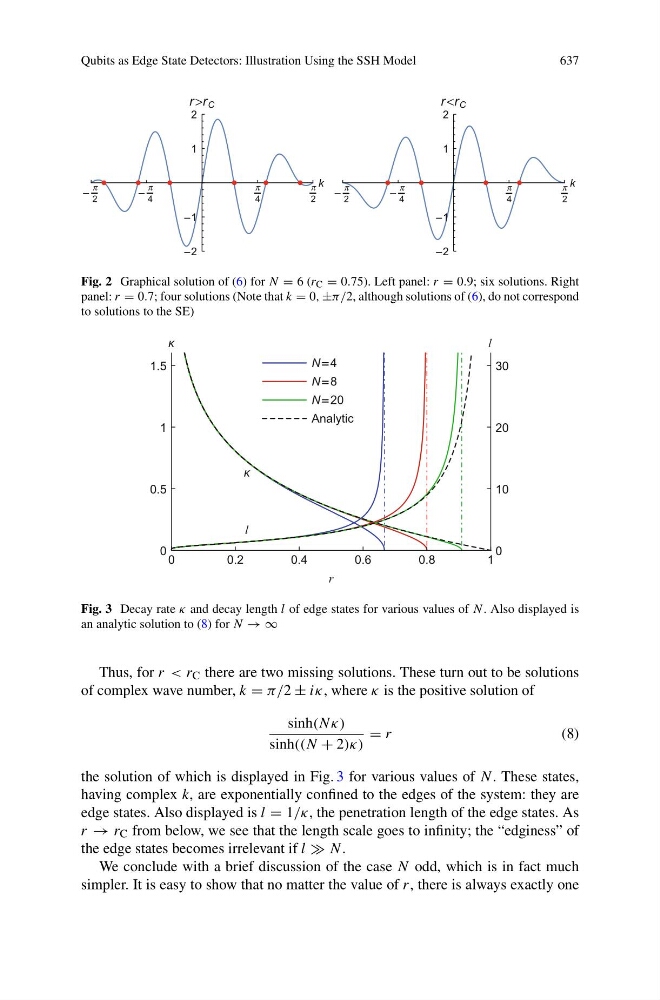
panel: r = 0.7; four solutions (Note that k = 0, ±π/2, although solutions of (6), do not correspond
to solutions to the SE)
κ
l
κ
l
N = 4
N = 8
N = 20
Analytic
0
0.2
0.4
0.6
0.8
1
0
0.5
1
1.5
r
0
10
20
30
Fig. 3 Decay rate κ and decay length l of edge states for various values of N . Also displayed is
an analytic solution to (8) for N → ∞
Thus, for r < r C there are two missing solutions. These turn out to be solutions
of complex wave number, k = π/2 ± iκ, where κ is the positive solution of
sinh(Nκ)
sinh((N + 2)κ)
= r
(8)
the solution of which is displayed in Fig. 3 for various values of N . These states,
having complex k, are exponentially confined to the edges of the system: they are
edge states. Also displayed is l = 1/κ, the penetration length of the edge states. As
r → r C from below, we see that the length scale goes to infinity; the “edginess” of
the edge states becomes irrelevant if l N .
We conclude with a brief discussion of the case N odd, which is in fact much
simpler. It is easy to show that no matter the value of r, there is always exactly one
637
- 2
p
p
p
p
p
p
p
p
- 4
4
2
k
-2
-1
1
2
r >r C
- 2
- 4
4
2
k
-2
-1
1
2
r
panel: r = 0.7; four solutions (Note that k = 0, ±π/2, although solutions of (6), do not correspond
to solutions to the SE)
κ
l
κ
l
N = 4
N = 8
N = 20
Analytic
0
0.2
0.4
0.6
0.8
1
0
0.5
1
1.5
r
0
10
20
30
Fig. 3 Decay rate κ and decay length l of edge states for various values of N . Also displayed is
an analytic solution to (8) for N → ∞
Thus, for r < r C there are two missing solutions. These turn out to be solutions
of complex wave number, k = π/2 ± iκ, where κ is the positive solution of
sinh(Nκ)
sinh((N + 2)κ)
= r
(8)
the solution of which is displayed in Fig. 3 for various values of N . These states,
having complex k, are exponentially confined to the edges of the system: they are
edge states. Also displayed is l = 1/κ, the penetration length of the edge states. As
r → r C from below, we see that the length scale goes to infinity; the “edginess” of
the edge states becomes irrelevant if l N .
We conclude with a brief discussion of the case N odd, which is in fact much
simpler. It is easy to show that no matter the value of r, there is always exactly one