

Loopholes in W R Searches at the LHC
593
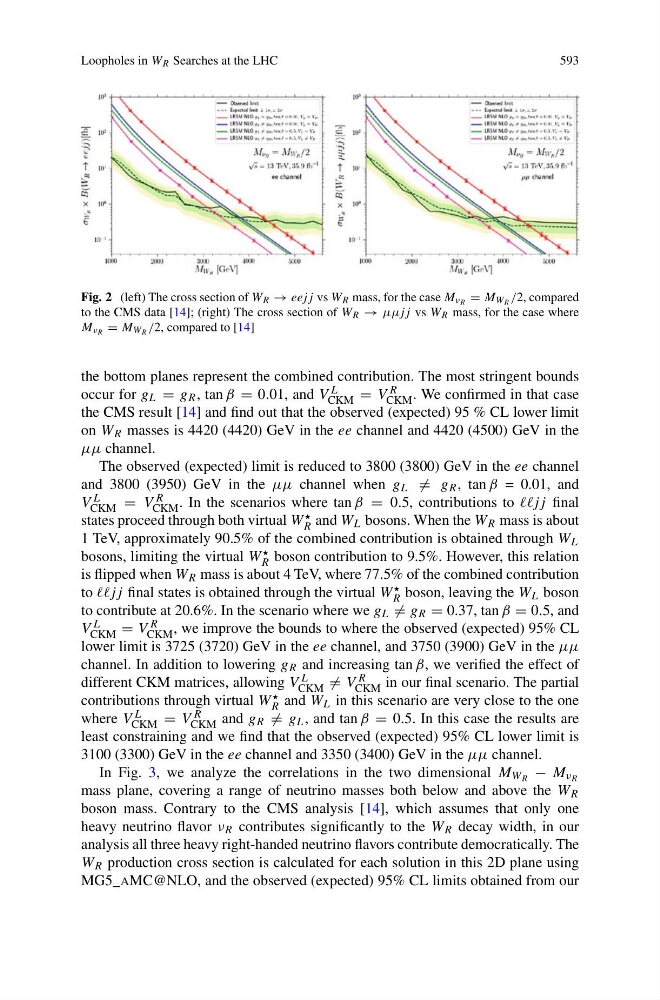
Fig. 2 (left) The cross section of W R → eejj vs W R mass, for the case M ν R = M W R /2, compared
to the CMS data [14]; (right) The cross section of W R → μμjj vs W R mass, for the case where
M ν R = M W R /2, compared to [14]
the bottom planes represent the combined contribution. The most stringent bounds
occur for g L = g R , tan β = 0.01, and V L
CKM = V R
CKM . We confirmed in that case
the CMS result [14] and find out that the observed (expected) 95 % CL lower limit
on W R masses is 4420 (4420) GeV in the ee channel and 4420 (4500) GeV in the
μμ channel.
The observed (expected) limit is reduced to 3800 (3800) GeV in the ee channel
and 3800 (3950) GeV in the μμ channel when g L = g R , tan β = 0.01, and
V L
CKM = V R
CKM . In the scenarios where tan β = 0.5, contributions to jj final
states proceed through both virtual W
R and W L bosons. When the W R mass is about
1 TeV, approximately 90.5% of the combined contribution is obtained through W L
bosons, limiting the virtual W
R boson contribution to 9.5%. However, this relation
is flipped when W R mass is about 4 TeV, where 77.5% of the combined contribution
to jj final states is obtained through the virtual W
R boson, leaving the W L boson
to contribute at 20.6%. In the scenario where we g L = g R = 0.37, tan β = 0.5, and
V L
CKM = V R
CKM , we improve the bounds to where the observed (expected) 95% CL
lower limit is 3725 (3720) GeV in the ee channel, and 3750 (3900) GeV in the μμ
channel. In addition to lowering g R and increasing tan β, we verified the effect of
different CKM matrices, allowing V L
CKM = V R
CKM in our final scenario. The partial
contributions through virtual W
R and W L in this scenario are very close to the one
where V L
CKM = V R
CKM and g R = g L , and tan β = 0.5. In this case the results are
least constraining and we find that the observed (expected) 95% CL lower limit is
3100 (3300) GeV in the ee channel and 3350 (3400) GeV in the μμ channel.
In Fig. 3, we analyze the correlations in the two dimensional M W R − M ν R
mass plane, covering a range of neutrino masses both below and above the W R
boson mass. Contrary to the CMS analysis [14], which assumes that only one
heavy neutrino flavor ν R contributes significantly to the W R decay width, in our
analysis all three heavy right-handed neutrino flavors contribute democratically. The
W R production cross section is calculated for each solution in this 2D plane using
MG5_AMC@NLO, and the observed (expected) 95% CL limits obtained from our
593
Fig. 2 (left) The cross section of W R → eejj vs W R mass, for the case M ν R = M W R /2, compared
to the CMS data [14]; (right) The cross section of W R → μμjj vs W R mass, for the case where
M ν R = M W R /2, compared to [14]
the bottom planes represent the combined contribution. The most stringent bounds
occur for g L = g R , tan β = 0.01, and V L
CKM = V R
CKM . We confirmed in that case
the CMS result [14] and find out that the observed (expected) 95 % CL lower limit
on W R masses is 4420 (4420) GeV in the ee channel and 4420 (4500) GeV in the
μμ channel.
The observed (expected) limit is reduced to 3800 (3800) GeV in the ee channel
and 3800 (3950) GeV in the μμ channel when g L = g R , tan β = 0.01, and
V L
CKM = V R
CKM . In the scenarios where tan β = 0.5, contributions to jj final
states proceed through both virtual W
R and W L bosons. When the W R mass is about
1 TeV, approximately 90.5% of the combined contribution is obtained through W L
bosons, limiting the virtual W
R boson contribution to 9.5%. However, this relation
is flipped when W R mass is about 4 TeV, where 77.5% of the combined contribution
to jj final states is obtained through the virtual W
R boson, leaving the W L boson
to contribute at 20.6%. In the scenario where we g L = g R = 0.37, tan β = 0.5, and
V L
CKM = V R
CKM , we improve the bounds to where the observed (expected) 95% CL
lower limit is 3725 (3720) GeV in the ee channel, and 3750 (3900) GeV in the μμ
channel. In addition to lowering g R and increasing tan β, we verified the effect of
different CKM matrices, allowing V L
CKM = V R
CKM in our final scenario. The partial
contributions through virtual W
R and W L in this scenario are very close to the one
where V L
CKM = V R
CKM and g R = g L , and tan β = 0.5. In this case the results are
least constraining and we find that the observed (expected) 95% CL lower limit is
3100 (3300) GeV in the ee channel and 3350 (3400) GeV in the μμ channel.
In Fig. 3, we analyze the correlations in the two dimensional M W R − M ν R
mass plane, covering a range of neutrino masses both below and above the W R
boson mass. Contrary to the CMS analysis [14], which assumes that only one
heavy neutrino flavor ν R contributes significantly to the W R decay width, in our
analysis all three heavy right-handed neutrino flavors contribute democratically. The
W R production cross section is calculated for each solution in this 2D plane using
MG5_AMC@NLO, and the observed (expected) 95% CL limits obtained from our