

592
Ö. Özdal
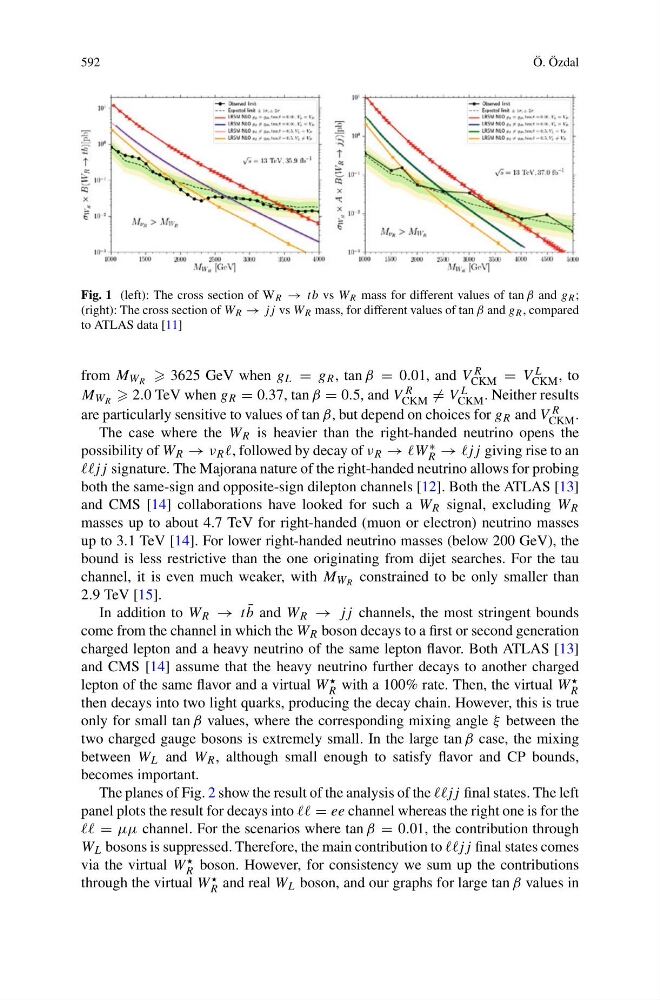
Fig. 1 (left): The cross section of W R → tb vs W R mass for different values of tan β and g R ;
(right): The cross section of W R → jj vs W R mass, for different values of tan β and g R , compared
to ATLAS data [11]
from M W R 3625 GeV when g L = g R , tan β = 0.01, and V R
CKM = V L
CKM , to
M W R 2.0 TeV when g R = 0.37, tan β = 0.5, and V R
CKM = V L
CKM . Neither results
are particularly sensitive to values of tan β, but depend on choices for g R and V R
CKM .
The case where the W R is heavier than the right-handed neutrino opens the
possibility of W R → ν R , followed by decay of ν R → ∗
R → jj giving rise to an
jj signature. The Majorana nature of the right-handed neutrino allows for probing
both the same-sign and opposite-sign dilepton channels [12]. Both the ATLAS [13]
and CMS [14] collaborations have looked for such a W R signal, excluding W R
masses up to about 4.7 TeV for right-handed (muon or electron) neutrino masses
up to 3.1 TeV [14]. For lower right-handed neutrino masses (below 200 GeV), the
bound is less restrictive than the one originating from dijet searches. For the tau
channel, it is even much weaker, with M W R constrained to be only smaller than
2.9 TeV [15].
In addition to W R → t ¯
b and W R → jj channels, the most stringent bounds
come from the channel in which the W R boson decays to a first or second generation
charged lepton and a heavy neutrino of the same lepton flavor. Both ATLAS [13]
and CMS [14] assume that the heavy neutrino further decays to another charged
lepton of the same flavor and a virtual W
R with a 100% rate. Then, the virtual W
R
then decays into two light quarks, producing the decay chain. However, this is true
only for small tan β values, where the corresponding mixing angle ξ between the
two charged gauge bosons is extremely small. In the large tan β case, the mixing
between W L and W R , although small enough to satisfy flavor and CP bounds,
becomes important.
The planes of Fig. 2 show the result of the analysis of the jj final states. The left
panel plots the result for decays into = ee channel whereas the right one is for the
= μμ channel. For the scenarios where tan β = 0.01, the contribution through
W L bosons is suppressed. Therefore, the main contribution to jj final states comes
via the virtual W
R boson. However, for consistency we sum up the contributions
through the virtual W
R and real W L boson, and our graphs for large tan β values in
Ö. Özdal
Fig. 1 (left): The cross section of W R → tb vs W R mass for different values of tan β and g R ;
(right): The cross section of W R → jj vs W R mass, for different values of tan β and g R , compared
to ATLAS data [11]
from M W R 3625 GeV when g L = g R , tan β = 0.01, and V R
CKM = V L
CKM , to
M W R 2.0 TeV when g R = 0.37, tan β = 0.5, and V R
CKM = V L
CKM . Neither results
are particularly sensitive to values of tan β, but depend on choices for g R and V R
CKM .
The case where the W R is heavier than the right-handed neutrino opens the
possibility of W R → ν R , followed by decay of ν R → ∗
R → jj giving rise to an
jj signature. The Majorana nature of the right-handed neutrino allows for probing
both the same-sign and opposite-sign dilepton channels [12]. Both the ATLAS [13]
and CMS [14] collaborations have looked for such a W R signal, excluding W R
masses up to about 4.7 TeV for right-handed (muon or electron) neutrino masses
up to 3.1 TeV [14]. For lower right-handed neutrino masses (below 200 GeV), the
bound is less restrictive than the one originating from dijet searches. For the tau
channel, it is even much weaker, with M W R constrained to be only smaller than
2.9 TeV [15].
In addition to W R → t ¯
b and W R → jj channels, the most stringent bounds
come from the channel in which the W R boson decays to a first or second generation
charged lepton and a heavy neutrino of the same lepton flavor. Both ATLAS [13]
and CMS [14] assume that the heavy neutrino further decays to another charged
lepton of the same flavor and a virtual W
R with a 100% rate. Then, the virtual W
R
then decays into two light quarks, producing the decay chain. However, this is true
only for small tan β values, where the corresponding mixing angle ξ between the
two charged gauge bosons is extremely small. In the large tan β case, the mixing
between W L and W R , although small enough to satisfy flavor and CP bounds,
becomes important.
The planes of Fig. 2 show the result of the analysis of the jj final states. The left
panel plots the result for decays into = ee channel whereas the right one is for the
= μμ channel. For the scenarios where tan β = 0.01, the contribution through
W L bosons is suppressed. Therefore, the main contribution to jj final states comes
via the virtual W
R boson. However, for consistency we sum up the contributions
through the virtual W
R and real W L boson, and our graphs for large tan β values in