

590
Ö. Özdal
• For each value of M W R we obtain many solutions for V R
CKM consistent with all
bounds. Of these solutions, we choose the one yielding the smallest branching
ratio for W R → t ¯
b. 3
• When M ν R > M W R , solutions emerge allowing for low values of BR(W R →
t ¯
b), which vary from about 23.3% for high M W R , to about 29% for low M W R ,
while when M ν R < M W R , this ratio changes from 15.7% for high M W R , to about
24.7% for low M W R .
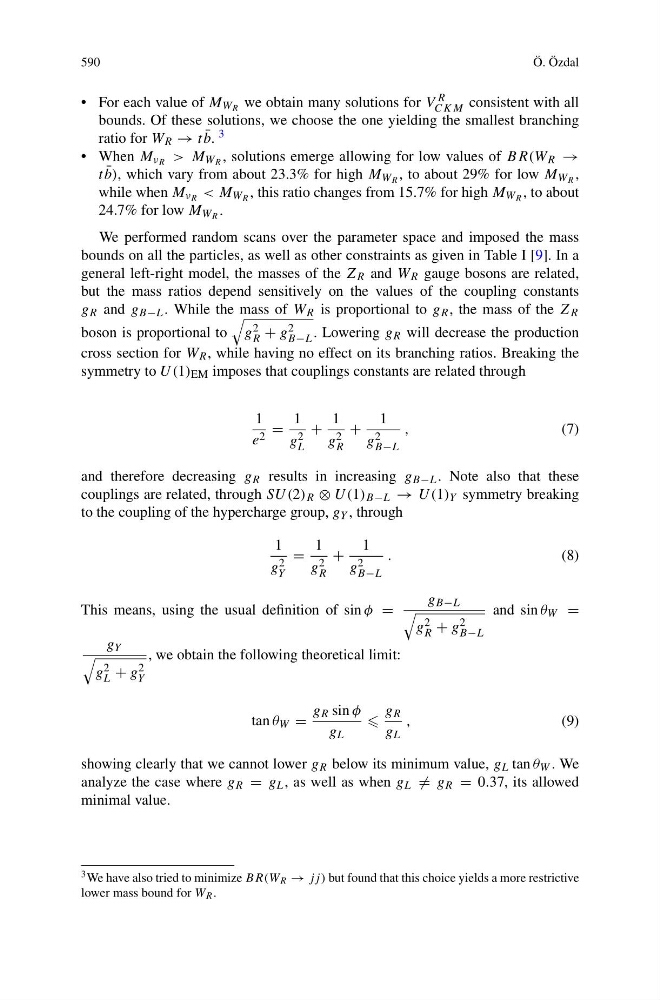
We performed random scans over the parameter space and imposed the mass
bounds on all the particles, as well as other constraints as given in Table I [9]. In a
general left-right model, the masses of the Z R and W R gauge bosons are related,
but the mass ratios depend sensitively on the values of the coupling constants
g R and g B−L . While the mass of W R is proportional to g R , the mass of the Z R
boson is proportional to
g 2
R + g 2
B−L . Lowering g R will decrease the production
cross section for W R , while having no effect on its branching ratios. Breaking the
symmetry to U(1) EM imposes that couplings constants are related through
1
e 2 =
1
g 2
L
+
1
g 2
R
+
1
g 2
B−L
,
(7)
and therefore decreasing g R results in increasing g B−L . Note also that these
couplings are related, through SU (2) R ⊗ U(1) B−L → U(1) Y symmetry breaking
to the coupling of the hypercharge group, g Y , through
1
g 2
Y
=
1
g 2
R
+
1
g 2
B−L
.
(8)
This means, using the usual definition of sin φ =
g B−L
g 2
R + g 2
B−L
and sin θ W =
g Y
g 2
L + g 2
Y
, we obtain the following theoretical limit:
tan θ W =
g R sin φ
g L
g R
g L
,
(9)
showing clearly that we cannot lower g R below its minimum value, g L tan θ W . We
analyze the case where g R = g L , as well as when g L = g R = 0.37, its allowed
minimal value.
3 We have also tried to minimize BR(W R → jj ) but found that this choice yields a more restrictive
lower mass bound for W R .
Ö. Özdal
• For each value of M W R we obtain many solutions for V R
CKM consistent with all
bounds. Of these solutions, we choose the one yielding the smallest branching
ratio for W R → t ¯
b. 3
• When M ν R > M W R , solutions emerge allowing for low values of BR(W R →
t ¯
b), which vary from about 23.3% for high M W R , to about 29% for low M W R ,
while when M ν R < M W R , this ratio changes from 15.7% for high M W R , to about
24.7% for low M W R .
We performed random scans over the parameter space and imposed the mass
bounds on all the particles, as well as other constraints as given in Table I [9]. In a
general left-right model, the masses of the Z R and W R gauge bosons are related,
but the mass ratios depend sensitively on the values of the coupling constants
g R and g B−L . While the mass of W R is proportional to g R , the mass of the Z R
boson is proportional to
g 2
R + g 2
B−L . Lowering g R will decrease the production
cross section for W R , while having no effect on its branching ratios. Breaking the
symmetry to U(1) EM imposes that couplings constants are related through
1
e 2 =
1
g 2
L
+
1
g 2
R
+
1
g 2
B−L
,
(7)
and therefore decreasing g R results in increasing g B−L . Note also that these
couplings are related, through SU (2) R ⊗ U(1) B−L → U(1) Y symmetry breaking
to the coupling of the hypercharge group, g Y , through
1
g 2
Y
=
1
g 2
R
+
1
g 2
B−L
.
(8)
This means, using the usual definition of sin φ =
g B−L
g 2
R + g 2
B−L
and sin θ W =
g Y
g 2
L + g 2
Y
, we obtain the following theoretical limit:
tan θ W =
g R sin φ
g L
g R
g L
,
(9)
showing clearly that we cannot lower g R below its minimum value, g L tan θ W . We
analyze the case where g R = g L , as well as when g L = g R = 0.37, its allowed
minimal value.
3 We have also tried to minimize BR(W R → jj ) but found that this choice yields a more restrictive
lower mass bound for W R .