

Loopholes in W R Searches at the LHC
589
where the mixing angle ξ and the mass eigenvalues are given by
tan 2ξ =
4g R g L κ 1 κ 2
2g 2
R v 2
R + (g 2
R − g 2
L )v 2
≈
2g L κ 1 κ 2
g R v 2
R
(4)
M
2
W 1
=
1
4
g
2
L v
2 cos
2 ξ + g
2
R (2v
2
R + v
2 ) sin
2 ξ − 2g R g L κ 1 κ 2 cos ξ sin ξ
M
2
W 2
=
1
4
g
2
L v
2 sin
2 ξ + g
2
R (2v
2
R + v
2 ) cos
2 ξ + 2g R g L κ 1 κ 2 cos ξ sin ξ
. (5)
The SU (2) R breaking scale v R and mixing angle ξ are restricted from low energy
observables, such as K L − K S , K , B 0 − ¯
B 0 mixings and b → sγ processes, which
constrain the right scale through the charged right-handed W R boson mass as well
as the triplet Higgs masses. Taking into account the smallness of the mixing angle ξ ,
in what follows we shall refer to W 1 as W L and W 2 as W R , as to be able to compare
with experimental results and nomenclature. 2
In most analyses, W R bosons are expected to be heavy. However all of the
analyses assume that the model is manifestly left-right symmetric, that is, the
coupling constants are the same for the left and right gauge sectors, g L = g R and
that the quark mass mixing in the right-handed sector V R
CKM is either diagonal,
or equal to the one in the left-handed sector (the Cabibbo–Kobayashi–Maskawa
matrix, V L
CKM ). This does not have to be the case, and analyses of a more general
model, the so-called asymmetric left-right model exist [7, 8].
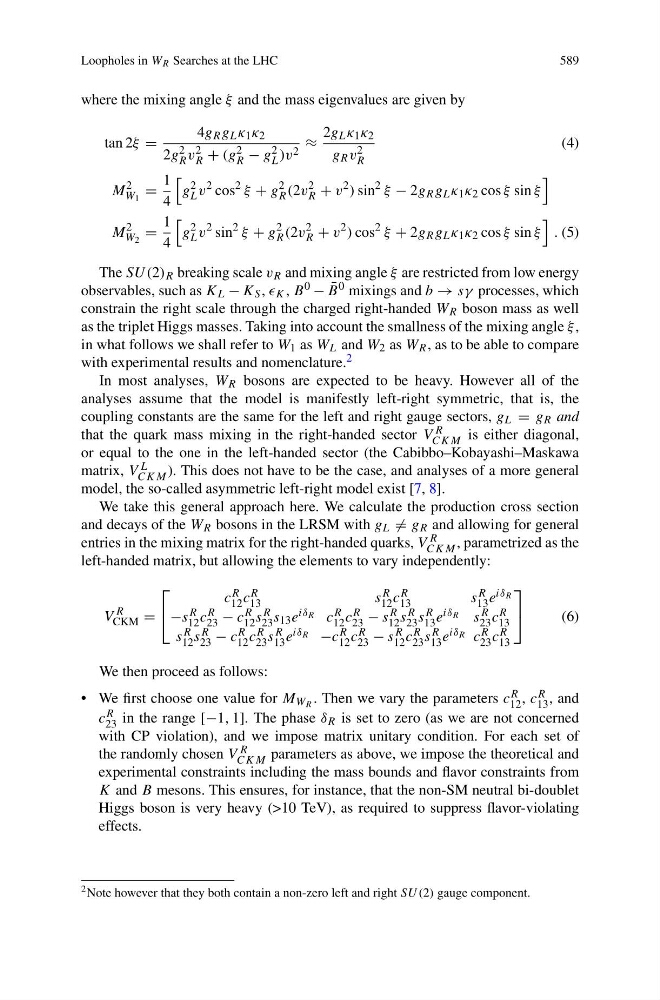
We take this general approach here. We calculate the production cross section
and decays of the W R bosons in the LRSM with g L = g R and allowing for general
entries in the mixing matrix for the right-handed quarks, V R
CKM , parametrized as the
left-handed matrix, but allowing the elements to vary independently:
V
R
CKM =
⎡
⎣
c R
12 c R
13
s R
12 c R
13
s R
13 e iδ R
−s R
12 c R
23 − c R
12 s R
23 s 13 e iδ R c R
12 c R
23 − s R
12 s R
23 s R
13 e iδ R s R
23 c R
13
s R
12 s R
23 − c R
12 c R
23 s R
13 e iδ R −c R
12 c R
23 − s R
12 c R
23 s R
13 e iδ R c R
23 c R
13
⎤
⎦
(6)
We then proceed as follows:
• We first choose one value for M W R . Then we vary the parameters c R
12 , c R
13 , and
c R
23 in the range [−1, 1]. The phase δ R is set to zero (as we are not concerned
with CP violation), and we impose matrix unitary condition. For each set of
the randomly chosen V R
CKM parameters as above, we impose the theoretical and
experimental constraints including the mass bounds and flavor constraints from
K and B mesons. This ensures, for instance, that the non-SM neutral bi-doublet
Higgs boson is very heavy (>10 TeV), as required to suppress flavor-violating
effects.
2 Note however that they both contain a non-zero left and right SU (2) gauge component.
589
where the mixing angle ξ and the mass eigenvalues are given by
tan 2ξ =
4g R g L κ 1 κ 2
2g 2
R v 2
R + (g 2
R − g 2
L )v 2
≈
2g L κ 1 κ 2
g R v 2
R
(4)
M
2
W 1
=
1
4
g
2
L v
2 cos
2 ξ + g
2
R (2v
2
R + v
2 ) sin
2 ξ − 2g R g L κ 1 κ 2 cos ξ sin ξ
M
2
W 2
=
1
4
g
2
L v
2 sin
2 ξ + g
2
R (2v
2
R + v
2 ) cos
2 ξ + 2g R g L κ 1 κ 2 cos ξ sin ξ
. (5)
The SU (2) R breaking scale v R and mixing angle ξ are restricted from low energy
observables, such as K L − K S , K , B 0 − ¯
B 0 mixings and b → sγ processes, which
constrain the right scale through the charged right-handed W R boson mass as well
as the triplet Higgs masses. Taking into account the smallness of the mixing angle ξ ,
in what follows we shall refer to W 1 as W L and W 2 as W R , as to be able to compare
with experimental results and nomenclature. 2
In most analyses, W R bosons are expected to be heavy. However all of the
analyses assume that the model is manifestly left-right symmetric, that is, the
coupling constants are the same for the left and right gauge sectors, g L = g R and
that the quark mass mixing in the right-handed sector V R
CKM is either diagonal,
or equal to the one in the left-handed sector (the Cabibbo–Kobayashi–Maskawa
matrix, V L
CKM ). This does not have to be the case, and analyses of a more general
model, the so-called asymmetric left-right model exist [7, 8].
We take this general approach here. We calculate the production cross section
and decays of the W R bosons in the LRSM with g L = g R and allowing for general
entries in the mixing matrix for the right-handed quarks, V R
CKM , parametrized as the
left-handed matrix, but allowing the elements to vary independently:
V
R
CKM =
⎡
⎣
c R
12 c R
13
s R
12 c R
13
s R
13 e iδ R
−s R
12 c R
23 − c R
12 s R
23 s 13 e iδ R c R
12 c R
23 − s R
12 s R
23 s R
13 e iδ R s R
23 c R
13
s R
12 s R
23 − c R
12 c R
23 s R
13 e iδ R −c R
12 c R
23 − s R
12 c R
23 s R
13 e iδ R c R
23 c R
13
⎤
⎦
(6)
We then proceed as follows:
• We first choose one value for M W R . Then we vary the parameters c R
12 , c R
13 , and
c R
23 in the range [−1, 1]. The phase δ R is set to zero (as we are not concerned
with CP violation), and we impose matrix unitary condition. For each set of
the randomly chosen V R
CKM parameters as above, we impose the theoretical and
experimental constraints including the mass bounds and flavor constraints from
K and B mesons. This ensures, for instance, that the non-SM neutral bi-doublet
Higgs boson is very heavy (>10 TeV), as required to suppress flavor-violating
effects.
2 Note however that they both contain a non-zero left and right SU (2) gauge component.