

Axion-Like Particles, Magnetars, and X-ray Astronomy
571
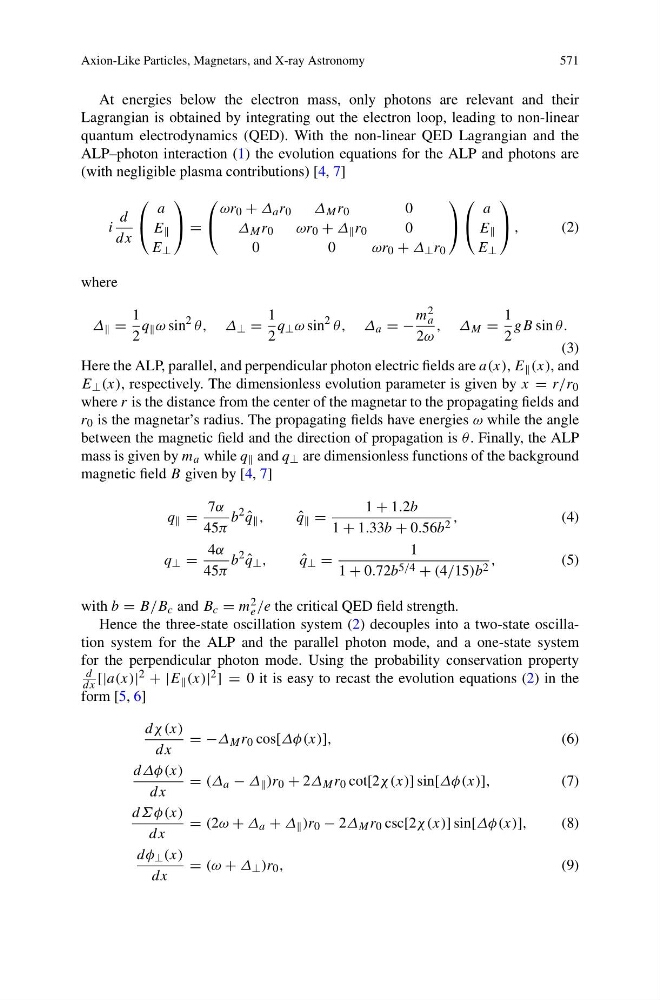
At energies below the electron mass, only photons are relevant and their
Lagrangian is obtained by integrating out the electron loop, leading to non-linear
quantum electrodynamics (QED). With the non-linear QED Lagrangian and the
ALP–photon interaction (1) the evolution equations for the ALP and photons are
(with negligible plasma contributions) [4, 7]
i
d
dx
⎛
⎝
a
E
E ⊥
⎞
⎠ =
⎛
⎝
ωr 0 + Δ a r 0
Δ M r 0
0
Δ M r 0
ωr 0 + Δ r 0
0
0
0
ωr 0 + Δ ⊥ r 0
⎞
⎠
⎛
⎝
a
E
E ⊥
⎞
⎠ ,
(2)
where
Δ =
1
2
q ω sin
2 θ, Δ ⊥ =
1
2
q ⊥ ω sin
2 θ, Δ a = −
m 2
a
2ω
, Δ M =
1
2
gB sin θ.
(3)
Here the ALP, parallel, and perpendicular photon electric fields are a(x), E (x), and
E ⊥ (x), respectively. The dimensionless evolution parameter is given by x = r/r 0
where r is the distance from the center of the magnetar to the propagating fields and
r 0 is the magnetar’s radius. The propagating fields have energies ω while the angle
between the magnetic field and the direction of propagation is θ . Finally, the ALP
mass is given by m a while q and q ⊥ are dimensionless functions of the background
magnetic field B given by [4, 7]
q =
7α
45π
b
2
ˆ
q ,
ˆ
q =
1 + 1.2b
1 + 1.33b + 0.56b 2 ,
(4)
q ⊥ =
4α
45π
b
2
ˆ
q ⊥ ,
ˆ
q ⊥ =
1
1 + 0.72b 5/4 + (4/15)b 2 ,
(5)
with b = B/B c and B c = m 2
e /e the critical QED field strength.
Hence the three-state oscillation system (2) decouples into a two-state oscillation system for the ALP and the parallel photon mode, and a one-state system
for the perpendicular photon mode. Using the probability conservation property
d
dx [|a(x)| 2 + |E (x)| 2 ] = 0 it is easy to recast the evolution equations (2) in the
form [5, 6]
dχ(x)
dx
= −Δ M r 0 cos[Δφ(x)],
(6)
dΔφ(x)
dx
= (Δ a − Δ )r 0 + 2Δ M r 0 cot[2χ(x)] sin[Δφ(x)],
(7)
dΣφ(x)
dx
= (2ω + Δ a + Δ )r 0 − 2Δ M r 0 csc[2χ(x)] sin[Δφ(x)],
(8)
dφ ⊥ (x)
dx
= (ω + Δ ⊥ )r 0 ,
(9)
571
At energies below the electron mass, only photons are relevant and their
Lagrangian is obtained by integrating out the electron loop, leading to non-linear
quantum electrodynamics (QED). With the non-linear QED Lagrangian and the
ALP–photon interaction (1) the evolution equations for the ALP and photons are
(with negligible plasma contributions) [4, 7]
i
d
dx
⎛
⎝
a
E
E ⊥
⎞
⎠ =
⎛
⎝
ωr 0 + Δ a r 0
Δ M r 0
0
Δ M r 0
ωr 0 + Δ r 0
0
0
0
ωr 0 + Δ ⊥ r 0
⎞
⎠
⎛
⎝
a
E
E ⊥
⎞
⎠ ,
(2)
where
Δ =
1
2
q ω sin
2 θ, Δ ⊥ =
1
2
q ⊥ ω sin
2 θ, Δ a = −
m 2
a
2ω
, Δ M =
1
2
gB sin θ.
(3)
Here the ALP, parallel, and perpendicular photon electric fields are a(x), E (x), and
E ⊥ (x), respectively. The dimensionless evolution parameter is given by x = r/r 0
where r is the distance from the center of the magnetar to the propagating fields and
r 0 is the magnetar’s radius. The propagating fields have energies ω while the angle
between the magnetic field and the direction of propagation is θ . Finally, the ALP
mass is given by m a while q and q ⊥ are dimensionless functions of the background
magnetic field B given by [4, 7]
q =
7α
45π
b
2
ˆ
q ,
ˆ
q =
1 + 1.2b
1 + 1.33b + 0.56b 2 ,
(4)
q ⊥ =
4α
45π
b
2
ˆ
q ⊥ ,
ˆ
q ⊥ =
1
1 + 0.72b 5/4 + (4/15)b 2 ,
(5)
with b = B/B c and B c = m 2
e /e the critical QED field strength.
Hence the three-state oscillation system (2) decouples into a two-state oscillation system for the ALP and the parallel photon mode, and a one-state system
for the perpendicular photon mode. Using the probability conservation property
d
dx [|a(x)| 2 + |E (x)| 2 ] = 0 it is easy to recast the evolution equations (2) in the
form [5, 6]
dχ(x)
dx
= −Δ M r 0 cos[Δφ(x)],
(6)
dΔφ(x)
dx
= (Δ a − Δ )r 0 + 2Δ M r 0 cot[2χ(x)] sin[Δφ(x)],
(7)
dΣφ(x)
dx
= (2ω + Δ a + Δ )r 0 − 2Δ M r 0 csc[2χ(x)] sin[Δφ(x)],
(8)
dφ ⊥ (x)
dx
= (ω + Δ ⊥ )r 0 ,
(9)