

570
J.-F. Fortin and K. Sinha
ALPs are ubiquitous in string theory [3]. Contrary to vanilla axions that couple
to the SM through coupling constants dependent on their mass, ALPs in the
string theory axiverse have independent parameters: their coupling constants to
the SM are unrelated to their mass. Moreover, ALPs are generically very light
and weakly coupled. Hence, they are notoriously hard to produce and detect.
Their existence might nonetheless be inferred from indirect detection. Indeed, in
dense stellar objects, ALP production can be significant and, once produced, they
can easily escape, leading to an extra energy sink. Thus, ALP production cannot
be too large otherwise the extra energy sink would ruin the agreement between
standard astrophysical evolution scenarios and observations. The upper bound is
usually taken as follows: the ALP emissivity should not be larger than the neutrino
emissivity. This condition leads to one constraint on the ALP parameter space.
Moreover, in background magnetic fields, oscillations between ALPs and photons occur [4]. Such oscillations can lead to significant changes to the photon
spectrum. Since the ALP emissivity can be as large as the neutrino emissivity, and
the latter is usually much larger than the photon emissivity, a second constraint
on the ALP parameter space appears. For the oscillations to be substantial, it is
necessary to have extreme magnetic fields. Therefore magnetars—neutron stars
with extreme magnetic fields—are the natural stellar candidates to focus on in such
scenarios. Moreover, since the dominant ALP production mechanism in the core
of magnetars is nucleon–nucleon bremsstrahlung, the ALP emissivity peaks in the
X-ray range, thus ALP oscillations will predominantly occur with X-ray photons.
One interesting effect of the oscillations is therefore related to X-ray polarization.
Indeed, ALPs couple to the parallel mode of the photon, hence the photon spectrum
and the photon polarization, described by the Stokes parameters, are modified by
the presence of ALPs. This brief communication presents the modifications to the
Stokes parameters originating from the production of ALPs in magnetars and their
subsequent conversion in the magnetosphere [5, 6].
2 Oscillation Equations
The interacting Lagrangian between ALPs and the SM particles of interest for
magnetars is given by
L ⊃ −
g
4
aF μν ˜
F
μν
+ g aN (∂ μ a) ¯
Nγ
μ γ 5 N.
(1)
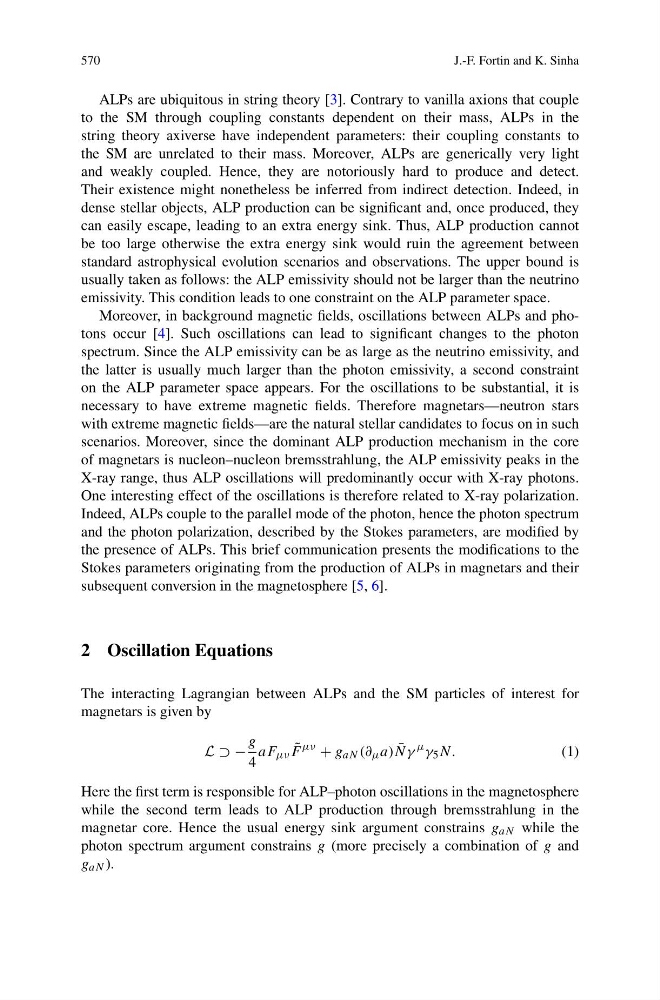
Here the first term is responsible for ALP–photon oscillations in the magnetosphere
while the second term leads to ALP production through bremsstrahlung in the
magnetar core. Hence the usual energy sink argument constrains g aN while the
photon spectrum argument constrains g (more precisely a combination of g and
g aN ).
J.-F. Fortin and K. Sinha
ALPs are ubiquitous in string theory [3]. Contrary to vanilla axions that couple
to the SM through coupling constants dependent on their mass, ALPs in the
string theory axiverse have independent parameters: their coupling constants to
the SM are unrelated to their mass. Moreover, ALPs are generically very light
and weakly coupled. Hence, they are notoriously hard to produce and detect.
Their existence might nonetheless be inferred from indirect detection. Indeed, in
dense stellar objects, ALP production can be significant and, once produced, they
can easily escape, leading to an extra energy sink. Thus, ALP production cannot
be too large otherwise the extra energy sink would ruin the agreement between
standard astrophysical evolution scenarios and observations. The upper bound is
usually taken as follows: the ALP emissivity should not be larger than the neutrino
emissivity. This condition leads to one constraint on the ALP parameter space.
Moreover, in background magnetic fields, oscillations between ALPs and photons occur [4]. Such oscillations can lead to significant changes to the photon
spectrum. Since the ALP emissivity can be as large as the neutrino emissivity, and
the latter is usually much larger than the photon emissivity, a second constraint
on the ALP parameter space appears. For the oscillations to be substantial, it is
necessary to have extreme magnetic fields. Therefore magnetars—neutron stars
with extreme magnetic fields—are the natural stellar candidates to focus on in such
scenarios. Moreover, since the dominant ALP production mechanism in the core
of magnetars is nucleon–nucleon bremsstrahlung, the ALP emissivity peaks in the
X-ray range, thus ALP oscillations will predominantly occur with X-ray photons.
One interesting effect of the oscillations is therefore related to X-ray polarization.
Indeed, ALPs couple to the parallel mode of the photon, hence the photon spectrum
and the photon polarization, described by the Stokes parameters, are modified by
the presence of ALPs. This brief communication presents the modifications to the
Stokes parameters originating from the production of ALPs in magnetars and their
subsequent conversion in the magnetosphere [5, 6].
2 Oscillation Equations
The interacting Lagrangian between ALPs and the SM particles of interest for
magnetars is given by
L ⊃ −
g
4
aF μν ˜
F
μν
+ g aN (∂ μ a) ¯
Nγ
μ γ 5 N.
(1)
Here the first term is responsible for ALP–photon oscillations in the magnetosphere
while the second term leads to ALP production through bremsstrahlung in the
magnetar core. Hence the usual energy sink argument constrains g aN while the
photon spectrum argument constrains g (more precisely a combination of g and
g aN ).