

Leptophobic Z in Supersymmetry and Where to Find Them
565
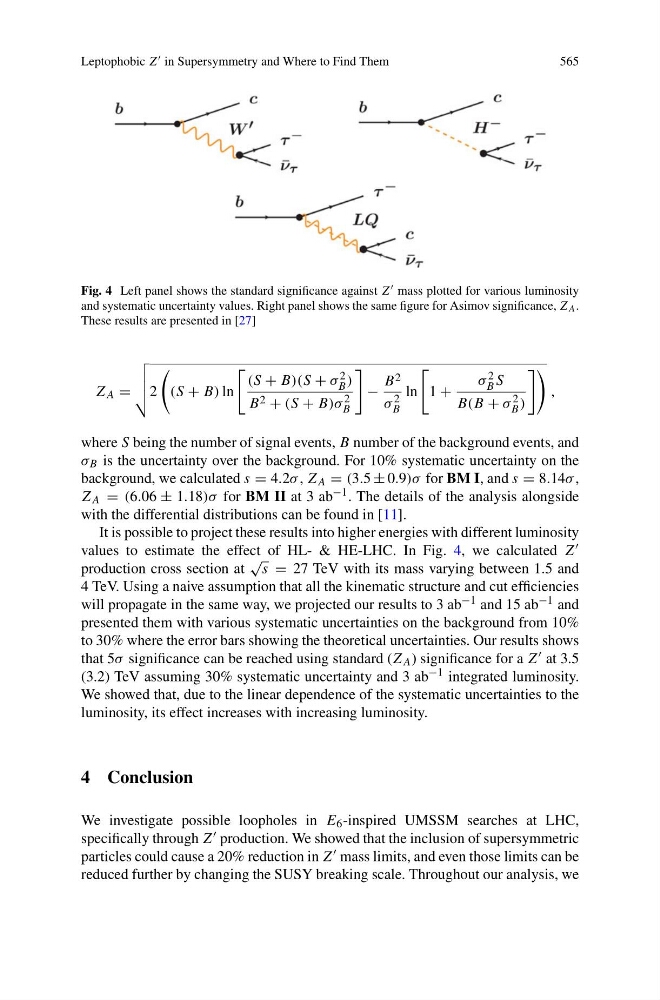
Fig. 4 Left panel shows the standard significance against Z mass plotted for various luminosity
and systematic uncertainty values. Right panel shows the same figure for Asimov significance, Z A .
These results are presented in [27]
Z A =
2
(S + B) ln
(S + B)(S + σ 2
B )
B 2 + (S + B)σ 2
B
−
B 2
σ 2
B
ln
1 +
σ 2
B S
B(B + σ 2
B )
,
where S being the number of signal events, B number of the background events, and
σ B is the uncertainty over the background. For 10% systematic uncertainty on the
background, we calculated s = 4.2σ , Z A = (3.5 ± 0.9)σ for BM I, and s = 8.14σ ,
Z A = (6.06 ± 1.18)σ for BM II at 3 ab −1 . The details of the analysis alongside
with the differential distributions can be found in [11].
It is possible to project these results into higher energies with different luminosity
values to estimate the effect of HL- & HE-LHC. In Fig. 4, we calculated Z
production cross section at
√
s = 27 TeV with its mass varying between 1.5 and
4 TeV. Using a naive assumption that all the kinematic structure and cut efficiencies
will propagate in the same way, we projected our results to 3 ab −1 and 15 ab −1 and
presented them with various systematic uncertainties on the background from 10%
to 30% where the error bars showing the theoretical uncertainties. Our results shows
that 5σ significance can be reached using standard (Z A ) significance for a Z at 3.5
(3.2) TeV assuming 30% systematic uncertainty and 3 ab −1 integrated luminosity.
We showed that, due to the linear dependence of the systematic uncertainties to the
luminosity, its effect increases with increasing luminosity.
4 Conclusion
We investigate possible loopholes in E 6 -inspired UMSSM searches at LHC,
specifically through Z production. We showed that the inclusion of supersymmetric
particles could cause a 20% reduction in Z mass limits, and even those limits can be
reduced further by changing the SUSY breaking scale. Throughout our analysis, we
565
Fig. 4 Left panel shows the standard significance against Z mass plotted for various luminosity
and systematic uncertainty values. Right panel shows the same figure for Asimov significance, Z A .
These results are presented in [27]
Z A =
2
(S + B) ln
(S + B)(S + σ 2
B )
B 2 + (S + B)σ 2
B
−
B 2
σ 2
B
ln
1 +
σ 2
B S
B(B + σ 2
B )
,
where S being the number of signal events, B number of the background events, and
σ B is the uncertainty over the background. For 10% systematic uncertainty on the
background, we calculated s = 4.2σ , Z A = (3.5 ± 0.9)σ for BM I, and s = 8.14σ ,
Z A = (6.06 ± 1.18)σ for BM II at 3 ab −1 . The details of the analysis alongside
with the differential distributions can be found in [11].
It is possible to project these results into higher energies with different luminosity
values to estimate the effect of HL- & HE-LHC. In Fig. 4, we calculated Z
production cross section at
√
s = 27 TeV with its mass varying between 1.5 and
4 TeV. Using a naive assumption that all the kinematic structure and cut efficiencies
will propagate in the same way, we projected our results to 3 ab −1 and 15 ab −1 and
presented them with various systematic uncertainties on the background from 10%
to 30% where the error bars showing the theoretical uncertainties. Our results shows
that 5σ significance can be reached using standard (Z A ) significance for a Z at 3.5
(3.2) TeV assuming 30% systematic uncertainty and 3 ab −1 integrated luminosity.
We showed that, due to the linear dependence of the systematic uncertainties to the
luminosity, its effect increases with increasing luminosity.
4 Conclusion
We investigate possible loopholes in E 6 -inspired UMSSM searches at LHC,
specifically through Z production. We showed that the inclusion of supersymmetric
particles could cause a 20% reduction in Z mass limits, and even those limits can be
reduced further by changing the SUSY breaking scale. Throughout our analysis, we