

564
J. Y. Araz
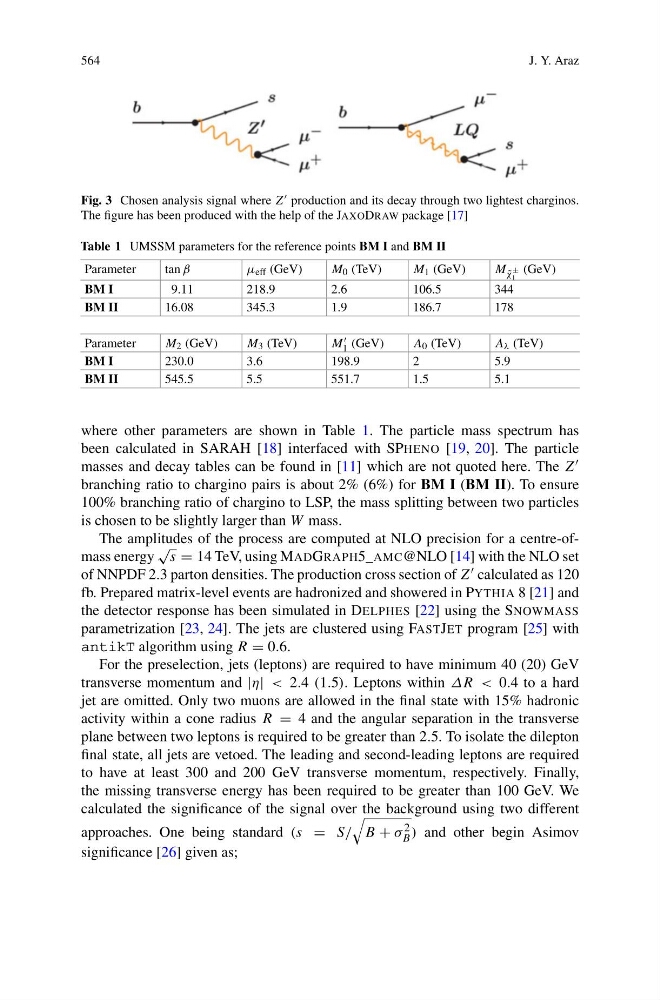
Fig. 3 Chosen analysis signal where Z production and its decay through two lightest charginos.
The figure has been produced with the help of the JAXODRAW package [17]
Table 1 UMSSM parameters for the reference points BM I and BM II
Parameter
tan β
μ eff (GeV)
M 0 (TeV)
M 1 (GeV)
M ˜
χ
±
1
(GeV)
BM I
9.11
218.9
2.6
106.5
344
BM II
16.08
345.3
1.9
186.7
178
Parameter
M 2 (GeV)
M 3 (TeV)
M
1 (GeV)
A 0 (TeV)
A λ (TeV)
BM I
230.0
3.6
198.9
2
5.9
BM II
545.5
5.5
551.7
1.5
5.1
where other parameters are shown in Table 1. The particle mass spectrum has
been calculated in SARAH [18] interfaced with SPHENO [19, 20]. The particle
masses and decay tables can be found in [11] which are not quoted here. The Z
branching ratio to chargino pairs is about 2% (6%) for BM I (BM II). To ensure
100% branching ratio of chargino to LSP, the mass splitting between two particles
is chosen to be slightly larger than W mass.
The amplitudes of the process are computed at NLO precision for a centre-ofmass energy
√
s = 14 TeV, using MADGRAPH5_AMC@NLO [14] with the NLO set
of NNPDF 2.3 parton densities. The production cross section of Z calculated as 120
fb. Prepared matrix-level events are hadronized and showered in PYTHIA 8 [21] and
the detector response has been simulated in DELPHES [22] using the SNOWMASS
parametrization [23, 24]. The jets are clustered using FASTJET program [25] with
antikT algorithm using R = 0.6.
For the preselection, jets (leptons) are required to have minimum 40 (20) GeV
transverse momentum and |η| < 2.4 (1.5). Leptons within ΔR < 0.4 to a hard
jet are omitted. Only two muons are allowed in the final state with 15% hadronic
activity within a cone radius R = 4 and the angular separation in the transverse
plane between two leptons is required to be greater than 2.5. To isolate the dilepton
final state, all jets are vetoed. The leading and second-leading leptons are required
to have at least 300 and 200 GeV transverse momentum, respectively. Finally,
the missing transverse energy has been required to be greater than 100 GeV. We
calculated the significance of the signal over the background using two different
approaches. One being standard (s = S/
B + σ 2
B ) and other begin Asimov
significance [26] given as;
J. Y. Araz
Fig. 3 Chosen analysis signal where Z production and its decay through two lightest charginos.
The figure has been produced with the help of the JAXODRAW package [17]
Table 1 UMSSM parameters for the reference points BM I and BM II
Parameter
tan β
μ eff (GeV)
M 0 (TeV)
M 1 (GeV)
M ˜
χ
±
1
(GeV)
BM I
9.11
218.9
2.6
106.5
344
BM II
16.08
345.3
1.9
186.7
178
Parameter
M 2 (GeV)
M 3 (TeV)
M
1 (GeV)
A 0 (TeV)
A λ (TeV)
BM I
230.0
3.6
198.9
2
5.9
BM II
545.5
5.5
551.7
1.5
5.1
where other parameters are shown in Table 1. The particle mass spectrum has
been calculated in SARAH [18] interfaced with SPHENO [19, 20]. The particle
masses and decay tables can be found in [11] which are not quoted here. The Z
branching ratio to chargino pairs is about 2% (6%) for BM I (BM II). To ensure
100% branching ratio of chargino to LSP, the mass splitting between two particles
is chosen to be slightly larger than W mass.
The amplitudes of the process are computed at NLO precision for a centre-ofmass energy
√
s = 14 TeV, using MADGRAPH5_AMC@NLO [14] with the NLO set
of NNPDF 2.3 parton densities. The production cross section of Z calculated as 120
fb. Prepared matrix-level events are hadronized and showered in PYTHIA 8 [21] and
the detector response has been simulated in DELPHES [22] using the SNOWMASS
parametrization [23, 24]. The jets are clustered using FASTJET program [25] with
antikT algorithm using R = 0.6.
For the preselection, jets (leptons) are required to have minimum 40 (20) GeV
transverse momentum and |η| < 2.4 (1.5). Leptons within ΔR < 0.4 to a hard
jet are omitted. Only two muons are allowed in the final state with 15% hadronic
activity within a cone radius R = 4 and the angular separation in the transverse
plane between two leptons is required to be greater than 2.5. To isolate the dilepton
final state, all jets are vetoed. The leading and second-leading leptons are required
to have at least 300 and 200 GeV transverse momentum, respectively. Finally,
the missing transverse energy has been required to be greater than 100 GeV. We
calculated the significance of the signal over the background using two different
approaches. One being standard (s = S/
B + σ 2
B ) and other begin Asimov
significance [26] given as;