

556
M. B. Wise
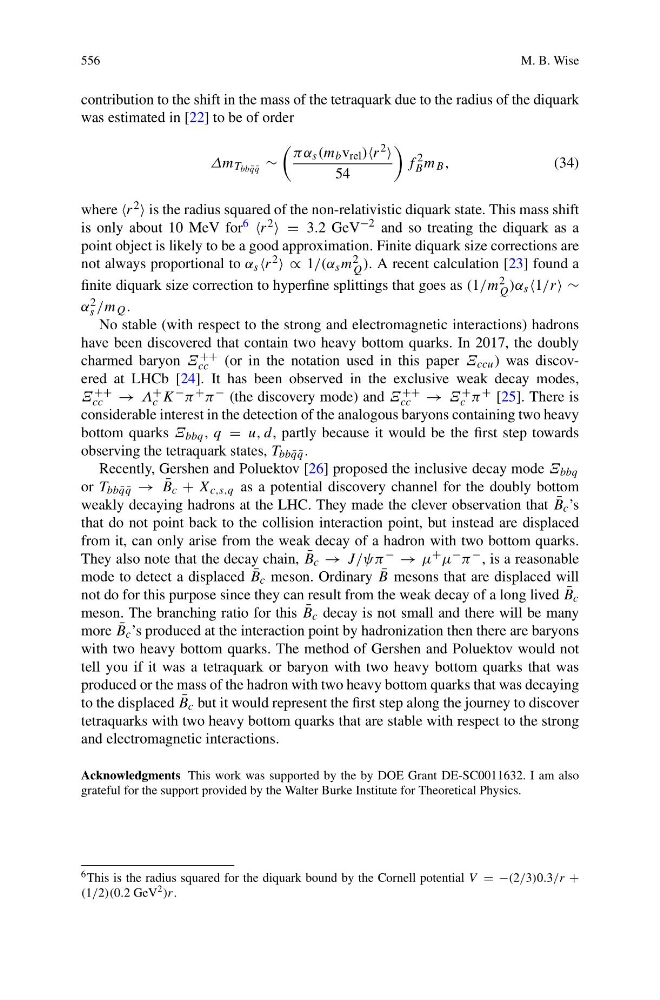
contribution to the shift in the mass of the tetraquark due to the radius of the diquark
was estimated in [22] to be of order
Δm T bb ¯
q ¯
q ∼
πα s (m b v rel ) 2
54
f
2
B m B ,
(34)
where 2 is the radius squared of the non-relativistic diquark state. This mass shift
is only about 10 MeV for 6 2 = 3.2 GeV
−2 and so treating the diquark as a
point object is likely to be a good approximation. Finite diquark size corrections are
not always proportional to α s 2 ∝ 1/(α s m 2
Q ). A recent calculation [23] found a
finite diquark size correction to hyperfine splittings that goes as (1/m 2
Q )α s ∼
α 2
s /m Q .
No stable (with respect to the strong and electromagnetic interactions) hadrons
have been discovered that contain two heavy bottom quarks. In 2017, the doubly
charmed baryon Ξ ++
cc (or in the notation used in this paper Ξ ccu ) was discovered at LHCb [24]. It has been observed in the exclusive weak decay modes,
Ξ ++
cc → Λ +
c K − π + π − (the discovery mode) and Ξ ++
cc → Ξ +
c π + [25]. There is
considerable interest in the detection of the analogous baryons containing two heavy
bottom quarks Ξ bbq , q = u, d, partly because it would be the first step towards
observing the tetraquark states, T bb ¯
q ¯
q .
Recently, Gershen and Poluektov [26] proposed the inclusive decay mode Ξ bbq
or T bb ¯
q ¯
q → ¯
B c + X c,s,q as a potential discovery channel for the doubly bottom
weakly decaying hadrons at the LHC. They made the clever observation that ¯
B c ’s
that do not point back to the collision interaction point, but instead are displaced
from it, can only arise from the weak decay of a hadron with two bottom quarks.
They also note that the decay chain, ¯
B c → J /ψπ − → μ + μ − π − , is a reasonable
mode to detect a displaced ¯
B c meson. Ordinary ¯
B mesons that are displaced will
not do for this purpose since they can result from the weak decay of a long lived ¯
B c
meson. The branching ratio for this ¯
B c decay is not small and there will be many
more ¯
B c ’s produced at the interaction point by hadronization then there are baryons
with two heavy bottom quarks. The method of Gershen and Poluektov would not
tell you if it was a tetraquark or baryon with two heavy bottom quarks that was
produced or the mass of the hadron with two heavy bottom quarks that was decaying
to the displaced ¯
B c but it would represent the first step along the journey to discover
tetraquarks with two heavy bottom quarks that are stable with respect to the strong
and electromagnetic interactions.
Acknowledgments This work was supported by the by DOE Grant DE-SC0011632. I am also
grateful for the support provided by the Walter Burke Institute for Theoretical Physics.
6 This is the radius squared for the diquark bound by the Cornell potential V = −(2/3)0.3/r +
(1/2)(0.2 GeV
2 )r.
M. B. Wise
contribution to the shift in the mass of the tetraquark due to the radius of the diquark
was estimated in [22] to be of order
Δm T bb ¯
q ¯
q ∼
πα s (m b v rel ) 2
54
f
2
B m B ,
(34)
where 2 is the radius squared of the non-relativistic diquark state. This mass shift
is only about 10 MeV for 6 2 = 3.2 GeV
−2 and so treating the diquark as a
point object is likely to be a good approximation. Finite diquark size corrections are
not always proportional to α s 2 ∝ 1/(α s m 2
Q ). A recent calculation [23] found a
finite diquark size correction to hyperfine splittings that goes as (1/m 2
Q )α s ∼
α 2
s /m Q .
No stable (with respect to the strong and electromagnetic interactions) hadrons
have been discovered that contain two heavy bottom quarks. In 2017, the doubly
charmed baryon Ξ ++
cc (or in the notation used in this paper Ξ ccu ) was discovered at LHCb [24]. It has been observed in the exclusive weak decay modes,
Ξ ++
cc → Λ +
c K − π + π − (the discovery mode) and Ξ ++
cc → Ξ +
c π + [25]. There is
considerable interest in the detection of the analogous baryons containing two heavy
bottom quarks Ξ bbq , q = u, d, partly because it would be the first step towards
observing the tetraquark states, T bb ¯
q ¯
q .
Recently, Gershen and Poluektov [26] proposed the inclusive decay mode Ξ bbq
or T bb ¯
q ¯
q → ¯
B c + X c,s,q as a potential discovery channel for the doubly bottom
weakly decaying hadrons at the LHC. They made the clever observation that ¯
B c ’s
that do not point back to the collision interaction point, but instead are displaced
from it, can only arise from the weak decay of a hadron with two bottom quarks.
They also note that the decay chain, ¯
B c → J /ψπ − → μ + μ − π − , is a reasonable
mode to detect a displaced ¯
B c meson. Ordinary ¯
B mesons that are displaced will
not do for this purpose since they can result from the weak decay of a long lived ¯
B c
meson. The branching ratio for this ¯
B c decay is not small and there will be many
more ¯
B c ’s produced at the interaction point by hadronization then there are baryons
with two heavy bottom quarks. The method of Gershen and Poluektov would not
tell you if it was a tetraquark or baryon with two heavy bottom quarks that was
produced or the mass of the hadron with two heavy bottom quarks that was decaying
to the displaced ¯
B c but it would represent the first step along the journey to discover
tetraquarks with two heavy bottom quarks that are stable with respect to the strong
and electromagnetic interactions.
Acknowledgments This work was supported by the by DOE Grant DE-SC0011632. I am also
grateful for the support provided by the Walter Burke Institute for Theoretical Physics.
6 This is the radius squared for the diquark bound by the Cornell potential V = −(2/3)0.3/r +
(1/2)(0.2 GeV
2 )r.