

Applications of Symmetry to the Large Scale Structure of the Universe. . .
555
is attractive. Hence the diquark has a large Coulombic binding energy 4 (compared
with Λ QCD ) and a small size 5 (compared with 1/Λ QCD ). Strong decay of the lowest
lying T QQ ¯
q ¯
q tetraquark states to a baryon with two heavy quarks and an anti-nucleon
(when q = u, d), Ξ QQq + ¯
N qqq , is kinematically forbidden since the final state has
an additional q ¯
q pair, which costs an additional ∼600 MeV of mass. Strong decay
to two heavy mesons M Q ¯
q +M Q ¯
q does not require an additional q ¯
q pair but now the
final state does not have the large color Coulombic binding energy proportional to
m Q that the tetraquark state does and so this channel is also kinematically forbidden.
For very heavy quarks the diquark inside a tetraquark is a small color anti-triplet that
can be treated as a point like object.
There has been some recent theoretical work [18–20] that indicates that the
bottom quark is heavy enough for the ground state T bb ¯
q ¯
q tetraquarks to be stable
with respect to the strong and electromagnetic interactions with a mass that is around
100 MeV below the ¯
B ¯
B threshold. Such tetraquarks produced at a collider will be
long lived with a lifetime approximately half the B meson lifetime. The three papers
supporting this conclusion on the stability of tetraquarks with two heavy bottom
quarks are a lattice calculation, a fit using heavy quark methods, and a fit/derivation
using more phenomenological methods.
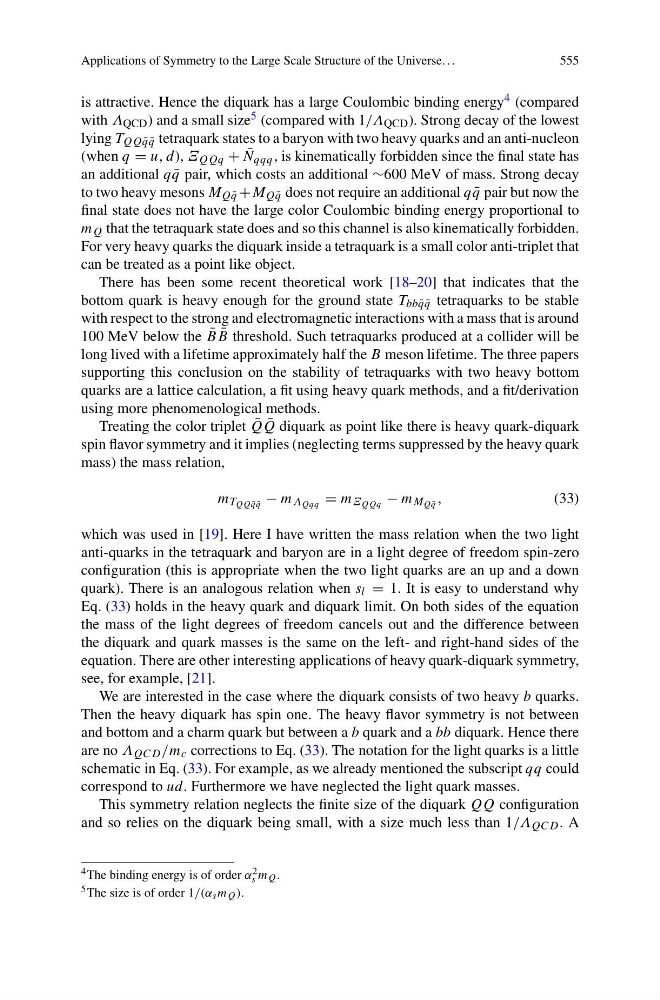
Treating the color triplet ¯
Q ¯
Q diquark as point like there is heavy quark-diquark
spin flavor symmetry and it implies (neglecting terms suppressed by the heavy quark
mass) the mass relation,
m T QQ ¯
q ¯
q − m Λ Qqq = m Ξ QQq − m M Q ¯
q ,
(33)
which was used in [19]. Here I have written the mass relation when the two light
anti-quarks in the tetraquark and baryon are in a light degree of freedom spin-zero
configuration (this is appropriate when the two light quarks are an up and a down
quark). There is an analogous relation when s l = 1. It is easy to understand why
Eq. (33) holds in the heavy quark and diquark limit. On both sides of the equation
the mass of the light degrees of freedom cancels out and the difference between
the diquark and quark masses is the same on the left- and right-hand sides of the
equation. There are other interesting applications of heavy quark-diquark symmetry,
see, for example, [21].
We are interested in the case where the diquark consists of two heavy b quarks.
Then the heavy diquark has spin one. The heavy flavor symmetry is not between
and bottom and a charm quark but between a b quark and a bb diquark. Hence there
are no Λ QCD /m c corrections to Eq. (33). The notation for the light quarks is a little
schematic in Eq. (33). For example, as we already mentioned the subscript qq could
correspond to ud. Furthermore we have neglected the light quark masses.
This symmetry relation neglects the finite size of the diquark QQ configuration
and so relies on the diquark being small, with a size much less than 1/Λ QCD . A
4 The binding energy is of order α 2
s m Q .
5 The size is of order 1/(α s m Q ).
555
is attractive. Hence the diquark has a large Coulombic binding energy 4 (compared
with Λ QCD ) and a small size 5 (compared with 1/Λ QCD ). Strong decay of the lowest
lying T QQ ¯
q ¯
q tetraquark states to a baryon with two heavy quarks and an anti-nucleon
(when q = u, d), Ξ QQq + ¯
N qqq , is kinematically forbidden since the final state has
an additional q ¯
q pair, which costs an additional ∼600 MeV of mass. Strong decay
to two heavy mesons M Q ¯
q +M Q ¯
q does not require an additional q ¯
q pair but now the
final state does not have the large color Coulombic binding energy proportional to
m Q that the tetraquark state does and so this channel is also kinematically forbidden.
For very heavy quarks the diquark inside a tetraquark is a small color anti-triplet that
can be treated as a point like object.
There has been some recent theoretical work [18–20] that indicates that the
bottom quark is heavy enough for the ground state T bb ¯
q ¯
q tetraquarks to be stable
with respect to the strong and electromagnetic interactions with a mass that is around
100 MeV below the ¯
B ¯
B threshold. Such tetraquarks produced at a collider will be
long lived with a lifetime approximately half the B meson lifetime. The three papers
supporting this conclusion on the stability of tetraquarks with two heavy bottom
quarks are a lattice calculation, a fit using heavy quark methods, and a fit/derivation
using more phenomenological methods.
Treating the color triplet ¯
Q ¯
Q diquark as point like there is heavy quark-diquark
spin flavor symmetry and it implies (neglecting terms suppressed by the heavy quark
mass) the mass relation,
m T QQ ¯
q ¯
q − m Λ Qqq = m Ξ QQq − m M Q ¯
q ,
(33)
which was used in [19]. Here I have written the mass relation when the two light
anti-quarks in the tetraquark and baryon are in a light degree of freedom spin-zero
configuration (this is appropriate when the two light quarks are an up and a down
quark). There is an analogous relation when s l = 1. It is easy to understand why
Eq. (33) holds in the heavy quark and diquark limit. On both sides of the equation
the mass of the light degrees of freedom cancels out and the difference between
the diquark and quark masses is the same on the left- and right-hand sides of the
equation. There are other interesting applications of heavy quark-diquark symmetry,
see, for example, [21].
We are interested in the case where the diquark consists of two heavy b quarks.
Then the heavy diquark has spin one. The heavy flavor symmetry is not between
and bottom and a charm quark but between a b quark and a bb diquark. Hence there
are no Λ QCD /m c corrections to Eq. (33). The notation for the light quarks is a little
schematic in Eq. (33). For example, as we already mentioned the subscript qq could
correspond to ud. Furthermore we have neglected the light quark masses.
This symmetry relation neglects the finite size of the diquark QQ configuration
and so relies on the diquark being small, with a size much less than 1/Λ QCD . A
4 The binding energy is of order α 2
s m Q .
5 The size is of order 1/(α s m Q ).