

Time Evolution in Quantum Systems and Stochastics
531
δ
j
f j →
dx f (x), w tj → W (x, t),
(32)
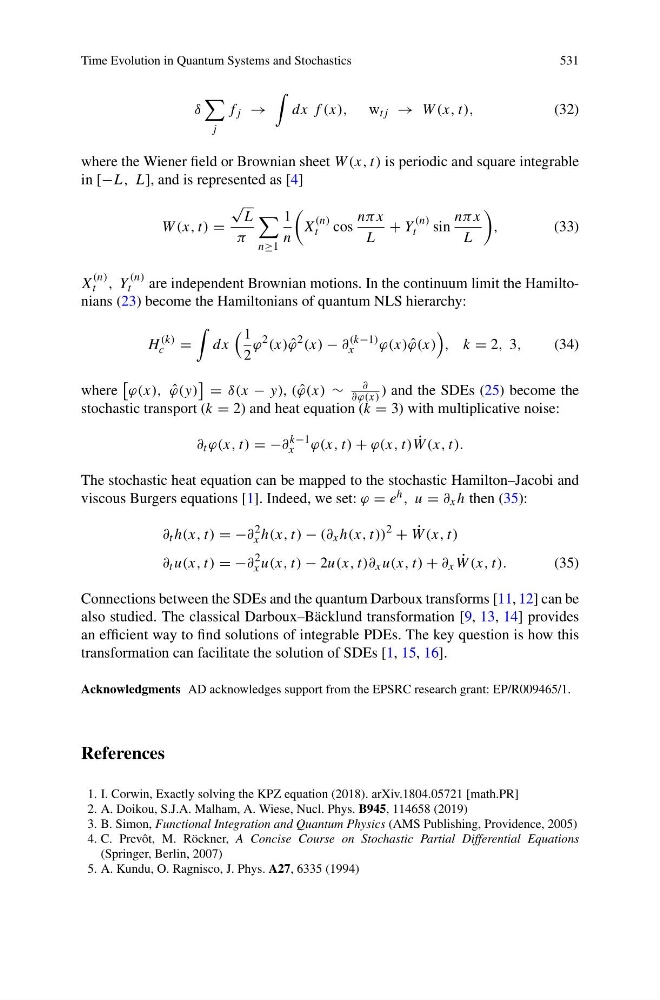
where the Wiener field or Brownian sheet W (x, t) is periodic and square integrable
in [−L, L], and is represented as [4]
W (x, t) =
√
L
π
n≥1
1
n
X
(n)
t cos
nπ x
L
+ Y
(n)
t sin
nπ x
L
,
(33)
X
(n)
t , Y
(n)
t
are independent Brownian motions. In the continuum limit the Hamiltonians (23) become the Hamiltonians of quantum NLS hierarchy:
H
(k)
c =
dx
1
2
ϕ
2 (x) ˆ
ϕ
2 (x) − ∂
(k−1)
x
ϕ(x) ˆ
ϕ(x)
, k = 2, 3,
(34)
where
ϕ(x), ˆ
ϕ(y)
= δ(x − y), ( ˆ
ϕ(x) ∼
∂
∂ϕ(x) ) and the SDEs (25) become the
stochastic transport (k = 2) and heat equation (k = 3) with multiplicative noise:
∂ t ϕ(x, t) = −∂
k−1
x ϕ(x, t) + ϕ(x, t) ˙
W (x, t).
The stochastic heat equation can be mapped to the stochastic Hamilton–Jacobi and
viscous Burgers equations [1]. Indeed, we set: ϕ = e h , u = ∂ x h then (35):
∂ t h(x, t) = −∂
2
x h(x, t) − (∂ x h(x, t))
2
+ ˙
W (x, t)
∂ t u(x, t) = −∂
2
x u(x, t) − 2u(x, t)∂ x u(x, t) + ∂ x ˙
W (x, t).
(35)
Connections between the SDEs and the quantum Darboux transforms [11, 12] can be
also studied. The classical Darboux–Bäcklund transformation [9, 13, 14] provides
an efficient way to find solutions of integrable PDEs. The key question is how this
transformation can facilitate the solution of SDEs [1, 15, 16].
Acknowledgments AD acknowledges support from the EPSRC research grant: EP/R009465/1.
References
1. I. Corwin, Exactly solving the KPZ equation (2018). arXiv.1804.05721 [math.PR]
2. A. Doikou, S.J.A. Malham, A. Wiese, Nucl. Phys. B945, 114658 (2019)
3. B. Simon, Functional Integration and Quantum Physics (AMS Publishing, Providence, 2005)
4. C. Prevôt, M. Röckner, A Concise Course on Stochastic Partial Differential Equations
(Springer, Berlin, 2007)
5. A. Kundu, O. Ragnisco, J. Phys. A27, 6335 (1994)
531
δ
j
f j →
dx f (x), w tj → W (x, t),
(32)
where the Wiener field or Brownian sheet W (x, t) is periodic and square integrable
in [−L, L], and is represented as [4]
W (x, t) =
√
L
π
n≥1
1
n
X
(n)
t cos
nπ x
L
+ Y
(n)
t sin
nπ x
L
,
(33)
X
(n)
t , Y
(n)
t
are independent Brownian motions. In the continuum limit the Hamiltonians (23) become the Hamiltonians of quantum NLS hierarchy:
H
(k)
c =
dx
1
2
ϕ
2 (x) ˆ
ϕ
2 (x) − ∂
(k−1)
x
ϕ(x) ˆ
ϕ(x)
, k = 2, 3,
(34)
where
ϕ(x), ˆ
ϕ(y)
= δ(x − y), ( ˆ
ϕ(x) ∼
∂
∂ϕ(x) ) and the SDEs (25) become the
stochastic transport (k = 2) and heat equation (k = 3) with multiplicative noise:
∂ t ϕ(x, t) = −∂
k−1
x ϕ(x, t) + ϕ(x, t) ˙
W (x, t).
The stochastic heat equation can be mapped to the stochastic Hamilton–Jacobi and
viscous Burgers equations [1]. Indeed, we set: ϕ = e h , u = ∂ x h then (35):
∂ t h(x, t) = −∂
2
x h(x, t) − (∂ x h(x, t))
2
+ ˙
W (x, t)
∂ t u(x, t) = −∂
2
x u(x, t) − 2u(x, t)∂ x u(x, t) + ∂ x ˙
W (x, t).
(35)
Connections between the SDEs and the quantum Darboux transforms [11, 12] can be
also studied. The classical Darboux–Bäcklund transformation [9, 13, 14] provides
an efficient way to find solutions of integrable PDEs. The key question is how this
transformation can facilitate the solution of SDEs [1, 15, 16].
Acknowledgments AD acknowledges support from the EPSRC research grant: EP/R009465/1.
References
1. I. Corwin, Exactly solving the KPZ equation (2018). arXiv.1804.05721 [math.PR]
2. A. Doikou, S.J.A. Malham, A. Wiese, Nucl. Phys. B945, 114658 (2019)
3. B. Simon, Functional Integration and Quantum Physics (AMS Publishing, Providence, 2005)
4. C. Prevôt, M. Röckner, A Concise Course on Stochastic Partial Differential Equations
(Springer, Berlin, 2007)
5. A. Kundu, O. Ragnisco, J. Phys. A27, 6335 (1994)