

Dressing for a Vector Modified KdV Hierarchy
515
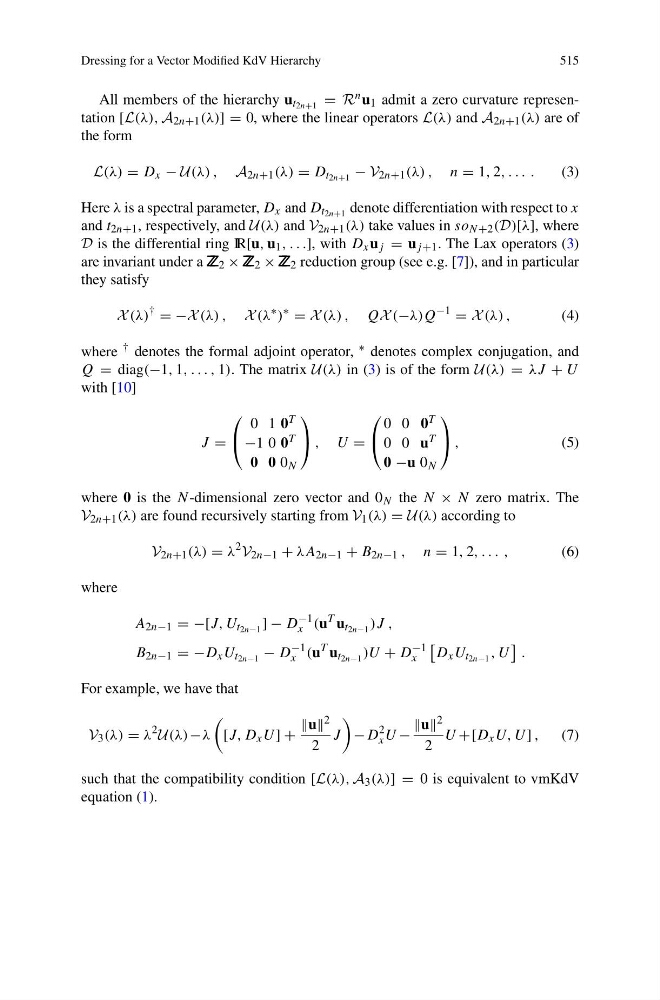
All members of the hierarchy u t 2n+1 = R n u 1 admit a zero curvature representation [L(λ), A 2n+1 (λ)] = 0, where the linear operators L(λ) and A 2n+1 (λ) are of
the form
L(λ) = D x − U (λ) , A 2n+1 (λ) = D t 2n+1 − V 2n+1 (λ) , n = 1, 2, . . . .
(3)
Here λ is a spectral parameter, D x and D t 2n+1 denote differentiation with respect to x
and t 2n+1 , respectively, and U (λ) and V 2n+1 (λ) take values in so N +2 (D)[λ], where
D is the differential ring IR[u, u 1 , . . .], with D x u j = u j +1 . The Lax operators (3)
are invariant under a Z Z 2 × Z Z 2 × Z Z 2 reduction group (see e.g. [7]), and in particular
they satisfy
X (λ)
†
= −X (λ) , X (λ
∗ )
∗
= X (λ) , QX (−λ)Q
−1
= X (λ) ,
(4)
where † denotes the formal adjoint operator, ∗ denotes complex conjugation, and
Q = diag(−1, 1, . . . , 1). The matrix U (λ) in (3) is of the form U (λ) = λJ + U
with [10]
J =
⎛
⎝
0 1 0 T
−1 0 0 T
0 0 0 N
⎞
⎠ , U =
⎛
⎝
0 0 0 T
0 0 u T
0 −u 0 N
⎞
⎠ ,
(5)
where 0 is the N -dimensional zero vector and 0 N the N × N zero matrix. The
V 2n+1 (λ) are found recursively starting from V 1 (λ) = U (λ) according to
V 2n+1 (λ) = λ
2
V 2n−1 + λA 2n−1 + B 2n−1 , n = 1, 2, . . . ,
(6)
where
A 2n−1 = −[J, U t 2n−1 ] − D
−1
x (u
T u t 2n−1 )J ,
B 2n−1 = −D x U t 2n−1 − D
−1
x (u
T u t 2n−1 )U + D
−1
x
D x U t 2n−1 , U
.
For example, we have that
V 3 (λ) = λ
2
U (λ)−λ
[J, D x U ] +
2
2
J
−D
2
x U −
2
2
U +[D x U, U ] ,
(7)
such that the compatibility condition [L(λ), A 3 (λ)] = 0 is equivalent to vmKdV
equation (1).
515
All members of the hierarchy u t 2n+1 = R n u 1 admit a zero curvature representation [L(λ), A 2n+1 (λ)] = 0, where the linear operators L(λ) and A 2n+1 (λ) are of
the form
L(λ) = D x − U (λ) , A 2n+1 (λ) = D t 2n+1 − V 2n+1 (λ) , n = 1, 2, . . . .
(3)
Here λ is a spectral parameter, D x and D t 2n+1 denote differentiation with respect to x
and t 2n+1 , respectively, and U (λ) and V 2n+1 (λ) take values in so N +2 (D)[λ], where
D is the differential ring IR[u, u 1 , . . .], with D x u j = u j +1 . The Lax operators (3)
are invariant under a Z Z 2 × Z Z 2 × Z Z 2 reduction group (see e.g. [7]), and in particular
they satisfy
X (λ)
†
= −X (λ) , X (λ
∗ )
∗
= X (λ) , QX (−λ)Q
−1
= X (λ) ,
(4)
where † denotes the formal adjoint operator, ∗ denotes complex conjugation, and
Q = diag(−1, 1, . . . , 1). The matrix U (λ) in (3) is of the form U (λ) = λJ + U
with [10]
J =
⎛
⎝
0 1 0 T
−1 0 0 T
0 0 0 N
⎞
⎠ , U =
⎛
⎝
0 0 0 T
0 0 u T
0 −u 0 N
⎞
⎠ ,
(5)
where 0 is the N -dimensional zero vector and 0 N the N × N zero matrix. The
V 2n+1 (λ) are found recursively starting from V 1 (λ) = U (λ) according to
V 2n+1 (λ) = λ
2
V 2n−1 + λA 2n−1 + B 2n−1 , n = 1, 2, . . . ,
(6)
where
A 2n−1 = −[J, U t 2n−1 ] − D
−1
x (u
T u t 2n−1 )J ,
B 2n−1 = −D x U t 2n−1 − D
−1
x (u
T u t 2n−1 )U + D
−1
x
D x U t 2n−1 , U
.
For example, we have that
V 3 (λ) = λ
2
U (λ)−λ
[J, D x U ] +
2
2
J
−D
2
x U −
2
2
U +[D x U, U ] ,
(7)
such that the compatibility condition [L(λ), A 3 (λ)] = 0 is equivalent to vmKdV
equation (1).