

514
P. Adamopoulou and G. Papamikos
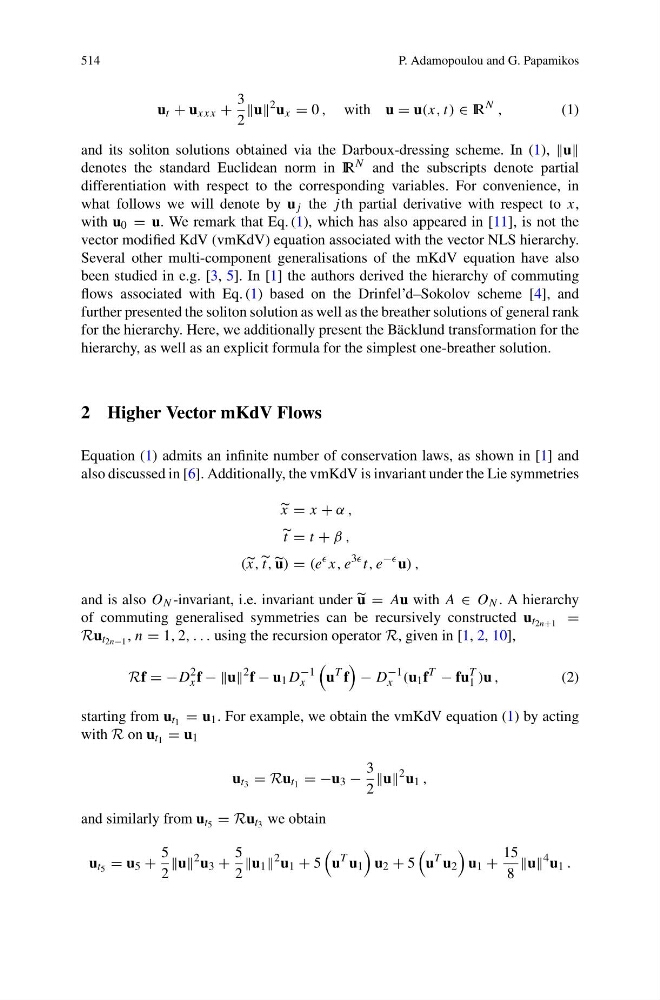
u t + u xxx +
3
2
2 u x = 0 , with u = u(x, t) ∈ IR
N ,
(1)
and its soliton solutions obtained via the Darboux-dressing scheme. In (1),
denotes the standard Euclidean norm in IR
N and the subscripts denote partial
differentiation with respect to the corresponding variables. For convenience, in
what follows we will denote by u j the j th partial derivative with respect to x,
with u 0 = u. We remark that Eq. (1), which has also appeared in [11], is not the
vector modified KdV (vmKdV) equation associated with the vector NLS hierarchy.
Several other multi-component generalisations of the mKdV equation have also
been studied in e.g. [3, 5]. In [1] the authors derived the hierarchy of commuting
flows associated with Eq. (1) based on the Drinfel’d–Sokolov scheme [4], and
further presented the soliton solution as well as the breather solutions of general rank
for the hierarchy. Here, we additionally present the Bäcklund transformation for the
hierarchy, as well as an explicit formula for the simplest one-breather solution.
2 Higher Vector mKdV Flows
Equation (1) admits an infinite number of conservation laws, as shown in [1] and
also discussed in [6]. Additionally, the vmKdV is invariant under the Lie symmetries
x = x + α ,
t = t + β ,
( x, t, u) = (e
x, e
3 t, e
− u) ,
and is also O N -invariant, i.e. invariant under u = Au with A ∈ O N . A hierarchy
of commuting generalised symmetries can be recursively constructed u t 2n+1 =
Ru t 2n−1 , n = 1, 2, . . . using the recursion operator R, given in [1, 2, 10],
Rf = −D
2
x f − −u
2 f − u 1 D
−1
x
u
T f
− D
−1
x (u 1 f
T
− fu
T
1 )u ,
(2)
starting from u t 1 = u 1 . For example, we obtain the vmKdV equation (1) by acting
with R on u t 1 = u 1
u t 3 = Ru t 1 = −u 3 −
3
2
2 u 1 ,
and similarly from u t 5 = Ru t 3 we obtain
u t 5 = u 5 +
5
2
2 u 3 +
5
2
1
2 u 1 + 5
u
T u 1
u 2 + 5
u
T u 2
u 1 +
15
8
4 u 1 .
P. Adamopoulou and G. Papamikos
u t + u xxx +
3
2
2 u x = 0 , with u = u(x, t) ∈ IR
N ,
(1)
and its soliton solutions obtained via the Darboux-dressing scheme. In (1),
denotes the standard Euclidean norm in IR
N and the subscripts denote partial
differentiation with respect to the corresponding variables. For convenience, in
what follows we will denote by u j the j th partial derivative with respect to x,
with u 0 = u. We remark that Eq. (1), which has also appeared in [11], is not the
vector modified KdV (vmKdV) equation associated with the vector NLS hierarchy.
Several other multi-component generalisations of the mKdV equation have also
been studied in e.g. [3, 5]. In [1] the authors derived the hierarchy of commuting
flows associated with Eq. (1) based on the Drinfel’d–Sokolov scheme [4], and
further presented the soliton solution as well as the breather solutions of general rank
for the hierarchy. Here, we additionally present the Bäcklund transformation for the
hierarchy, as well as an explicit formula for the simplest one-breather solution.
2 Higher Vector mKdV Flows
Equation (1) admits an infinite number of conservation laws, as shown in [1] and
also discussed in [6]. Additionally, the vmKdV is invariant under the Lie symmetries
x = x + α ,
t = t + β ,
( x, t, u) = (e
x, e
3 t, e
− u) ,
and is also O N -invariant, i.e. invariant under u = Au with A ∈ O N . A hierarchy
of commuting generalised symmetries can be recursively constructed u t 2n+1 =
Ru t 2n−1 , n = 1, 2, . . . using the recursion operator R, given in [1, 2, 10],
Rf = −D
2
x f − −u
2 f − u 1 D
−1
x
u
T f
− D
−1
x (u 1 f
T
− fu
T
1 )u ,
(2)
starting from u t 1 = u 1 . For example, we obtain the vmKdV equation (1) by acting
with R on u t 1 = u 1
u t 3 = Ru t 1 = −u 3 −
3
2
2 u 1 ,
and similarly from u t 5 = Ru t 3 we obtain
u t 5 = u 5 +
5
2
2 u 3 +
5
2
1
2 u 1 + 5
u
T u 1
u 2 + 5
u
T u 2
u 1 +
15
8
4 u 1 .