

Three Partial Differential Equations in Curved Space and their Respective Solutions
493
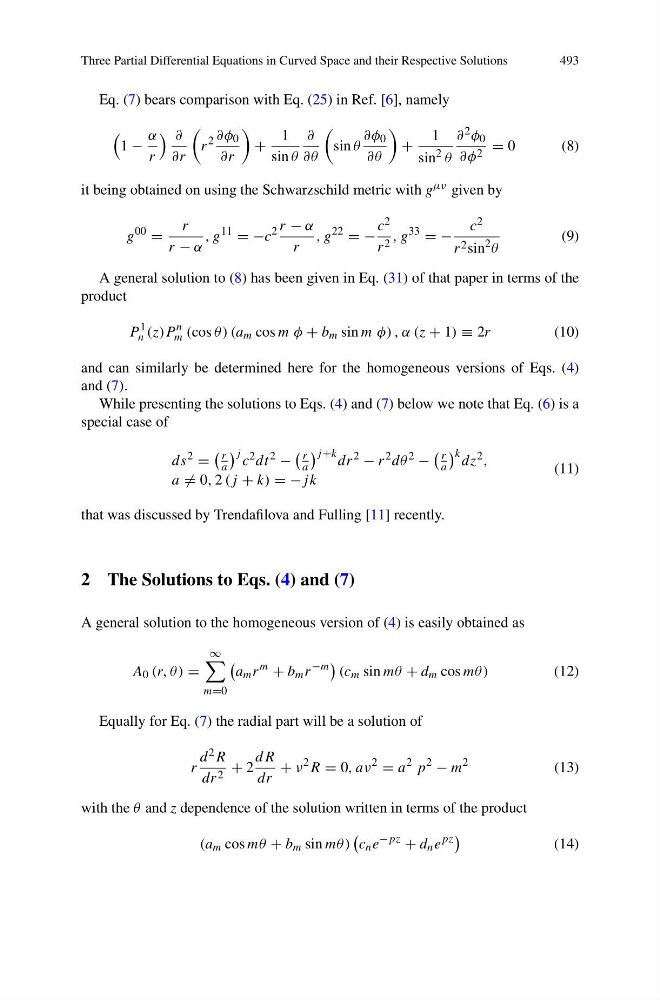
Eq. (7) bears comparison with Eq. (25) in Ref. [6], namely
1 −
α
r
∂
∂r
r
2 ∂φ 0
∂r
+
1
sin θ
∂
∂θ
sin θ
∂φ 0
∂θ
+
1
sin
2 θ
∂ 2 φ 0
∂φ 2 = 0
( 8 )
it being obtained on using the Schwarzschild metric with g μν given by
g
00
=
r
r − α
, g
11
= −c
2 r − α
r
, g
22
= −
c 2
r 2 , g
33
= −
c 2
r 2 sin
2 θ
(9)
A general solution to (8) has been given in Eq. (31) of that paper in terms of the
product
P
1
n (z)P
n
m (cos θ ) (a m cos m φ + b m sin m φ) , α (z + 1) ≡ 2r
(10)
and can similarly be determined here for the homogeneous versions of Eqs. (4)
and (7).
While presenting the solutions to Eqs. (4) and (7) below we note that Eq. (6) is a
special case of
ds 2 =
r
a
j c 2 dt 2 −
r
a
j +k dr 2 − r 2 dθ 2 −
r
a
k dz 2 ,
a = 0, 2 (j + k) = −jk
(11)
that was discussed by Trendafilova and Fulling [11] recently.
2 The Solutions to Eqs. (4) and (7)
A general solution to the homogeneous version of (4) is easily obtained as
A 0 (r, θ ) =
∞
m=0
a m r
m
+ b m r
−m
(c m sin mθ + d m cos mθ )
(12)
Equally for Eq. (7) the radial part will be a solution of
r
d 2 R
dr 2 + 2
dR
dr
+ ν
2 R = 0, aν
2
= a
2 p
2
− m
2
(13)
with the θ and z dependence of the solution written in terms of the product
(a m cos mθ + b m sin mθ )
c n e
−pz
+ d n e
pz
(14)
493
Eq. (7) bears comparison with Eq. (25) in Ref. [6], namely
1 −
α
r
∂
∂r
r
2 ∂φ 0
∂r
+
1
sin θ
∂
∂θ
sin θ
∂φ 0
∂θ
+
1
sin
2 θ
∂ 2 φ 0
∂φ 2 = 0
( 8 )
it being obtained on using the Schwarzschild metric with g μν given by
g
00
=
r
r − α
, g
11
= −c
2 r − α
r
, g
22
= −
c 2
r 2 , g
33
= −
c 2
r 2 sin
2 θ
(9)
A general solution to (8) has been given in Eq. (31) of that paper in terms of the
product
P
1
n (z)P
n
m (cos θ ) (a m cos m φ + b m sin m φ) , α (z + 1) ≡ 2r
(10)
and can similarly be determined here for the homogeneous versions of Eqs. (4)
and (7).
While presenting the solutions to Eqs. (4) and (7) below we note that Eq. (6) is a
special case of
ds 2 =
r
a
j c 2 dt 2 −
r
a
j +k dr 2 − r 2 dθ 2 −
r
a
k dz 2 ,
a = 0, 2 (j + k) = −jk
(11)
that was discussed by Trendafilova and Fulling [11] recently.
2 The Solutions to Eqs. (4) and (7)
A general solution to the homogeneous version of (4) is easily obtained as
A 0 (r, θ ) =
∞
m=0
a m r
m
+ b m r
−m
(c m sin mθ + d m cos mθ )
(12)
Equally for Eq. (7) the radial part will be a solution of
r
d 2 R
dr 2 + 2
dR
dr
+ ν
2 R = 0, aν
2
= a
2 p
2
− m
2
(13)
with the θ and z dependence of the solution written in terms of the product
(a m cos mθ + b m sin mθ )
c n e
−pz
+ d n e
pz
(14)