

492
G. Kamath
recently. The aforesaid methods motivate this report in an effort to determine the
electrostatic and exact solutions to Maxwell’s equation in curved space; while the
former are easier to obtain as solutions of second-order partial differential equations
using Whittaker’s method [6] in two examples in 2 + 1 and 3 + 1 dimensions,
respectively, and this will be dealt with first in the sequel, a sensible answer with
Ref. [6] eludes us for the third example with the metric of Banados, Teitelboim and
Zanelli [7], thus motivating—in the latter part of this report—an answer via the firstorder partial differential equations of Moses [5] but with the orientation suggested
by Plebanski [8].
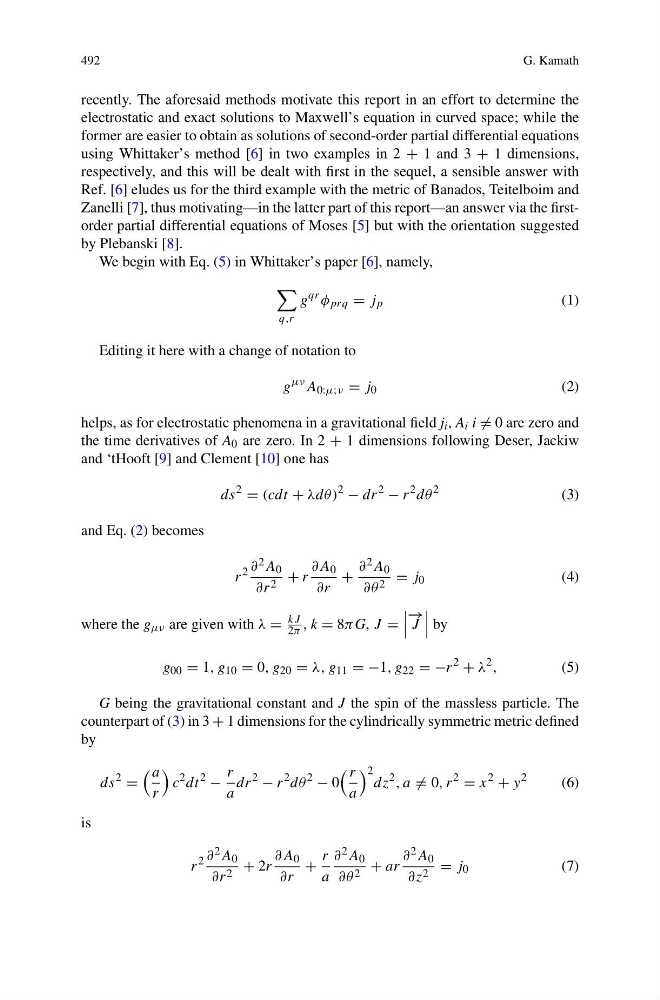
We begin with Eq. (5) in Whittaker’s paper [6], namely,
q,r
g
qr φ prq = j p
(1)
Editing it here with a change of notation to
g
μν A 0:μ;ν = j 0
(2)
helps, as for electrostatic phenomena in a gravitational field j i , A i i = 0 are zero and
the time derivatives of A 0 are zero. In 2 + 1 dimensions following Deser, Jackiw
and ‘tHooft [9] and Clement [10] one has
ds
2
= (cdt + λdθ )
2
− dr
2
− r
2 dθ
2
(3)
and Eq. (2) becomes
r
2 ∂ 2 A 0
∂r 2 + r
∂A 0
∂r
+
∂ 2 A 0
∂θ 2 = j 0
(4)
where the g μν are given with λ =
kJ
2π , k = 8π G, J =
− →
J
by
g 00 = 1, g 10 = 0, g 20 = λ, g 11 = −1, g 22 = −r
2
+ λ
2 ,
(5)
G being the gravitational constant and J the spin of the massless particle. The
counterpart of (3) in 3 + 1 dimensions for the cylindrically symmetric metric defined
by
ds
2
=
a
r
c
2 dt
2
−
r
a
dr
2
− r
2 dθ
2
− 0
r
a
2
dz
2 , a = 0, r
2
= x
2
+ y
2
(6)
is
r
2 ∂ 2 A 0
∂r 2 + 2r
∂A 0
∂r
+
r
a
∂ 2 A 0
∂θ 2 + ar
∂ 2 A 0
∂z 2 = j 0
(7)
G. Kamath
recently. The aforesaid methods motivate this report in an effort to determine the
electrostatic and exact solutions to Maxwell’s equation in curved space; while the
former are easier to obtain as solutions of second-order partial differential equations
using Whittaker’s method [6] in two examples in 2 + 1 and 3 + 1 dimensions,
respectively, and this will be dealt with first in the sequel, a sensible answer with
Ref. [6] eludes us for the third example with the metric of Banados, Teitelboim and
Zanelli [7], thus motivating—in the latter part of this report—an answer via the firstorder partial differential equations of Moses [5] but with the orientation suggested
by Plebanski [8].
We begin with Eq. (5) in Whittaker’s paper [6], namely,
q,r
g
qr φ prq = j p
(1)
Editing it here with a change of notation to
g
μν A 0:μ;ν = j 0
(2)
helps, as for electrostatic phenomena in a gravitational field j i , A i i = 0 are zero and
the time derivatives of A 0 are zero. In 2 + 1 dimensions following Deser, Jackiw
and ‘tHooft [9] and Clement [10] one has
ds
2
= (cdt + λdθ )
2
− dr
2
− r
2 dθ
2
(3)
and Eq. (2) becomes
r
2 ∂ 2 A 0
∂r 2 + r
∂A 0
∂r
+
∂ 2 A 0
∂θ 2 = j 0
(4)
where the g μν are given with λ =
kJ
2π , k = 8π G, J =
− →
J
by
g 00 = 1, g 10 = 0, g 20 = λ, g 11 = −1, g 22 = −r
2
+ λ
2 ,
(5)
G being the gravitational constant and J the spin of the massless particle. The
counterpart of (3) in 3 + 1 dimensions for the cylindrically symmetric metric defined
by
ds
2
=
a
r
c
2 dt
2
−
r
a
dr
2
− r
2 dθ
2
− 0
r
a
2
dz
2 , a = 0, r
2
= x
2
+ y
2
(6)
is
r
2 ∂ 2 A 0
∂r 2 + 2r
∂A 0
∂r
+
r
a
∂ 2 A 0
∂θ 2 + ar
∂ 2 A 0
∂z 2 = j 0
(7)