

Features of Discrete Integrability
31
4.3 What About Singularities?
Singularities are known to play a fundamental rôle in the game. For quad equations,
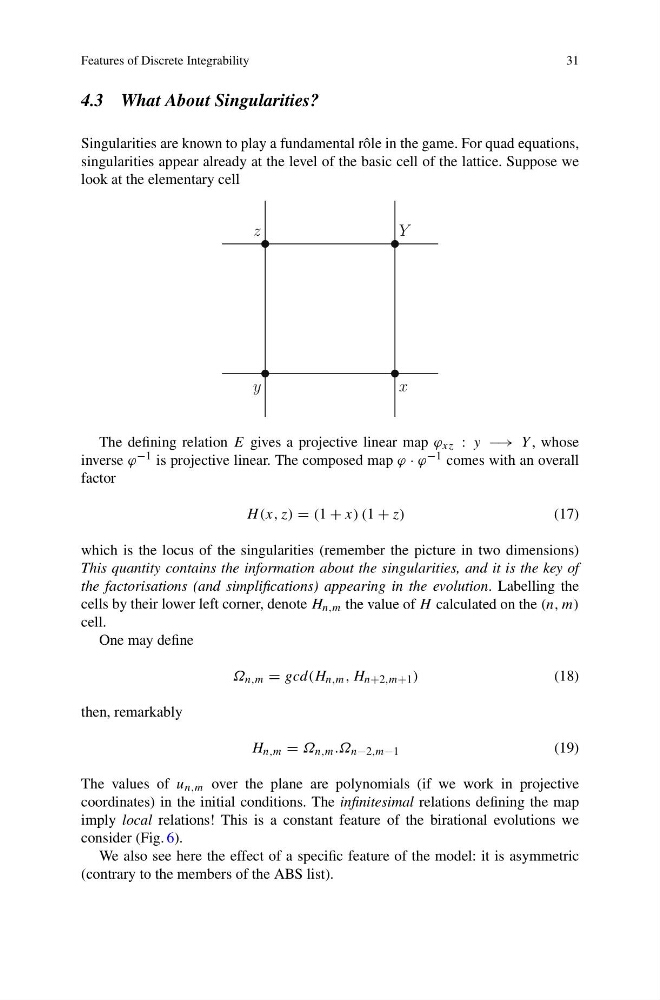
singularities appear already at the level of the basic cell of the lattice. Suppose we
look at the elementary cell
x
z
y
Y
The defining relation E gives a projective linear map ϕ xz : y −→ Y , whose
inverse ϕ −1 is projective linear. The composed map ϕ · ϕ −1 comes with an overall
factor
H (x, z) = (1 + x) (1 + z)
(17)
which is the locus of the singularities (remember the picture in two dimensions)
This quantity contains the information about the singularities, and it is the key of
the factorisations (and simplifications) appearing in the evolution. Labelling the
cells by their lower left corner, denote H n,m the value of H calculated on the (n, m)
cell.
One may define
Ω n,m = gcd(H n,m , H n+2,m+1 )
(18)
then, remarkably
H n,m = Ω n,m .Ω n−2,m−1
(19)
The values of u n,m over the plane are polynomials (if we work in projective
coordinates) in the initial conditions. The infinitesimal relations defining the map
imply local relations! This is a constant feature of the birational evolutions we
consider (Fig. 6).
We also see here the effect of a specific feature of the model: it is asymmetric
(contrary to the members of the ABS list).
31
4.3 What About Singularities?
Singularities are known to play a fundamental rôle in the game. For quad equations,
singularities appear already at the level of the basic cell of the lattice. Suppose we
look at the elementary cell
x
z
y
Y
The defining relation E gives a projective linear map ϕ xz : y −→ Y , whose
inverse ϕ −1 is projective linear. The composed map ϕ · ϕ −1 comes with an overall
factor
H (x, z) = (1 + x) (1 + z)
(17)
which is the locus of the singularities (remember the picture in two dimensions)
This quantity contains the information about the singularities, and it is the key of
the factorisations (and simplifications) appearing in the evolution. Labelling the
cells by their lower left corner, denote H n,m the value of H calculated on the (n, m)
cell.
One may define
Ω n,m = gcd(H n,m , H n+2,m+1 )
(18)
then, remarkably
H n,m = Ω n,m .Ω n−2,m−1
(19)
The values of u n,m over the plane are polynomials (if we work in projective
coordinates) in the initial conditions. The infinitesimal relations defining the map
imply local relations! This is a constant feature of the birational evolutions we
consider (Fig. 6).
We also see here the effect of a specific feature of the model: it is asymmetric
(contrary to the members of the ABS list).