

30
C. M. Viallet
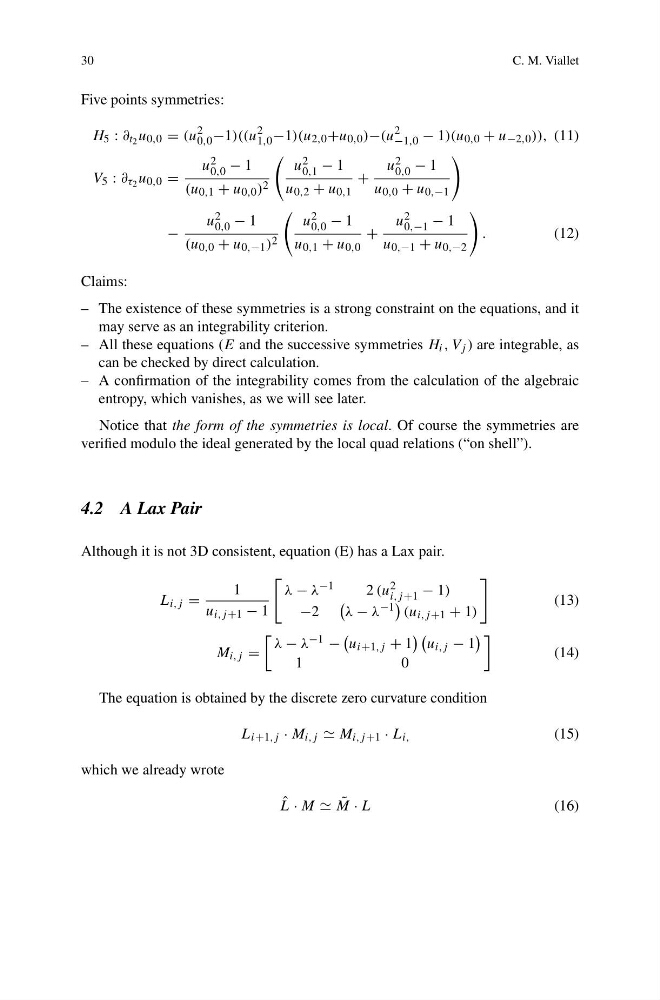
Five points symmetries:
H 5 : ∂ t 2 u 0,0 = (u
2
0,0 −1)((u
2
1,0 −1)(u 2,0 +u 0,0 )−(u
2
−1,0 − 1)(u 0,0 + u −2,0 )), (11)
V 5 : ∂ τ 2 u 0,0 =
u 2
0,0 − 1
(u 0,1 + u 0,0 ) 2
u 2
0,1 − 1
u 0,2 + u 0,1
+
u 2
0,0 − 1
u 0,0 + u 0,−1
−
u 2
0,0 − 1
(u 0,0 + u 0,−1 ) 2
u 2
0,0 − 1
u 0,1 + u 0,0
+
u 2
0,−1 − 1
u 0,−1 + u 0,−2
.
(12)
Claims:
– The existence of these symmetries is a strong constraint on the equations, and it
may serve as an integrability criterion.
– All these equations (E and the successive symmetries H i , V j ) are integrable, as
can be checked by direct calculation.
– A confirmation of the integrability comes from the calculation of the algebraic
entropy, which vanishes, as we will see later.
Notice that the form of the symmetries is local. Of course the symmetries are
verified modulo the ideal generated by the local quad relations (“on shell”).
4.2 A Lax Pair
Although it is not 3D consistent, equation (E) has a Lax pair.
L i,j =
1
u i,j +1 − 1
λ − λ −1
2 (u 2
i,j +1 − 1)
−2
λ − λ −1
(u i,j +1 + 1)
(13)
M i,j =
λ − λ −1 −
u i+1,j + 1
u i,j − 1
1
0
(14)
The equation is obtained by the discrete zero curvature condition
L i+1,j · M i,j M i,j +1 · L i,
(15)
which we already wrote
ˆ
L · M ˜
M · L
(16)
C. M. Viallet
Five points symmetries:
H 5 : ∂ t 2 u 0,0 = (u
2
0,0 −1)((u
2
1,0 −1)(u 2,0 +u 0,0 )−(u
2
−1,0 − 1)(u 0,0 + u −2,0 )), (11)
V 5 : ∂ τ 2 u 0,0 =
u 2
0,0 − 1
(u 0,1 + u 0,0 ) 2
u 2
0,1 − 1
u 0,2 + u 0,1
+
u 2
0,0 − 1
u 0,0 + u 0,−1
−
u 2
0,0 − 1
(u 0,0 + u 0,−1 ) 2
u 2
0,0 − 1
u 0,1 + u 0,0
+
u 2
0,−1 − 1
u 0,−1 + u 0,−2
.
(12)
Claims:
– The existence of these symmetries is a strong constraint on the equations, and it
may serve as an integrability criterion.
– All these equations (E and the successive symmetries H i , V j ) are integrable, as
can be checked by direct calculation.
– A confirmation of the integrability comes from the calculation of the algebraic
entropy, which vanishes, as we will see later.
Notice that the form of the symmetries is local. Of course the symmetries are
verified modulo the ideal generated by the local quad relations (“on shell”).
4.2 A Lax Pair
Although it is not 3D consistent, equation (E) has a Lax pair.
L i,j =
1
u i,j +1 − 1
λ − λ −1
2 (u 2
i,j +1 − 1)
−2
λ − λ −1
(u i,j +1 + 1)
(13)
M i,j =
λ − λ −1 −
u i+1,j + 1
u i,j − 1
1
0
(14)
The equation is obtained by the discrete zero curvature condition
L i+1,j · M i,j M i,j +1 · L i,
(15)
which we already wrote
ˆ
L · M ˜
M · L
(16)