

Aberration in Gravito-Electromagnetism
473
single wavelength, we are computing what is normally called Newtonian noise.
Dimensionally of course, the result we obtain is the same as the far field result,
and hence the analysis at Eq. (25) applies to our result, just as well.
4 LIGO-Type Experiment
To get an idea of experimental observability of the predicted force, suppose that
we choose 4m = 1 kg and the factor α =
Δ
R 0
to be 1/20. Then for a frequency
of 1 kHz (which is at the good precision upper limit of LIGO), the total effective
gravito-electric field of the four oscillating masses is
E
1 kHz
G,total
(t) = 12
√
Gm
ω
c
2
Δ
R 0
2
(cos
2 (ωt) + 3 sin
2 (ωt))
26.4 × 10
−18
× (cos
2 (2000πt) + 3 sin
2 (2000π t)).
(28)
Let us consider the LIGO system, here the mirror mass is 40 kg. Then the total
force exerted on the LIGO mirror, obtained from the geodesic equation (Eq. (9)),
would be
1 kHz
G
(t) 8.6 × 10
−21 .
(29)
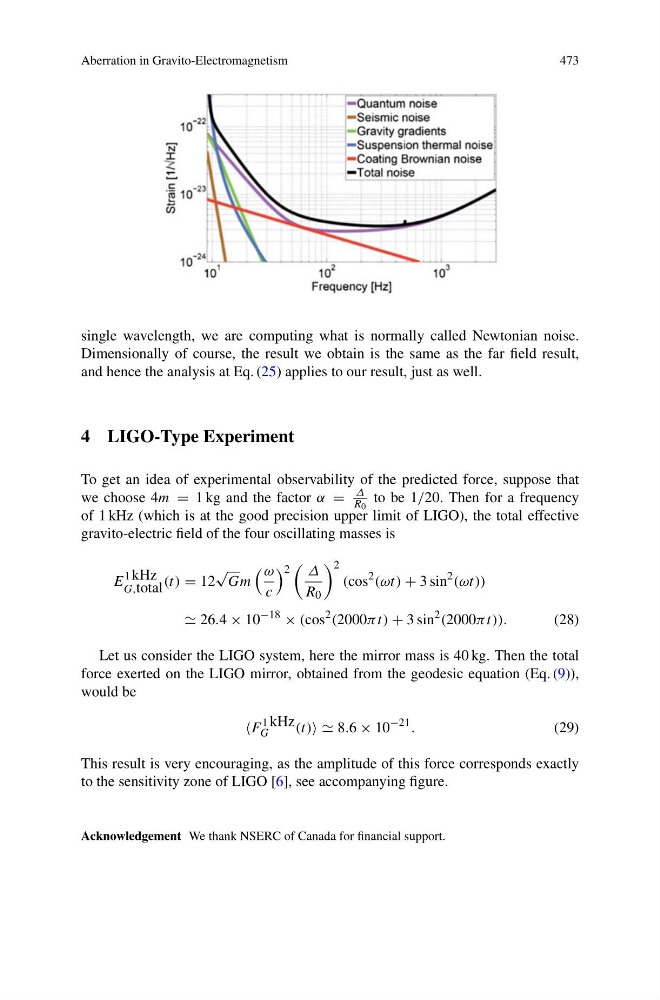
This result is very encouraging, as the amplitude of this force corresponds exactly
to the sensitivity zone of LIGO [6], see accompanying figure.
Acknowledgement We thank NSERC of Canada for financial support.
473
single wavelength, we are computing what is normally called Newtonian noise.
Dimensionally of course, the result we obtain is the same as the far field result,
and hence the analysis at Eq. (25) applies to our result, just as well.
4 LIGO-Type Experiment
To get an idea of experimental observability of the predicted force, suppose that
we choose 4m = 1 kg and the factor α =
Δ
R 0
to be 1/20. Then for a frequency
of 1 kHz (which is at the good precision upper limit of LIGO), the total effective
gravito-electric field of the four oscillating masses is
E
1 kHz
G,total
(t) = 12
√
Gm
ω
c
2
Δ
R 0
2
(cos
2 (ωt) + 3 sin
2 (ωt))
26.4 × 10
−18
× (cos
2 (2000πt) + 3 sin
2 (2000π t)).
(28)
Let us consider the LIGO system, here the mirror mass is 40 kg. Then the total
force exerted on the LIGO mirror, obtained from the geodesic equation (Eq. (9)),
would be
1 kHz
G
(t) 8.6 × 10
−21 .
(29)
This result is very encouraging, as the amplitude of this force corresponds exactly
to the sensitivity zone of LIGO [6], see accompanying figure.
Acknowledgement We thank NSERC of Canada for financial support.