

472
V. Massart and M. B. Paranjape
Then given MΔ = −M H Δ H
˙
Q + ˙
Q H = 2MΔ(t) ˙
Δ(t) + 2M H Δ H (t) ˙
Δ H (t) = 2MΔ(t)( ˙
Δ(t) − ˙
Δ H (t))
= 2MΔ(t) ˙
Δ(t)
1 +
M
M H
(25)
and we see the additional contribution of the compensating mass is indeed negligible.
3 Final Expression for the Force
We now impose harmonic motion for the movement of all the masses as given in
Eq. (14), then use the Lagrange inversion theorem to obtain a final expression for
the gravitational force at the detector from all of the masses. We will give the full
details in an extended article. We find for the mass m and its compensating mass
M H , dropping all terms of O
m
M H
E Eff
G (t) =
√
GM H
R 2
0
+
√
Gm
R 2 (t)
− 4
√
Gm
ω 2
c 2
Δ 2
R 2
0
(cos
2 (ωt) + 3 sin
2 (ωt))
=
√
GM H
R 2
0
+
√
Gm
R 2 (t)
− 4
√
Gm
R 2
0
(a(t)Δ(t) + 3v
2 (t)).
(26)
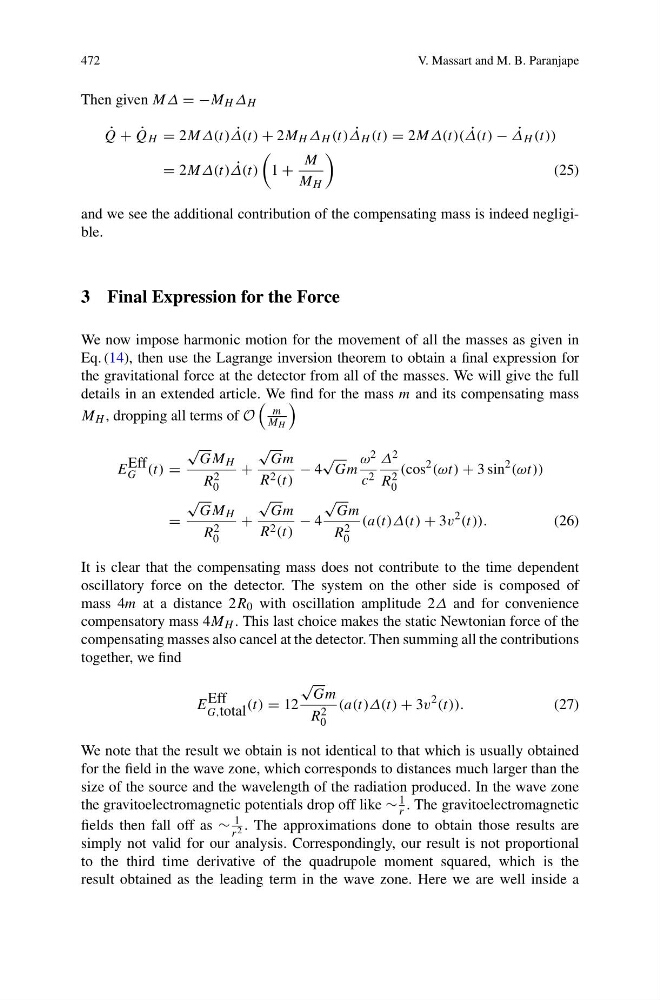
It is clear that the compensating mass does not contribute to the time dependent
oscillatory force on the detector. The system on the other side is composed of
mass 4m at a distance 2R 0 with oscillation amplitude 2Δ and for convenience
compensatory mass 4M H . This last choice makes the static Newtonian force of the
compensating masses also cancel at the detector. Then summing all the contributions
together, we find
E Eff
G,total
(t) = 12
√
Gm
R 2
0
(a(t)Δ(t) + 3v
2 (t)).
(27)
We note that the result we obtain is not identical to that which is usually obtained
for the field in the wave zone, which corresponds to distances much larger than the
size of the source and the wavelength of the radiation produced. In the wave zone
the gravitoelectromagnetic potentials drop off like ∼
1
r . The gravitoelectromagnetic
fields then fall off as ∼
1
r 2 . The approximations done to obtain those results are
simply not valid for our analysis. Correspondingly, our result is not proportional
to the third time derivative of the quadrupole moment squared, which is the
result obtained as the leading term in the wave zone. Here we are well inside a
V. Massart and M. B. Paranjape
Then given MΔ = −M H Δ H
˙
Q + ˙
Q H = 2MΔ(t) ˙
Δ(t) + 2M H Δ H (t) ˙
Δ H (t) = 2MΔ(t)( ˙
Δ(t) − ˙
Δ H (t))
= 2MΔ(t) ˙
Δ(t)
1 +
M
M H
(25)
and we see the additional contribution of the compensating mass is indeed negligible.
3 Final Expression for the Force
We now impose harmonic motion for the movement of all the masses as given in
Eq. (14), then use the Lagrange inversion theorem to obtain a final expression for
the gravitational force at the detector from all of the masses. We will give the full
details in an extended article. We find for the mass m and its compensating mass
M H , dropping all terms of O
m
M H
E Eff
G (t) =
√
GM H
R 2
0
+
√
Gm
R 2 (t)
− 4
√
Gm
ω 2
c 2
Δ 2
R 2
0
(cos
2 (ωt) + 3 sin
2 (ωt))
=
√
GM H
R 2
0
+
√
Gm
R 2 (t)
− 4
√
Gm
R 2
0
(a(t)Δ(t) + 3v
2 (t)).
(26)
It is clear that the compensating mass does not contribute to the time dependent
oscillatory force on the detector. The system on the other side is composed of
mass 4m at a distance 2R 0 with oscillation amplitude 2Δ and for convenience
compensatory mass 4M H . This last choice makes the static Newtonian force of the
compensating masses also cancel at the detector. Then summing all the contributions
together, we find
E Eff
G,total
(t) = 12
√
Gm
R 2
0
(a(t)Δ(t) + 3v
2 (t)).
(27)
We note that the result we obtain is not identical to that which is usually obtained
for the field in the wave zone, which corresponds to distances much larger than the
size of the source and the wavelength of the radiation produced. In the wave zone
the gravitoelectromagnetic potentials drop off like ∼
1
r . The gravitoelectromagnetic
fields then fall off as ∼
1
r 2 . The approximations done to obtain those results are
simply not valid for our analysis. Correspondingly, our result is not proportional
to the third time derivative of the quadrupole moment squared, which is the
result obtained as the leading term in the wave zone. Here we are well inside a